
The Origin and Value of Tutankhamun’s Treasure: A Heritage in Gold
Few archaeological findings have enthralled the globe as much as the discovery of Pharaoh Tutankhamun’s tomb in 1922 by British archaeologist Howard Carter. Concealed beneath the sands of the Valley of the Kings for over 3,000 years, the tomb of the youthful pharaoh, who governed during Egypt’s 18th Dynasty, unveiled not only the remains of a long-obscured ruler but also a dazzling assortment of treasures unmatched in magnificence and importance.

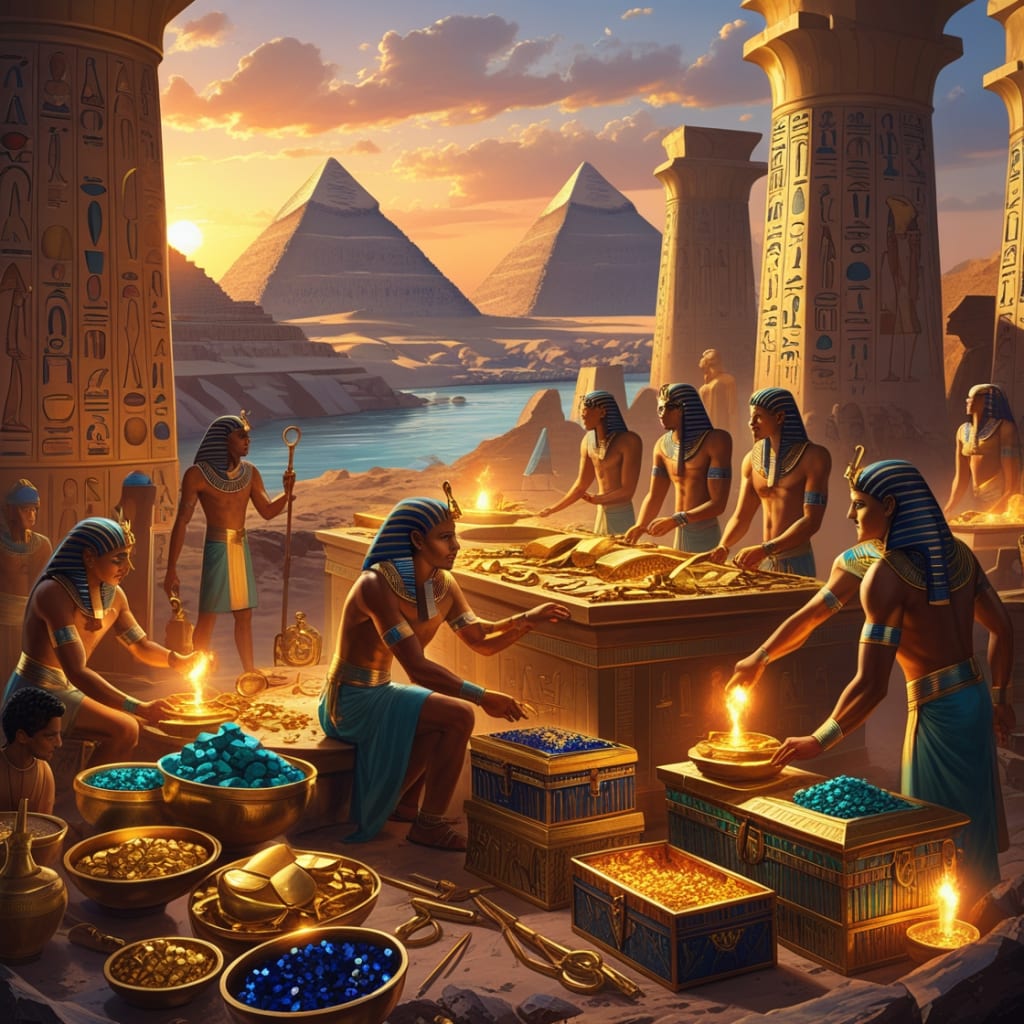
But from where did this vast treasure arise? Why was such wealth interred with a boy-king who perished around the age of 18 or 19? And what might be the current estimated worth of these treasures? This article investigates the origins, symbolism, and contemporary valuation of one of history’s most renowned caches.
The Origin of Tutankhamun’s Treasure:
Tutankhamun ruled during a turbulent epoch in ancient Egyptian history. His predecessor, Akhenatenthought to be his fathersought to transform Egypt’s faith by advocating the veneration of a singular deity, Aten, the sun disk, over the customary pantheon of gods. This monotheistic initiative disrupted Egyptian society, governance, and religious life.
Following Akhenaten’s passing, the young Tutankhamun ascended to the throne and endeavored to reinstate Egypt’s traditional beliefs and institutions. Although his reign was short-lived (circa 1332–1323 BCE), it signified a revival of political stability and religious orthodoxy. As part of this restoration, considerable efforts were made to affirm his divine legitimacy and kingship. This political and spiritual rejuvenation may elucidate the grandeur of his intermentthe treasure was intended not merely to commemorate a king but to symbolize the resurgence of the Egyptian order.
Numerous historians contend that a substantial portion of Tutankhamun’s burial artifacts may have been repurposed or inherited from preceding royal interments. Some relics discovered in his tomb feature inscriptions or designs that imply they initially belonged to otherspossibly even his stepmother Nefertiti or his father Akhenaten. This hypothesis is reinforced by evidence of hastily crafted or modified items within the tomb, indicating that the burial was orchestrated swiftly and perhaps under duress following the king’s unforeseen demise.
Contents of the Treasure:
The tomb of Tutankhamun housed over 5,000 artifacts, including:
The Golden Death Mask: Constructed from solid gold and adorned with lapis lazuli, quartz, obsidian, turquoise, and colored glass, this emblematic mask alone is believed to weigh over 10 kilograms and symbolizes the divine countenance of Osiris.
Three Nested Coffins: The innermost coffin, entirely fashioned from solid gold and weighing approximately 110 kilograms, enclosed the mummy of the pharaoh.
Chariots, Furniture, and Thrones: Many of these were inlaid with ivory, ebony, and precious metals, serving ceremonial functions in both life and the afterlife.
Canopic Shrine and Jars: Utilized to contain the pharaoh’s internal organs, these items were also crafted from gold and alabaster and elaborately decorated.
Statues and Figurines: Representing deities, guardians, and the king himself.
Jewelry and Amulets: Necklaces, rings, armlets, and earrings made of gold, semi-precious stones, and glass.
Weapons and Shields: Encompassing daggers, bows, and a curved sword (khopesh), frequently ceremonial yet emblematic of sovereign authority.
Symbolism and Purpose:
Every item within Tutankhamun’s burial site fulfilled a distinct spiritual function. The ancient Egyptians held a belief in the afterlife as a continuation of terrestrial existence. To guarantee a seamless transition and sustenance in the subsequent realm, the monarch required all the implements, provisions, furnishings, and magical safeguards he could transport with him. The items were not solely ornamental; they symbolized a spiritual safety net.
Estimated Net Worth of the Treasure:
Assigning a contemporary financial value to such artifacts is intricate. Numerous items are deemed invaluable owing to their cultural, artistic, and historical significance. Nevertheless, for the purpose of estimation:
The golden death mask may possess a value exceeding $2 million based solely on gold weight, but in the art market, its symbolic and historical significance could elevate it to $100–$200 million, if such a transaction were even plausible.
The solid gold inner coffin, weighing 110 kg, could be appraised at $6 million according to current gold valuesbut once more, its true worth in cultural terms is far greater.
Jewelry and statues, considering craftsmanship and materials, could collectively range from $50–100 million.
Furniture, chariots, and ceremonial artifacts might attract another $50–100 million, contingent on intricacy and condition.
In total, the net estimated financial value of Tutankhamun’s treasure could surpass $750 million to $1 billion, although this figure remains conjectural and is confined to material worth, not cultural or historical significance.
Conclusion:
Tutankhamun’s treasure serves as a magnificent testament to the splendor of ancient Egypt, yet it represents more than merely a compilation of gold. It narrates the saga of a civilization’s religious convictions, political turbulence, artistic brilliance, and veneration for death and the divine. The origin of his treasure is as political and spiritual as it is economica royal legacy molded by centuries of tradition and the necessity to validate a tenuous reign. While contemporary evaluations of worth endeavor to quantify the immeasurable, the legacy of Tutankhamun’s tomb remains a priceless glimpse into the ancient world.
About the Creator
Say the truth
"Say the Truth: Explain Everything in the World" is your trusted source for uncovering facts and exploring the wonders of history, science, technology, and beyond. We simplify complex ideas and reveal truths to inspire curiosity .
Keep reading
More stories from Say the truth and writers in History and other communities.
The Legacy of the Boy King: Unveiling the Treasure of Tutankhamun's Tomb
The Discovery that Resounded Globally In 1922, British archaeologist Howard Carter, supported by Lord Carnarvon, made an astounding discovery in Egypt's Valley of the Kings. After years of digging in challenging conditions with little fortune, Carter's tenacity ultimately bore fruit when he uncovered a staircase leading into the sands.
By Say the truth 8 months ago in History
Martin Luther King Jr.: The Voice of Peace and Justice
Martin Luther King Jr. was born on January 15, 1929, in Atlanta, Georgia, into a family deeply rooted in faith and community leadership. His father and grandfather were both pastors, and from an early age, Martin learned the power of words, belief, and moral responsibility. Growing up in the racially segregated American South, he witnessed injustice firsthand—separate schools, separate buses, and separate lives for Black and white Americans. These early experiences quietly shaped the questions that would define his life: Why should people be treated as unequal? And how could such injustice be peacefully undone?
By The best writer 5 days ago in History
Saudi Arabia Warns Against War
Saudi Arabia Warns Against War: Why Riyadh Opposes a U.S. Attack on Iran As tensions between the United States and Iran continue to rise, Saudi Arabia has taken a notable and cautious position: warning against any U.S. military attack on Iran. This stance may surprise some observers given the long history of rivalry between Riyadh and Tehran, but it reflects a broader regional concern that another major war in the Middle East could spiral beyond control.
By Wings of Time 4 days ago in History


Comments
There are no comments for this story
Be the first to respond and start the conversation.