
The Legacy of the Boy King: Unveiling the Treasure of Tutankhamun's Tomb
Concealed beneath the golden sands of the Valley of the Kings for over 3,000 years, the tomb of Tutankhamun contained one of the most significant archaeological treasures ever uncovered. This article explores the history, discovery, and enigma of the treasure entombed within the young pharaoh’s burial chambers.

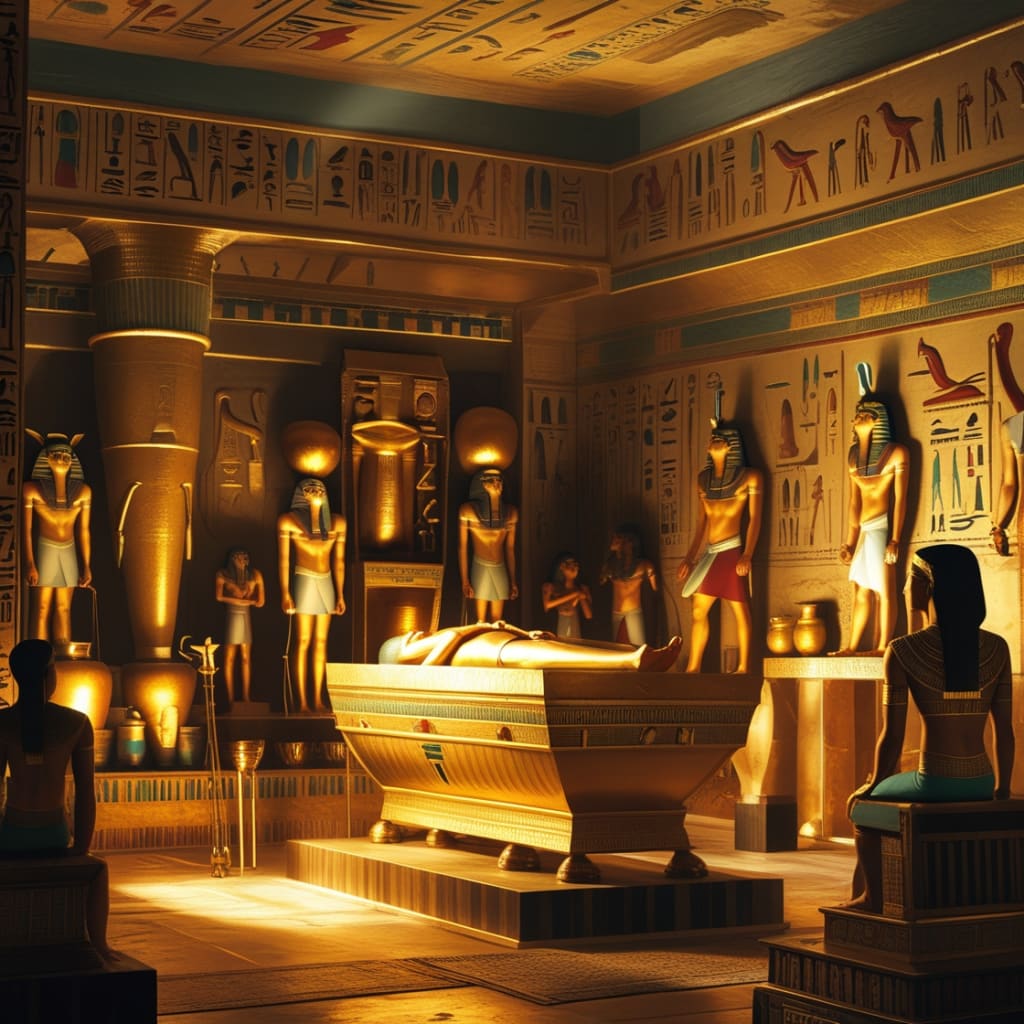
The Discovery that Resounded Globally
In 1922, British archaeologist Howard Carter, supported by Lord Carnarvon, made an astounding discovery in Egypt's Valley of the Kings. After years of digging in challenging conditions with little fortune, Carter's tenacity ultimately bore fruit when he uncovered a staircase leading into the sands.
At the base of these steps was a sealed doorinscribed with royal cartouches indicating it belonged to Tutankhamun, a relatively obscure pharaoh of the 18th Dynasty. Behind the entrance lay a tomb virtually unspoiled for more than three millennia. It was one of the most preserved royal tombs ever located in Egypt.
Upon glancing inside with a candle, Carter famously proclaimed:
“Yes, marvelous things! ”
What he observed was not merely a burial siteit was a resplendent chamber of unimaginable opulence.
The Myth of Tutankhamun
Tutankhamun (ruled circa 1332–1323 BCE) took the throne at merely nine years of age and passed away around the age of 18. He governed during a tumultuous era in Egyptian historyshortly following the controversial reign of Akhenaten, who had sought to revolutionize Egypt’s religion by venerating a singular deity, Aten.
Tutankhamun utilized his brief reign to restore traditional religious customs and stabilize the realm. Despite his relatively minor standing in Egyptian history, his notoriety surged in the 20th century, not because of his accomplishments, but owing to the astonishing bounty discovered in his tomb.
The Tomb: Chambers of Gold
The tomb of Tutankhamun, officially designated KV62, is modest in comparison to other pharaohs’ burial sites, likely a result of his unexpected demise and expedited burial. Nevertheless, it was extravagant beyond belief.
The tomb comprised four primary rooms:
Antechamber
Annex
Burial Chamber
Treasury
Each room was brimming with treasures that showcased the magnificence of ancient Egypt and the religious convictions of the era.
A Glimpse Inside: What Was Discovered?
Over 5,000 artifacts were cataloged from the tomb. Some of the most extraordinary items included:
The Golden Death Mask: The most iconic artifact, crafted from solid gold and adorned with lapis lazuli, quartz, obsidian, and colored glass, weighing over 10 kg. It was positioned directly over the mummy's head and shoulders.
The Nested Coffins: Three coffins encased the king’s mummified remains. The innermost coffin was constructed of solid gold.
Canopic Shrine: A golden shrine that housed alabaster jars, which contained the pharaoh’s preserved internal organs.
The Chariots: Several ceremonial and practical chariots were disassembled and interred within the tomb.
Thrones and Furniture: Ornately embellished thrones, beds, and chairs demonstrated exceptional artistry and provided insight into daily royal existence.
Weapons and Implements: Daggers (including one crafted from meteoric iron), bows, and other implements signify the pharaoh’s status as a warrior monarch.
Ornaments: Necklaces, rings, bracelets, and pendants, frequently adorned with semiprecious stones.
Figurines of Deities and Attendants: To guide and safeguard the pharaoh in the afterlife.
The Enigma of the Treasury Chamber
The Treasury housed some of the most sacred items in the tomb, including:
Anubis Altar: A lifelike statue of the jackal-headed deity Anubis overseeing the tomb.
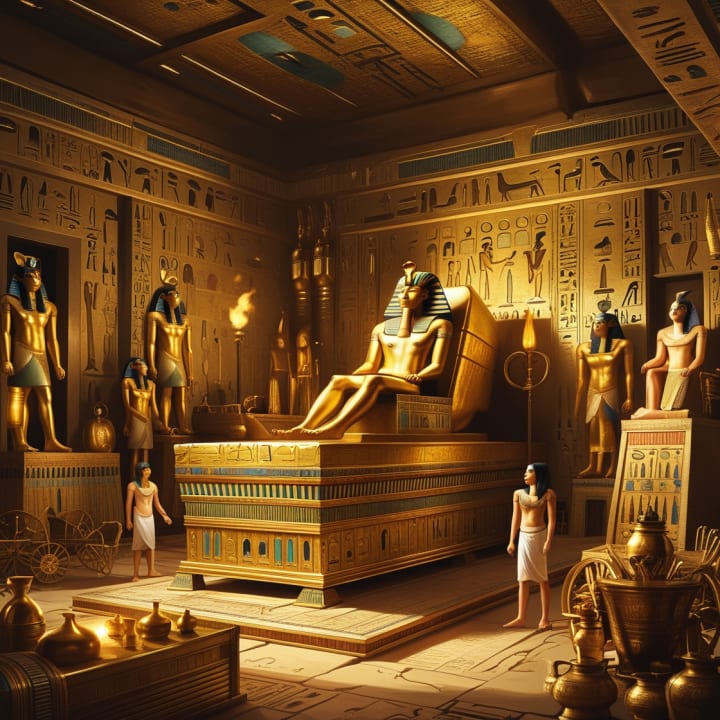
The Canopic Container: Protected by four goddesses with extended wings.
Model Vessels: Thought to assist the king in navigating the afterlife.
Scepters and Rods: Representing the king’s everlasting authority.
Each object was not merely ornamentalit possessed profound symbolic significance, intertwined with Egyptian beliefs in rebirth and divine rulership.
Curse of the Pharaoh?
Shortly after the tomb's discovery, Lord Carnarvon passed away under enigmatic circumstances, igniting speculation of a "curse of the pharaoh. " Newspapers exaggerated the fatalities of several individuals associated with the excavation. Although most deaths had logical explanations, the legend of the mummy’s curse became ingrained in Tutankhamun’s narrative.
The Heritage of Tutankhamun
Tutankhamun’s tomb transformed archaeology and Egyptology. For the first time, an almost untouched royal burial site was uncovered, presenting a comprehensive glimpse of New Kingdom interment traditions and artistic excellence.
The artifacts have subsequently traveled worldwide in major museum exhibitions, attracting millions of visitors. The Egyptian government has since erected the Grand Egyptian Museum near the pyramids of Giza, where Tutankhamun’s treasures will be permanently displayed.
Despite his brief reign and comparatively minor position in Egyptian history, Tutankhamun emerged as the timeless emblem of ancient Egypt’s splendor.
Conclusion
The treasure of Tutankhamun transcends mere gold and gemstonesit serves as a gateway into an ancient civilization, a connection between the living and the deceased, and a testament to the might, faith, and artistry of the pharaohs. Interred for millennia, the legacy of the boy king continues to radiate brighter than ever.
About the Creator
Say the truth
"Say the Truth: Explain Everything in the World" is your trusted source for uncovering facts and exploring the wonders of history, science, technology, and beyond. We simplify complex ideas and reveal truths to inspire curiosity .
Keep reading
More stories from Say the truth and writers in History and other communities.
The Disappeared Gems of Emperor Jahangir: An Elusive Mughal Wealth Beyond Belief
The Golden Era of the Mughal Empire The Mughal Empire during the early 17th century was at the zenith of its splendor. Encompassing a vast expanse of the Indian subcontinent, it exhibited a thriving economy, a strong administrative framework, and luxurious courtly life. Jahangir, whose name translates to "Conqueror of the World," assumed the throne in 1605 after Akbar’s passing and governed for over twenty years.
By Say the truth 8 months ago in History
Martin Luther King Jr.: The Voice of Peace and Justice
Martin Luther King Jr. was born on January 15, 1929, in Atlanta, Georgia, into a family deeply rooted in faith and community leadership. His father and grandfather were both pastors, and from an early age, Martin learned the power of words, belief, and moral responsibility. Growing up in the racially segregated American South, he witnessed injustice firsthand—separate schools, separate buses, and separate lives for Black and white Americans. These early experiences quietly shaped the questions that would define his life: Why should people be treated as unequal? And how could such injustice be peacefully undone?
By The best writer 5 days ago in History



Comments
There are no comments for this story
Be the first to respond and start the conversation.