
The Odyssey of Greek Civilization
From Prehistoric Times to the Classical Era

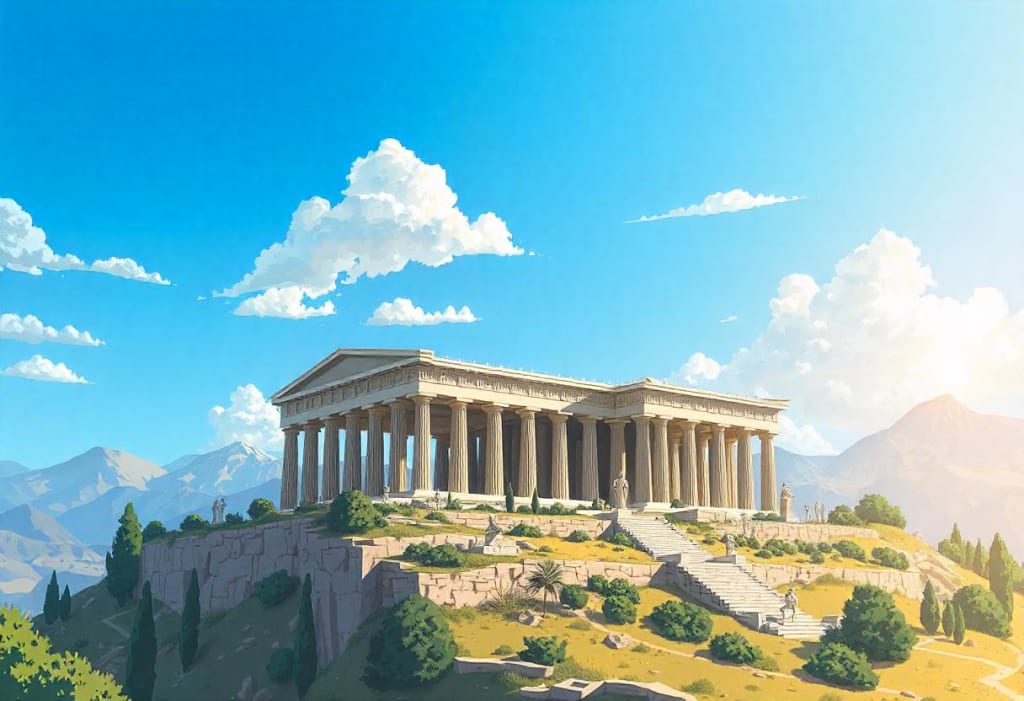
The Greeks, a people known for their rich mythology, enduring language and captivating culture, have left an indelible mark on history. Their architectural wonders and philosophical musings have transported us to a past filled with heroic tales and monstrous challenges, imparting powerful lessons passed down through the millennia. Delving into the dawn of Greek civilization, from its archaic roots to its classical grandeur, exploring the formation and legacy of this extraordinary culture.
Archaeological evidence reveals over 50 ancient sites across the Greek region, highlighting early human activities such as hunting, gathering, and domestic tasks, as evidenced by ceramic and mining artifacts found in the Petralona and Franchthi caves. Notably, the settlement on the island of Alonissos suggests active maritime communication, indicating that navigation was a practiced skill even in these early times.
The Neolithic period witnessed the emergence of more complex and permanent settlements, particularly in northern Greece. These communities, predominantly of the Pelasgian people, showcased advancements in animal domestication and agriculture. Towards the end of this period, a transition began with the introduction of versatile metals like gold, silver, and copper. This era also saw the destruction of various settlements in Thessaly due to geological forces.
The Greek Bronze Age heralded the rise of the Cycladic civilization, flourishing in the Aegean islands such as Delos, Naxos, and Paros. These islands provide the earliest evidence of continuous human habitation, with economies centered on trade and fishing. On the Greek mainland, disparate societies developed, shaped by the region's mountainous geography into distinct cultural groups like the Eutreses and Tirynthians.
The Minoan civilization, based on Crete, emerged as a dominant maritime power, renowned for its sophisticated architecture, ceramics, and undeciphered Linear A script. Their downfall, traditionally attributed to conquest by the Mycenaeans, was likely precipitated by the catastrophic eruption of the Thera volcano around 1650-1550 BCE. This event is often cited as the inspiration for Plato's Atlantis myth.
The Mycenaeans are frequently credited with laying the foundation for Greek culture, evidenced by their architectural prowess and the development of Linear B, an early form of Greek. Their religious practices, heavily influenced by the Minoans, laid the groundwork for the classical Greek pantheon.
Mycenaean civilization, however, collapsed around 1100 BCE, potentially due to Dorian invasions. This period, known as the Greek Dark Ages, saw a decline in documentation and cultural activity until a resurgence during the Archaic period.
The Archaic period marked the birth of city-states (poleis) and the introduction of republican governance, replacing monarchies. The Greeks, identifying as Hellenes, were united by language and religious beliefs but politically fragmented. Notable reforms, like those of Draco in Athens, laid the foundation for democracy.
Cultural advancements flourished with distinct Greek pottery and sculpture emerging. The first coins appeared in Aegina, and festivals like the Panathenaea celebrated the gods. These developments set the stage for the Classical period's cultural zenith.
Spanning from the Greek victory at Salamis in 480 BCE to Alexander the Great's death in 323 BCE, the Classical period was a pinnacle of artistic and intellectual achievement. Athens, under Pericles, saw the construction of the Acropolis and the rise of democracy. Philosophers like Socrates, Plato, and Aristotle laid the groundwork for Western thought, while advancements in art and architecture, such as the Parthenon sculptures, showcased a shift towards realism.
Tensions between Athens and Sparta culminated in the Peloponnesian Wars, which ultimately left Athens in ruins and Sparta weakened. The power vacuum was filled by Philip II of Macedon, whose son, Alexander the Great, expanded Greek influence through his vast conquests, spreading Hellenic culture across the known world.
Alexander's empire fractured after his death, leading to the Hellenistic period, during which Greek culture continued to thrive under the successors of his generals. Eventually, Roman intervention culminated in Greece becoming a Roman province in 146 BCE, yet Greek cultural influence persisted, shaping Roman art, philosophy, and governance.
The journey of Greek civilization, from its prehistoric roots through its classical heyday, reflects a legacy of innovation, resilience, and cultural richness.
About the Creator
A História
"Hi. My name is Wellington and I'm a passion for general history. Here, I publish articles on different periods and themes in history, from prehistory to the present day.
Keep reading
More stories from A História and writers in History and other communities.
The Rise and Legacy of the Assyrian Empire
One of the most formidable civilizations to emerge from the Mesopotamian region during the late Bronze Age were the Assyrians. Known for their military prowess and robust trade networks, the Assyrians founded an empire that lasted for centuries, leaving a lasting impact on world history.
By A Históriaabout a year ago in History
3 Everyday Rules That Exist Because Someone Once Did Something Very Stupid
Everywhere you go, you are surrounded by rules that feel oddly specific. Do not touch. No running. Contents hot. Do not insert body parts. These warnings aren’t theoretical. They weren’t written by pessimists or lawyers with too much free time. They exist because at some point in history, a real human being looked at a situation and thought, “This will probably be fine.”
By Enoch Sagini3 days ago in History


Comments
There are no comments for this story
Be the first to respond and start the conversation.