
The American President Who Never Wanted The Job
It took leaving the White House for him to achieve his dreams


The highest office in the land, the leader of the free world, the President of the United States of America. A position that is often considered the most powerful in the world today and a title that as of this writing, only 45 people can ever lay claim to.
We’ve all heard the stories of the Presidents who fought and clawed their way to the very top of Washington. Franklin D. Roosevelt’s secret battles with illness and disability, Barack Obama’s barrier breaking victory, Joe Biden’s near half-century dream coming true and most recently, Donald Trump’s return to office following an earlier defeat.
To millions of people, it is a dream job, the summit of one’s career, the culmination of one’s life work, the very apex of human achievement. But for one President however, the White House wasn’t so much the ideal destination as it was an unwelcome detour in the career he actually wanted.
William Howard Taft was America’s 27th President and by all accounts, he hated the job. In fact, he never wanted it in the first place. So much so that when the time came for him to leave office, he remained determined to fulfil his own personal ambitions.
So, how did he end up being President and what did he actually want to do? Let’s find out by diving into the story of William Howard Taft, the American President who never wanted the job.
Early Life

William Howard Taft was born on 15 September 1857 in Cincinnati Ohio. The Taft family were a well-respected political family who were also prominent in the legal world. William’s grandfather, Peter Rawson Taft was a renowned lawyer and judge while William’s father, Alphonso, followed a similar path before joining the cabinet of President Ulysses S. Grant where he served as Secretary of War and Attorney General.
As a child, young William was expected to follow in his father’s and grandfather’s footsteps. A good natured and big boned young man, he was never seen as inherently brilliant. Nonetheless, William succeeded both academically and in sports thanks to this hard working nature and from being rigorously pushed by his parents.
Taft attended Yale where he became champion of their wrestling team and later Cincinnati Law School where he obtained his degree in 1880. Coming from a family of lawyers and with a natural interest in the field himself, Taft graduated easily, passed the Bar and went to work.
He began his career as a prosecutor in his home state of Ohio, enjoying the job so much that he refused offers for higher paying posts in other fields. In 1887, he became a judge and soon set his eyes on fulfilling his lifelong dream, getting a seat in the US Supreme Court.
A Change Of Plans
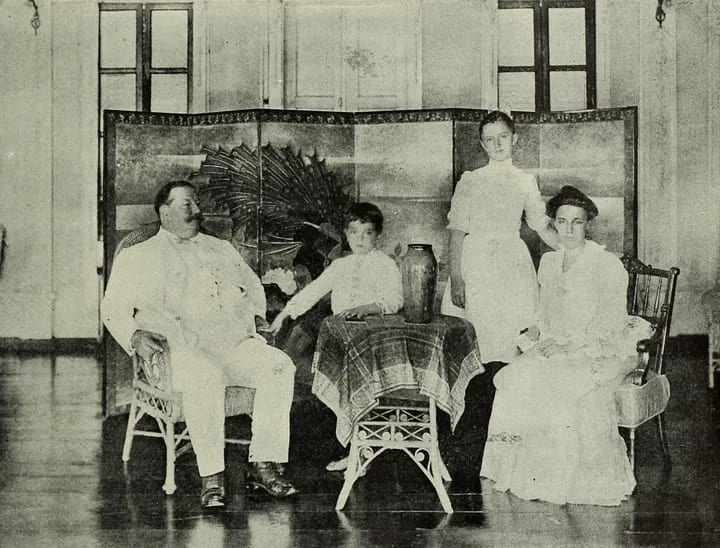
Early in his working life, Taft became acquainted with Helen Herron. Commonly called Nellie, she was an ambitious young socialite who also hailed from a politically connected family. At the age of 17, she made it her ambition to one day become the First Lady of the United States. In 1886, she and William got married and the new Mrs Taft wasted no time in steering her husband away from the courtroom and into the world of politics.
In 1889, Taft was eyeing a vacant position in the Supreme Court and was hoping to be nominated as a Supreme Court Justice. Much to his surprise however, he was instead appointed Solicitor General. Elevated into the high society of Washington, Taft found it difficult to mingle with politicians and government officials, gravitating instead towards people in the legal profession.
While Taft was a successful Solicitor General, he did not hesitate to resign when an opening arose for a position as a Federal Judge back in his hometown of Cincinnati. Away from Washington and settled back in Ohio, Taft saw the position as a stepping stone to the Supreme Court.
His income was further supplemented by the generosity of his brother Charles, a successful businessman, as well as his own appointment as a professor in his alma mater, the Cincinnati Law School. By all accounts, this was a period of professional and personal satisfaction in Taft’s life. His family was living comfortably and he seemed on the path to achieve his dream. However, things would quickly change again.
The Presidency He Never Wanted

In 1900, Taft was summoned to Washington to meet with President William McKinley. Hoping that it was regarding a possible Supreme Court nomination, Taft was shocked to find that he was being assigned a role in the Philippines instead. Taking the job under the promise that he would be considered for a position as a High Court Judge upon his return, Taft uprooted his family and travelled across the world.
Taft rose to become the Governor General of the Philippines and whether he liked it or not, was establishing himself as a major political player. His wife, Nellie relished her husband’s rise and made a name for herself as a prominent socialite in Filipino high society. Unfortunately, McKinley could not fulfil his promise to Taft as he was assassinated in 1901.
McKinley was then succeeded by Theodore Roosevelt, a friend of Taft’s who he had known from his days as Solicitor General. Recognising Taft’s ambition, Roosevelt offered him a vacant seat in the Supreme Court.
With his dream now hanging right in front of him, Taft made the difficult decision to turn the offer down. Feeling that he had yet to accomplish his job in the Philippines, Taft accepted a job as Secretary of War, a position that allowed him to return to America while maintaining his existing responsibilities. Once again, he had risen through the ranks of government.
Back in Washington, Taft believed that his dream to sit on the Supreme Court bench was once again within sights. Now, he was aiming higher, he wanted to be the Chief Justice, the highest position in America’s judiciary. Instead however, it soon became apparent that he was being groomed as Roosevelt’s successor. Spurred on by Roosevelt himself and by his wife Nellie, who wanted more than anything to become First Lady, Taft reluctantly accepted the nomination in 1908.
Despite a disastrous campaign that highlighted Taft’s unsuitability for frontline politics, he won the election and was sworn in as the 27th President of the United States of America. What should have been a dream come true to most, marked for Taft, the death of his own dream. As President, it seemed virtually impossible for him to ever find his way back into the legal world.
Taft’s Presidency has ranked among the less memorable but was also marked by periods of great personal hardship. Nellie suffered a stroke that permanently affected her movement and speech while the stress of having to care for his wife and serve as President began taking a toll on his own health too.
By the end of his first term, Taft’s weight had ballooned to over 350 pounds and he began suffering from shortness of breath and fatigue. Taft and Roosevelt had also fallen out by this point, with the former President forming a new party to run against the man he once endorsed as his heir.
During the 1912 elections, Taft refused to actively campaign. While he cited an old tradition where incumbent Presidents would not campaign for a second term, those close to Taft knew that he was simply fed-up with politics. The election was a three-way battle between Taft, Roosevelt and the Democratic candidate, Woodrow Wilson. Taft would come last in the race with Wilson becoming President.
Speaking of his loss, Taft described it as “not only a landslide but a tidal wave and holocaust all rolled into one general cataclysm.” While Nellie was devastated to be leaving the White House, Taft was quietly relieved that the whole ordeal was over.
Life As An Ex-President

At the time, former Presidents did not receive any pensions or benefits to secure their retirement. So, Taft had to find work and even then, the spectre of his Presidency continued to loom over him like an unwelcome shadow. As President, Taft had appointed a number of Supreme Court justices who were still on the bench after his defeat. This made it virtually impossible for him to return to legal practice due to a potential conflict of interest.
Fortunately for him, Yale, the college in which he previously studied, contacted him and offered him a position in their prestigious law faculty. Taft eagerly took the job and balanced his teaching role with speaking engagements, writing and serving as the president of the American Bar Association. Although not as fulfilling as the life he had once dreamed of, these were said to be among Taft’s most lucrative years.
Although a Republican, Taft maintained a positive relationship with Woodrow Wilson and openly supported Wilson’s establishment of the League of Nations. By this time, he appeared to have fallen into the role of an elder statesman relegated to a life of lectures, speeches and special appearances. However, Taft’s story was not yet finished.
A Dream Realised

In 1920, fellow Republican and Ohioan Warren G. Harding, won the Presidency. Taft was among those invited to advise the new President on appointments. Harding offered Taft the chance to fulfil his dream and told him that if Taft still wanted, Harding would appoint him as a Supreme Court Justice.
Taft countered Harding’s offer with the fact that he had appointed many of the currently sitting Judges, including the then Chief Justice, Edward Douglass White. Taft told Harding that on those grounds he could only accept the position of Chief Justice but was willing to wait for White to step aside first.
White, who had promised to one day make way for Taft, ended up dying in office in 1921. Harding then appointed Taft as Chief Justice. At the age of 63, Taft had finally fulfilled his lifelong ambition and remains the only person to have served as both President and Chief Justice.
Taft took to the job like a fish to water and was noted by his peers to be happier than he had ever been. On top of that, he also began looking after his health. During his time as Chief Justice, Taft lost almost 100 pounds, sticking to a strict diet and maintaining a routine of walking 3 miles to and from work everyday.
Remaining as Chief Justice till the end of his life in 1930, Taft had reached the very destination he had always wanted to from the start. This was a man who over the course of his life won power and later money but remained driven to the very end to achieve personal fulfilment.
By the end of his life, William Howard Taft achieved what most men could only dream of. The highest office in the land, wealth of his own and a solidified place in history. But it was only after all this, that he accomplished his own dream.
In the end, Taft’s story is not one of power gained or lost. Instead, it is of a man who refused to measure success by other people’s standards and was willing to work an entire lifetime to achieve a vision of it that resonated most with him personally.
About the Creator
Isa Nan
Written accounts of life, death and everything in between
A Knight of the Seven Kingdoms Series Review (Season 1)
As one of the biggest properties in fantasy, A Song of Ice and Fire remains immensely popular with audiences. After reaching far into the past with House of the Dragon, a second spin-off was on the cards. A Knight of the Seven Kingdoms serves up a bite-sized slice of action and drama, but it still claims a spot among the best small-screen titles.
By Robert Cain7 days ago in Geeks


Comments
There are no comments for this story
Be the first to respond and start the conversation.