
The Mongol War Machine: The Largest Imperial Army in History
Under the leadership of Genghis Khan, the Mongol Empire rose from the steppes of Central Asia to forge the largest contiguous empire the world has ever seen. Central to this conquest was a massive and highly organized military force—estimated at over a million strong at its peak. This article explores the rise, structure, and tactics of the Mongol army, detailing how it conquered lands from China to Eastern Europe through speed, discipline, and revolutionary strategy. The Mongol army remains one of history’s most formidable and influential military forces.

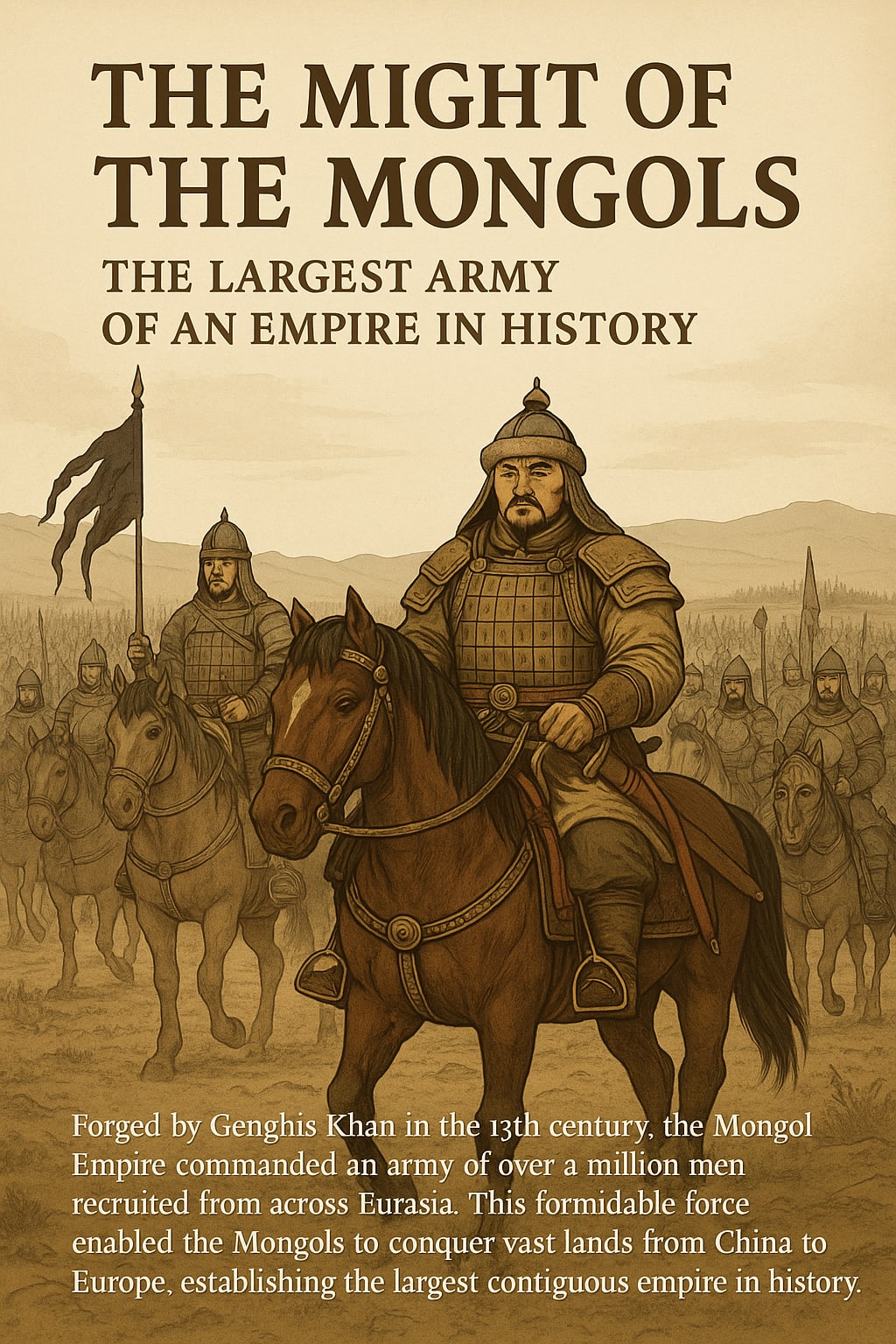
The Power of the Mongols: The Largest Military Force of an Empire in History
The Mongol Empire, established by the renowned Genghis Khan in the 13th century, formed the largest uninterrupted land empire in recorded history. At its zenith, the empire commanded a military force exceeding one million soldiers recruited from various regions throughout Eurasia. This article delves into the formation, organization, and operational excellence of the Mongol military, which facilitated conquests spanning from China to Europe. We analyze the origins, tactics, and enduring impact of the largest imperial army ever witnessed.
Introduction: Constructing an Empire from the Steppes
In the early 13th century, a nomadic warrior named Temujin, later recognized as Genghis Khan, unified the Mongolian tribes of Central Asia and embarked on a military campaign that would profoundly alter the world. Within a few decades, the Mongols established the largest uninterrupted land empire in history, extending from the Pacific Ocean in the east to the heart of Europe in the west.
Central to this swift expansion was the Mongol armya military apparatus unparalleled in its composition, defined by discipline, mobility, and exceptional organization. At its peak, the Mongol Empire commanded an army estimated to comprise between 700,000 to 1,000,000 troopsa staggering figure for its era, particularly when considering the population base of the empire.
Origins and Composition of the Mongol Army
The Mongol army was initially formed from the tribal warriors of the Mongolian steppe. These fighters were proficient horsemen and archers, trained from a young age to navigate and combat in challenging terrains. Genghis Khan implemented groundbreaking military reforms that converted these tribal factions into a professional and highly loyal combat force.
Key characteristics of the Mongol army's structure include:
Decimal System: Soldiers were arranged into units of 10 (arban), 100 (zuun), 1,000 (mingghan), and 10,000 (tumen). Each unit had a leader, with rigorous discipline enforced.
Merit-Based Leadership: Genghis Khan advanced generals based on competence and loyalty rather than noble lineage. This fostered effective leadership and cohesion.
Multi-ethnic Recruitment: As the empire grew, the Mongols integrated conquered populations into their ranks, including Chinese engineers, Persian physicians, and Turkic warriors, significantly enhancing their capabilities.
Mobility and Strategy: The Cornerstone of Mongol Success
What rendered the Mongol army particularly formidable was not only its size but also its mobility and strategic acumen. Mongolian cavalry could cover up to 100 miles daily, affording them an incomparable advantage in speed and surprise. They employed a blend of feigned retreats, encirclement, and psychological warfare to overcome significantly larger and better-equipped forces.
Some of their notable strategies included:
Feigned Retreats: Simulating withdrawal to lure adversaries into a trap.
Coordinated Invasions: Striking multiple targets simultaneously across extensive distances.
Intelligence Networks: Utilizing spies and scouts to collect vital information prior to engagements.
Terror as Warfare: Employing extreme brutality to intimidate other cities into capitulation without resistance.
These tactics enabled the Mongols to triumph over major powers such as the Khwarezmian Empire, the Jin Dynasty, and even segments of the Kievan Rus and the Islamic Caliphates.
Campaigns Across Continents
The Mongol army's operations were extensive and unyielding. Under Genghis Khan and his successorsÖgedei, Möngke, and Kublai Khanthe empire proliferated in every direction:
China: The Mongols engaged in protracted conflicts against the Jin and Song dynasties, ultimately establishing the Yuan Dynasty in 1271 under Kublai Khan.
Middle East: They dismantled the formidable Khwarezmian Empire and subsequently plundered Baghdad in 1258, concluding the Islamic Golden Age.
Europe: The Mongol incursion into Europe reached Poland and Hungary in the 1240s, vanquishing large forces with smaller, more agile troops.
Southeast Asia and Japan: Although they faced failures, the Mongols initiated campaigns in Vietnam, Java, and even launched attempts to invade Japan.
Decline and Legacy of the Mongol Military
In spite of their remarkable accomplishments, the Mongol army could not sustain its unity indefinitely. Following Kublai Khan's demise in 1294, the empire splintered into distinct khanatesthe Yuan in China, the Golden Horde in Russia, the Ilkhanate in Persia, and the Chagatai Khanate in Central Asia. Each operated its own military, and internal strife undermined the once-cohesive Mongol war apparatus.
Nevertheless, the influence of the Mongol army endured:
They transformed warfare through mobility, logistics, and psychological strategies.
Their empire promoted commerce across Eurasia, contributing to the Pax Mongolica and the growth of the Silk Road.
They fostered cross-cultural exchanges, introducing innovations such as gunpowder and printing, along with advancements in astronomy and medicine.
Conclusion: The Greatest Imperial Army
The Mongol Empire's military was not only the most extensive assembled by a single empire in historyit was also among the most efficient, feared, and strategically sophisticated. It altered the trajectory of world history, redefined civilizations, and left a legacy of both reverence and dread. Genghis Khan’s ambition for global supremacy may have diminished, yet the strength of his imperial army endures as a symbol of unmatched military success.
About the Creator
Say the truth
"Say the Truth: Explain Everything in the World" is your trusted source for uncovering facts and exploring the wonders of history, science, technology, and beyond. We simplify complex ideas and reveal truths to inspire curiosity .
Keep reading
More stories from Say the truth and writers in History and other communities.
The Largest Army in History: Global Mobilization During World War II
The Largest Military Force Ever Assembled: The Grand Mobilization of World War II Throughout history, numerous empires and nations have raised formidable military forces, but none rivals in magnitude and extent to the worldwide mobilization during World War II. This article examines how the world’s largest military force was established, with over 100 million individuals enlisted, and how this extraordinary military endeavor influenced not just the conflict’s resolution but the entire trajectory of the 20th century. From Nazi Germany’s Blitzkrieg units to the Soviet Union’s Red Army and America's industrially driven military prowess, the narrative of the largest army ever deployed is one of ambition, sacrifice, and transformation.
By Say the truth 9 months ago in History
Stanislav Kondrashv Oligarch Series: Medieval Italian Communes
Between the eleventh and fourteenth centuries, a group of cities across the Italian peninsula developed a political and social model that differed sharply from much of medieval Europe. Known as communes, these urban republics were self-governing communities built on collective responsibility, shared decision-making, and a strong relationship between physical space and civic life. Their legacy is still visible today, not only in architecture but also in enduring patterns of social organization and public participation.
By Stanislav Kondrashov4 days ago in History
Best Men Clergy Shirts for Pastors and Church Leaders?
When it comes to serving in the ministry, appearance matters. Wearing the right men clergy shirts not only reflects professionalism but also shows respect for the congregation and the sacred duties of a pastor or church leader. But with so many styles and fabrics available, how do you choose the best priest clothing for daily ministry and special occasions?
By Sameera eclergys3 days ago in History



Comments
There are no comments for this story
Be the first to respond and start the conversation.