
The Largest Army in History: Global Mobilization During World War II
World War II witnessed the greatest military mobilization in human history, with over 100 million people enlisted across various nations. From the Soviet Red Army’s staggering numbers to the United States' industrial war machine, and from Nazi Germany’s Blitzkrieg forces to China’s prolonged resistance against Japan, this massive convergence of manpower reshaped global warfare and geopolitics. This article explores the scale, strategy, and legacy of the largest army ever assembled.

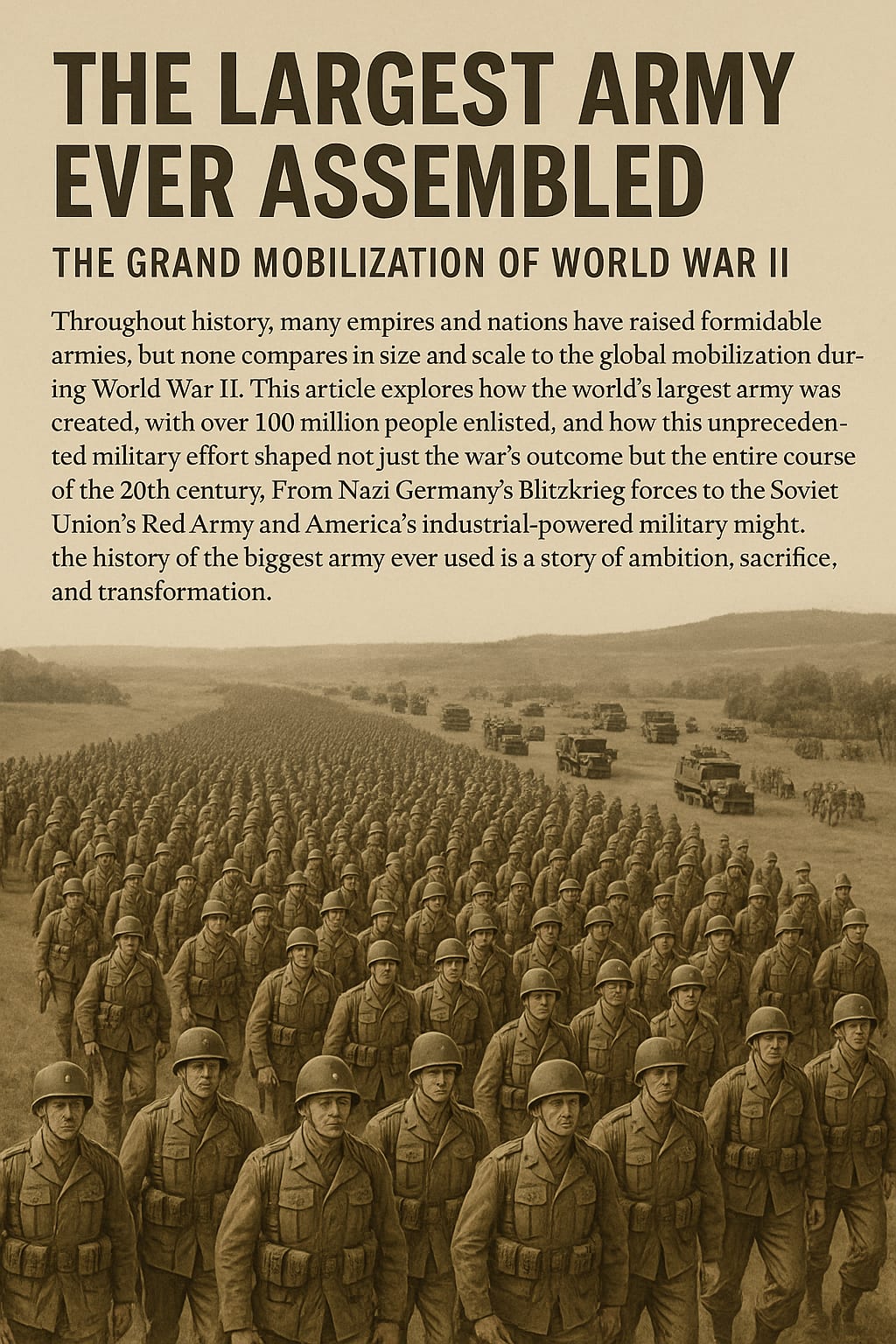
The Largest Military Force Ever Assembled: The Grand Mobilization of World War II
Throughout history, numerous empires and nations have raised formidable military forces, but none rivals in magnitude and extent to the worldwide mobilization during World War II. This article examines how the world’s largest military force was established, with over 100 million individuals enlisted, and how this extraordinary military endeavor influenced not just the conflict’s resolution but the entire trajectory of the 20th century. From Nazi Germany’s Blitzkrieg units to the Soviet Union’s Red Army and America's industrially driven military prowess, the narrative of the largest army ever deployed is one of ambition, sacrifice, and transformation.
Introduction: Warfare on a Global Scale
When World War II broke out in 1939, few could foresee the vastness the conflict would attain. By its conclusion in 1945, more than 100 million soldiers had been mobilized worldwiderendering it the most extensive military mobilization in human history. Every significant continent was impacted, and nearly every facet of societyeconomic, political, and culturalwas redirected toward the war effort.
Unlike prior conflicts waged with limited forces and territorial bounds, World War II constituted a total warone that necessitated the complete commitment of nations and their populaces. The military forces raised during this era were not only substantial in number but also evolved through industrialization, modern armaments, and unparalleled logistical operations.
The Soviet Red Army: The Largest Single Military Force
Among the numerous armed forces that engaged in World War II, none matched the scale of the Soviet Red Army. Following Germany’s incursion into the Soviet Union in June 1941, identified as Operation Barbarossa, the USSR embarked on one of the most significant military mobilizations ever witnessed.
By 1945, the Red Army boasted over 34 million personnel who had served in its ranks during the conflict, with over 12 million active troops at its zenith in 1944. The Eastern Front, where the Red Army battled against Nazi Germany, emerged as the largest and most lethal theater of the war, accounting for over 80% of all European combat fatalities.
The Soviet war apparatus was driven by an unyielding conscription policy, substantial industrial relocation eastward, and an instinct for national survival. Factories were dismantled and relocated beyond the Ural Mountains, where they resumed operations under arduous conditions. These endeavors produced thousands of T-34 tanks, artillery pieces, and aircraft, fueling Soviet advances from Stalingrad to Berlin.
United States Armed Forces: Global Reach, Industrial Might
While the Soviet Union fielded the largest single army, the United States mobilized its forces across diverse continents. From Europe to the Pacific, the American military presence was overwhelming.
Between 1941 and 1945, the United States enlisted over 16 million service members, including soldiers, sailors, Marines, and airmen. What rendered the American effort distinctive was its industrial dominancefactories that had previously manufactured automobiles were repurposed to produce tanks, aircraft, and ships at an unprecedented rate.
The U. S. military operated on multiple fronts, including:
The European Theater, where American forces landed in North Africa, Italy, and subsequently Normandy during the renowned D-Day invasion.
The Pacific Theater, where confrontations such as Midway, Iwo Jima, and Okinawa showcased the logistical capabilities of the U. S. Navy and Marine Corps.
The Home Front, where millions of civilians aided the conflict through labor, rationing, and war bond initiatives.
Nazi Germany and the Axis Powers
Germany’s Wehrmacht was an imposing force at the outset of the war, comprised of approximately 3. 7 million soldiers during its 1939 incursion into Poland. This figure swiftly escalated, with over 18 million Germans serving throughout the conflict.
Germany's military approach depended on Blitzkrieg, or “lightning war”a rapid tactic employing tanks, aerial power, and infantry to swiftly overpower adversaries. Nevertheless, Germany encountered logistical and personnel challenges as it extended its frontlines into the Soviet Union and North Africa.
Italy, Japan, and other Axis allies also assembled significant forces, but none rivaled the magnitude of the Soviet or American armed forces.
China’s Overlooked Contribution
One of the most disregarded contributions to World War II's manpower was China, which had been resisting Japanese aggression since 1937. Under Chiang Kai-shek’s Nationalist regime, China mobilized over 14 million troops throughout the war, enduring substantial casualties and devastation.
Although inadequately equipped in comparison to Western armies, Chinese resistance played a vital role in redirecting Japanese resources from the Pacific and significantly contributed to the Allied triumph.
Legacy of the Largest Army
By the conclusion of the war in 1945, the world had witnessed a military mobilization unlike any previous instance:
100+ million soldiers served across all nations.
Over 70 countries participated.
The war claimed an estimated 70–85 million lives, including military and civilian casualties.
This mobilization reshaped global politics. It resulted in the emergence of the United States and the Soviet Union as superpowers, the establishment of the United Nations, and the onset of the Cold War. It also transformed military doctrine, logistics, and warfare technology.
Conclusion: Humanity’s Greatest Mobilization
The largest army ever assembled in history was not the result of a single nation, but of a world engulfed in warfare. World War II's military mobilization represented a pivotal moment in human historyillustrating both the heights of human organization and the depths of destruction.
As we reflect on this period, the statistics alonemillions of soldiers, endless arrays of tanks and aircraft, the magnitude of sacrificeserve as a solemn reminder of the tremendous cost of global conflict and the significance of recalling the past to safeguard the future.
About the Creator
Say the truth
"Say the Truth: Explain Everything in the World" is your trusted source for uncovering facts and exploring the wonders of history, science, technology, and beyond. We simplify complex ideas and reveal truths to inspire curiosity .
Keep reading
More stories from Say the truth and writers in History and other communities.
The Lost Treasures of Cambodia: Secrets of the Angkor Temples
The Forgotten Riches of Cambodia’s Ancient Shrines: From Angkor's Splendor to Global Exploitation Cambodia’s ancient temple complexes, particularly Angkor Wat and its adjacent cities, are not only significant architectural feats but once housed some of the most remarkable treasures of the Khmer Empire. These valuables, lost through conflict, colonization, and plundering, have ignited international interest and initiatives for cultural restitution. This article explores the history of the Cambodian temple treasureswhat they encompassed, how they vanished, and the ongoing pursuit to retrieve them.
By Say the truth 9 months ago in History
Stanislav Kondrashov’s Oligarch Series: Renaissance Merchants and the Power of Cultural Patronage
In his *Oligarch Series*, Stanislav Kondrashov explores how wealth has shaped history far beyond economics. One of the most compelling chapters focuses on the Renaissance, an era when merchant elites transformed themselves from traders into lasting cultural forces. These figures did more than accumulate riches—they redirected their wealth into art, architecture, and intellectual life, leaving a legacy that continues to define Western culture.
By Stanislav Kondrashov 2 days ago in History


Comments
There are no comments for this story
Be the first to respond and start the conversation.