
The Man Who Fell from the Sky
The Body of the Somerton Man

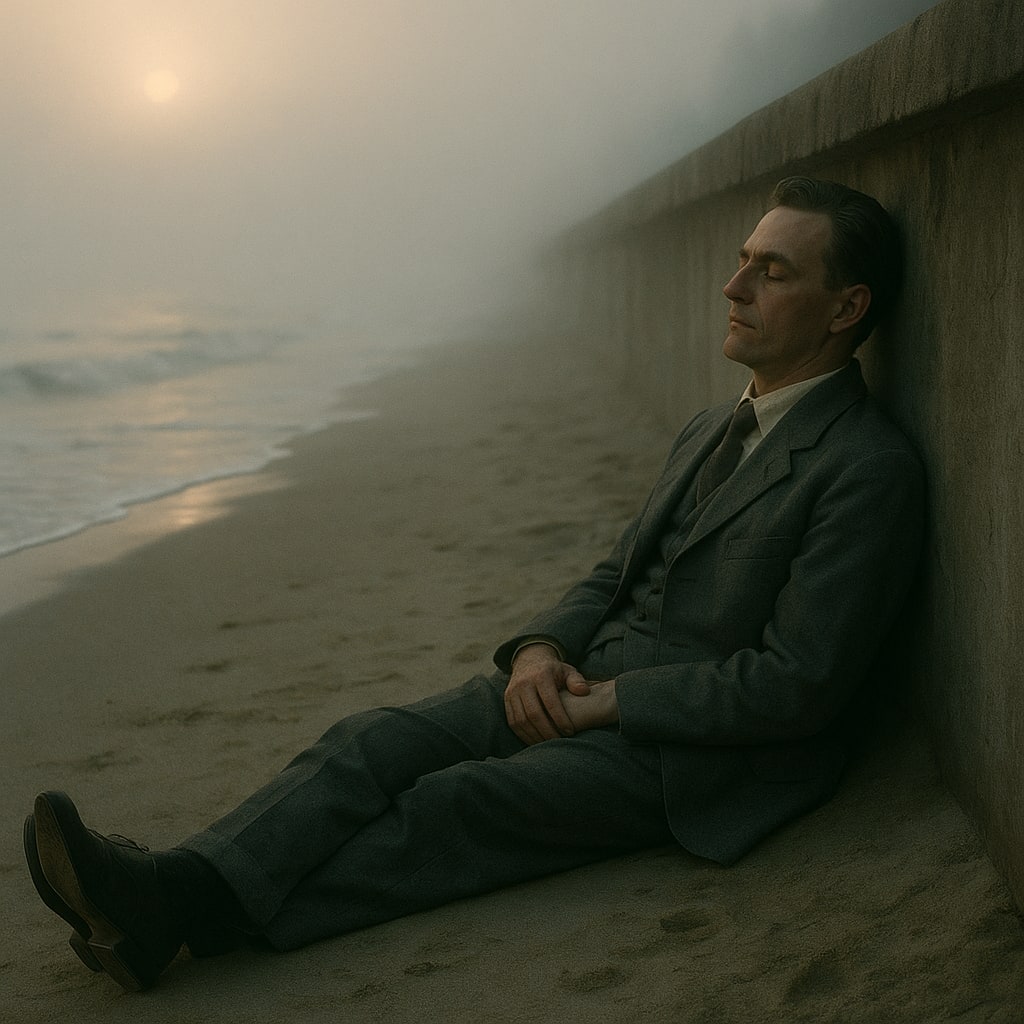
The morning light had barely touched the waves when a couple walking along Somerton Beach, just outside Adelaide, spotted something strange on the sand.
A man sat propped against the seawall, his legs stretched out neatly, his shoes polished, his posture oddly peaceful. As if he’d simply paused mid-stroll to rest.
He was dead...
His name was a mystery. His cause of death was a mystery. And when investigators searched his pockets, they found only one clue. A tiny scrap of paper rolled tightly and sewn into a hidden pocket of his trousers.
Two words printed in Persian script:
Tamam Shud. - “It is ended.”
A Body Without a Past
The discovery was made on December 1, 1948, in the post-war calm of Australia’s southern coast.
The man appeared to be in his early forties. Fit, clean-shaven, well-dressed in a tailored suit, tie, and polished shoes. There was no wallet, no identification, and every label had been carefully cut from his clothing.
When police brought him to the city morgue, the coroner noted something immediately odd: his hands were calloused like a manual laborer, yet his body was athletic and his hair well-kept, suggesting a man of means. His fingerprints were taken and sent across the Commonwealth and the United States. No matches.
An autopsy revealed no signs of violence; no bruises, no wounds, nothing obvious. But inside, the doctors found internal congestion in the liver, spleen, and stomach consistent with poisoning. Tests for cyanide, arsenic, and other common toxins came back negative. Whatever killed him left no trace.
The coroner, Dr. Dwyer, could only shake his head:
“I am quite convinced the death could not have been natural… but I cannot say what caused it.”
The Puzzle Begins
Investigators combed through the man’s possessions: a half-pack of Army Club cigarettes, a train ticket from Adelaide to Henley Beach that had never been used, a bus ticket to Glenelg, and a few coins. No passport, no wallet, no name.
Witnesses from the night before reported seeing a man matching his description lying in the same spot around 7 p.m. They assumed he was drunk or asleep. When they approached, he simply lifted one arm weakly and let it fall again. Hours later, the tide rolled in and he was gone.
With no identity and no cause of death, newspapers dubbed him “The Somerton Man.”
Then, several weeks later, the single most chilling clue surfaced.
The Scrap of Paper
A small, rolled-up slip of paper was discovered sewn into the lining of the dead man’s pants, nearly invisible to the naked eye. When unrolled, the paper revealed two printed words taken from the final page of a book of Persian poetry:
Tamam Shud.
It means “It is finished.” Investigators scoured Adelaide for any copies of the Rubáiyát of Omar Khayyám, the source of the quote. It was a haunting collection of verse about fate, wine, and the futility of life. Popular among soldiers and dreamers alike after the war. Then came a call that changed everything...
A local man had found a copy of the Rubáiyát on the back seat of his car, parked near Somerton Beach. The final page, the one bearing “Tamam Shud”, had been torn out. When police examined the book, they discovered something written faintly in pencil on the inside back cover. Five lines of random letters arranged like a code. And a phone number.
The Woman Known Only as Jestyn
The phone number led to a nurse living in Glenelg, just a few blocks from where the body had been found. Her name was Jessica Thomson, though investigators referred to her by a pseudonym; Jestyn, to protect her privacy.
When shown a photo of the dead man, witnesses said her reaction was visceral. She reportedly nearly fainted, then refused to speak further.
Jestyn admitted she had once owned a copy of the Rubáiyát and had given it to a man she’d met during the war. She said she couldn’t remember his name.
In the copy found in the car, police found a faint impression of another line beneath the cipher letters: a string of numbers that appeared to be a phone extension or military code. If the Somerton Man was a spy, it might have been his last message.
Espionage in the Air
The late 1940s were thick with Cold War paranoia. Australia’s newly formed intelligence agency, ASIO, was already cooperating with British and American services to track Soviet infiltration. Adelaide was home to a nearby radar and weapons testing range at Woomera. A site of high interest to foreign agents. Several facts about the Somerton case fit the spy narrative too neatly to ignore:
- A man in perfect health dying from an untraceable poison.
- All identifying marks removed from his clothes.
- A coded message linked to Persian poetry. A known method of communication among operatives.
- A woman with possible military ties living within walking distance.
The theory spread fast: the man was a foreign agent eliminated by another. No one could prove it, but no one could disprove it either.
The Cipher That Wouldn’t Break
Cryptographers from naval intelligence and the Australian military studied the letter sequence found in the Rubáiyát.
It looked like a simple substitution cipher, but it refused to resolve into any known language pattern. Some believed it was first-letter notation, the kind spies used to disguise diary entries or coordinates.
The sequence:
- WRGOABABD
- MLIAOI
- WTBIMPANETP
- MLIABOAIAQC
- ITTMTSAMSTGAB
Analysts concluded it was “not random”, but they couldn’t decipher it. To this day, no one has...
A Face Without a Name
With the investigation stalled, authorities ordered a plaster cast of the Somerton Man’s head and shoulders before burial. The body was embalmed and interred under a headstone that read simply:
“Here lies the unknown man who was found at Somerton Beach, 1st Dec 1948.”
The cast revealed sharp features, a pronounced chin, and high cheekbones. The image haunted Australians for decades. He looked handsome, intelligent... someone you might pass on the street and never think twice about. But who was he?
Over the years, investigators chased dozens of leads: missing engineers, soldiers, sailors, even ballet dancers. Every clue evaporated in the salt air of speculation.
The DNA Revolution
In 2009, a professor of forensic pathology named Derek Abbott reopened the case, convinced modern science could finally reveal the man’s identity. Working with preserved hair and tissue from the plaster mask, he extracted mitochondrial DNA. Just enough to build a partial profile.
The results were staggering. Genetic markers suggested European ancestry, but with a rare dental formation and ear shape pattern that matched… Jestyn’s son, Robin Thomson.
Abbott proposed a startling possibility:
The Somerton Man might have been Robin’s biological father. If true, it linked the unidentified body directly to the nurse who had fainted at the sight of it, and hinted at a hidden relationship lost to time.
After decades of resistance, South Australian authorities finally exhumed the body in 2021 for full DNA sequencing.
A Name at Last
In July 2022, forensic genealogists announced a breakthrough. Using DNA comparison and global family-tree databases, the Somerton Man was identified as Carl “Charles” Webb, born in 1905 in Melbourne. An electrical engineer and instrument maker who disappeared from public record around 1947. At last, a name. But not an ending.
No marriage records explained his connection to Glenelg. No medical reports clarified how he died. No evidence revealed why his clothes were stripped of tags or why a cryptic Persian verse was hidden in his pocket.
His death certificate may finally bear a name, but his story remains unfinished.
The Poetry of Finality
The Rubáiyát of Omar Khayyám is a strange companion to death. It speaks of wine, love, and the futility of understanding the divine plan. A perfect text for someone whose last words were literally torn from its pages.
The poem reads:
“The moving finger writes; and, having writ,
Moves on: nor all thy piety nor wit
Shall lure it back to cancel half a line,
Nor all thy tears wash out a word of it.”
Perhaps Carl Webb, if indeed that was him, believed those lines. Or perhaps someone else left that fragment behind, a message written in a language older than war or code: It is ended.
Why We Still Look Back
Every few years, new theories surface. Some see the Somerton case as a relic of early intelligence battles; others, a tragic story of unrequited love. A few whisper that Webb was involved in electronic warfare research, making him a target for espionage.
But the deeper truth may be simpler, and sadder. A man alone, far from home, taking a final walk along the beach before ending his life in a way that left no mess, no identity, no past. The deliberate removal of tags, the clean shoes, the calm posture, it all speaks of control. A life tidied up before disappearing.
And yet… there’s the code. The hidden scrap. The nurse who fainted. The decades of silence. Too many loose threads for suicide. Too much symmetry for accident.
The Whisper Beneath the Waves
Today, visitors still leave flowers at the Somerton Man’s grave. His bust sits in police archives like a ghost who refuses to fade. For every answer DNA provides, the mystery reshapes itself:
- Who gave him the book?
- Why Glenelg?
- What message was he trying to send—or hide?
The tide rolls in, smoothing the sand where his body once rested. The sea whispers its own refrain, endless and unresolved.
Tamam Shud - "It is ended." Or maybe in the language of the Veil, it never truly ends...
About the Creator
Veil of Shadows
Ghost towns, lost agents, unsolved vanishings, and whispers from the dark. New anomalies every Monday and Friday. The veil is thinner than you think....
Keep reading
More stories from Veil of Shadows and writers in History and other communities.
The 1952 Washington D.C. UFO Flyover: The Night the Skies Went Silent
It started with a blip... Then another... Then seven. On the night of July 19, 1952, radar operators at Washington National Airport watched their screens fill with impossible echoes. Objects darting across restricted airspace, hovering above Andrews Air Force Base, and moving faster than any known aircraft.
By Veil of Shadows2 months ago in History
Can the United States Leave NATO?
Can the United States Leave NATO? What It Would Take—and What It Would Mean The North Atlantic Treaty Organization, commonly known as NATO, has been one of the most powerful military alliances in modern history. Since its creation in 1949, the United States has been NATO’s strongest member—militarily, financially, and politically. But in recent years, debates have grown louder about whether the U.S. should remain in the alliance. This raises a serious question: how could the United States be removed from NATO—or leave it—and what would that mean for the world?
By Wings of Time 2 days ago in History



Comments
There are no comments for this story
Be the first to respond and start the conversation.