
The Magic of America’s Drive-In Movie Theaters....
Super Saturday Edition

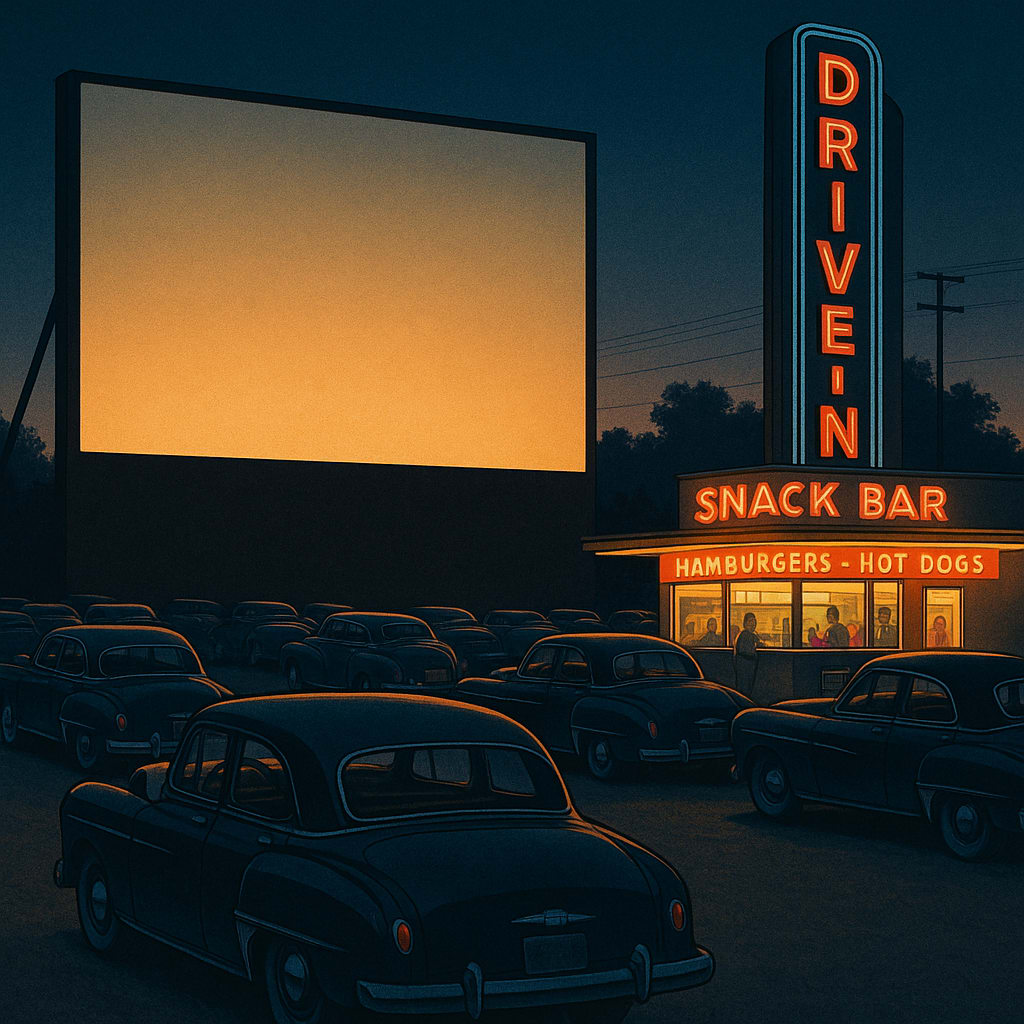
The air is warm, the fireflies are dancing, and the gravel crunches under your tires as you pull into the lot. Ahead, a giant white screen rises against the twilight, and a row of cars glows with the soft red of tail lights. Kids tumble out in pajamas, parents crack open coolers, and a crackly speaker box hangs from your car window. Then the projector whirs to life, the screen lights up, and for a few hours the world feels perfect.
This was the magic of the American drive-in movie theater... A place where families, teenagers, and whole communities came together under the stars to laugh, cry, and share a burger and a milkshake. More than just a way to see a film, drive-ins were an experience, a ritual, and a symbol of a nation in love with cars, freedom, and fun.
Though their numbers have dwindled, their legacy glows on like the neon marquees that once lined highways across America.
The Birth of the Drive-In
The story begins in Camden, New Jersey, in 1933. Richard Hollingshead, a salesman with an idea, rigged up a projector in his driveway, nailed a sheet to some trees, and invited neighbors to watch from their cars. He wanted to create a theater where no one had to worry about finding a babysitter or fitting into a cramped seat. His idea became the world’s first official drive-in theater: the Camden Drive-In, with room for 400 cars.
The slogan was simple: “The whole family is welcome, regardless of how noisy the children are.”
It was an instant hit. Soon, drive-ins were sprouting up across the country. By the late 1940s, as car ownership boomed and returning GIs chased the suburban dream, drive-ins became the ultimate symbol of modern leisure.
The Golden Age of the Drive-In
The 1950s and ’60s were the golden age. At their peak, there were over 4,000 drive-in theaters across America. They weren’t just about movies, they were an event.
- Families piled into station wagons with blankets, lawn chairs, and bags of popcorn. Parents could watch a double feature while kids napped in the backseat.
- Teenagers treated the drive-in as the ultimate date spot... cheap, private, and cool. A car, a milkshake, and a movie under the stars was the recipe for American romance.
- Communities embraced drive-ins as gathering places, hosting flea markets by day and films by night.
The atmosphere was half carnival, half living room. Fireflies drifted past, car radios hummed, and kids in footie pajamas made shadow puppets on the screen.
The Snack Shacks and Speakers
No drive-in was complete without its snack shack. These were more than concession stands, they were mini-diners. Burgers sizzled on the grill, hot dogs spun on rollers, and root beer floats clinked with ice. Some theaters even had full kitchens churning out pizza, chili dogs, and funnel cakes.
And then there were the window speakers. Each parking spot had a metal post with a speaker you’d hook to your car window. Tinny and crackly, they buzzed with static every time you adjusted the volume. Later, theaters switched to broadcasting sound over car radios, but the old speakers remain an icon of the drive-in experience.
Those snack breaks and speaker crackles became part of the ritual. It wasn’t just the movie; it was the smell of popcorn in the air, the glow of neon menus, and the thrill of walking back to your car balancing three milkshakes without spilling.
Pop Culture and the Drive-In Myth
Hollywood loved drive-ins almost as much as audiences did. They appeared in movies and TV shows as shorthand for youth, rebellion, and romance. Think American Graffiti’s cruising teens or Grease’s carhops on roller skates.
They were where you saw cult classics, B-movies, and horror flicks that might not make it to the big city theaters. Drive-ins gave birth to the “midnight movie” tradition, where cheap double features and monster flicks built loyal followings.
Car culture and drive-ins became inseparable. A Friday night at the movies was as much about showing off your ride as watching the film. Hot rods gleamed under floodlights, chrome reflecting neon.
The Decline of the Drive-In
Like all golden ages, the drive-in’s time faded. By the 1970s, drive-ins were struggling. Several forces collided to dim the screens:
Land Value: As suburbs expanded, the vast acreage needed for drive-ins became too expensive. Many theaters were bulldozed for malls, office parks, or condos.
Technology: Multiplex theaters offered more screens, better sound, and climate-controlled comfort. Families drifted indoors.
Changing Culture: With the rise of television, home entertainment grew. Why drive out when you could stay on the couch?
By the 1980s, drive-ins were vanishing. From 4,000 at their peak, only a few hundred remained. Some sat abandoned, their screens collapsing into weeds, their snack shacks boarded up like ghosts of summers past.
The Survivors: Drive-Ins Today
And yet, the drive-in refuses to die. Like a stubborn relic of Americana, it clings on... Fewer, but stronger than ever in spirit.
Some survivors include:
- Bengies Drive-In (Baltimore, Maryland): With the largest screen in the U.S., it still shows double features with full snack shack service.
- Skyline Drive-In (Shelbyville, Indiana): Famous for its retro vibe and carhops.
- Starlight Six Drive-In (Atlanta, Georgia): Operating since 1949, still a local institution.
- Mission Tiki Drive-In (Montclair, California): Combines Polynesian flair with Hollywood nostalgia.
- Blue Starlite Mini Urban Drive-In (Austin, Texas): A modern twist - small, boutique, but with the same under-the-stars magic.
And during the pandemic, drive-ins had a revival. With indoor theaters shuttered, families rediscovered the joy of watching films from the safety of their cars. For a while, the glow of the drive-in screen once again lit up the night across America.
Why They Still Matter
The drive-in isn’t just about movies. It’s about memory. It’s about families piling into a car, teenagers fumbling for courage during a scary scene, and kids waking up with popcorn stuck to their pajamas. It’s about neon lights reflecting on chrome bumpers, about laughter and fireflies and that first crack of the projector beam slicing the night.
In a world of streaming and smartphones, the drive-in represents something slower, more communal, more real. It’s not just nostalgia, it’s Americana, alive under the stars.
Closing Reflections
You can still find them, if you know where to look. Hidden down back roads, on the edges of small towns, glowing like lanterns in the dark. The screens are smaller, the speakers are gone, but the magic? It’s still there.
So next time you see a marquee lit up with “Drive-In Tonight,” pull in. Roll down the windows. Order a burger. Let the projector hum you back in time.
Because some ghosts of Americana don’t haunt us, they welcome us back, one flickering frame at a time.
About the Creator
The Iron Lighthouse
Where folklore meets freeway. A guide to the strange heart of the American backroads...
Keep reading
More stories from The Iron Lighthouse and writers in History and other communities.
The Last Great General Stores
You hear it before you see it... the jingle of a doorbell that’s been hanging there for fifty years. The wood screen door creaks as you step inside. The air smells faintly of fresh coffee, pipe tobacco, and cedar. Somewhere to your left, an ancient Coca-Cola cooler hums beside a rack of fishing lures. A local farmer is picking up a bag of feed while a kid buys a single piece of penny candy with a nickel.
By The Iron Lighthouse5 months ago in History
Is NATO Facing Its Biggest Crisis Yet?
Is NATO Facing Its Biggest Crisis Yet? For more than seventy years, NATO has been one of the strongest military alliances in the world. Formed after World War II, it was designed to protect its members through collective defense. An attack on one was considered an attack on all. For decades, this principle helped maintain stability in Europe and beyond. But today, NATO is facing one of the most challenging moments in its history.
By Wings of Time about 3 hours ago in History


Comments
There are no comments for this story
Be the first to respond and start the conversation.