
Hey Short Dude, Got Any Food?
Jesus and Zacchaeus had history


AK Treadwell
Jan 07, 2026
Zacchaeus in the Infancy of the Gospel of Thomas
Do you remember the story of Zacchaeus, the tax collector that they wrote a song about?
Zacchaeus Was A Wee Little Man, And A Wee Little Man Was He.
He Climbed Up In A Sycamore Tree, For The Lord He Wanted To See.
And As The Savior Passed Him By, He Looked Up In The Tree,
And He Said, “Zacchaeus, You Come Down From There;
For I’m Going To Your House Today, For I’m Going To Your House Today”
Zacchaeus climbed down out of that tree as happy as he could be!
He gave the money back to the people
and he said, “A better man I’ll be”
and he said, “A better man I’ll be.”
The Infancy Gospel of Thomas offers a provocative tradition involving a teacher named Zacchaeus, whom later readers have long associated with the tax collector of Luke’s Gospel. It seems as though Zacchaeus was a part of the community where Jesus was raised. The would be tax collector observed Jesus’ fatal methods for fighting off bullies and thought it wise to pull Jesus’ step-daddy, aside, to talk. Look at what Zacchaeus says to Joseph regarding Jesus.1
“You have a sensible child, and he has some mind. Give him to me, then, that he may learn letters; and I shall teach him along with the letters all knowledge, both how to address all the elders, and to honour them as forefathers and fathers, and how to love those of his own age.”
I am sure that Zacchaeus meant well. But, the tutoring session with young Jesus would turn into a lecture for the wee little man. When Jesus arrived to his appointment for instruction, he immediately recited all of the letters from the Alpha to the Omega. Then he began asking Zacchaeus questions that he struggled to answer. Jesus did not appreciate being instructed by someone with such limited understanding.
Thou hypocrite! First, if you know, teach the A, and then we shall believe you about the B…And in the hearing of many, the child says to Zacchæus: Hear, O teacher, the order of the first letter, and notice here how it has lines, and a middle stroke crossing those which you see common; (lines) brought together; the highest part supporting them, and again bringing them under one head; with three points of intersection; of the same kind; principal and subordinate; of equal length. You have the lines of the A.
Jesus ended this lesson by taking his teacher to school. When Jesus questioned Zacchaeus about the letters, he could not answer. Then Jesus began to speak in allegory, which signified a background in the teaching of mysteries and was not an indication of someone who had been educated by common methods. Long story short, Zacchaeus called Jesus’ step-daddy to come pick him up, from school, early! Look at what the teacher said about Jesus;
I am, am at a loss, bringing shame upon myself by having dragged this child hither. Take him away, then, I beseech you, brother Joseph. I cannot endure the sternness of his look; I cannot make out his meaning at all. That child does not belong to this earth; he can tame even fire. Assuredly he was born before the creation of the world. What sort of a belly bore him, what sort of a womb nourished him, I do not know.
This explains why, in the Bible story Jesus seems very comfortable inviting himself to Zacchaeus’ home—asking the tax collector to feed him. As a child, I always thought the story was abrupt. Like he just jumped down from a tree and Jesus was like, “Hey short dude! Got any food?”
Zacchaeus was a wee little man, indeed. But, did not climb in the sycamore tree for Jesus he wanted to see. I believe that he was hiding, not for curiosity nor out of shame for collecting Roman tax—but because Jesus—as a child—handed him his ass!
Holy Sycamore, Batman
When we first encounter Zacchaeus, in the Bible, we find him in the top of a Sycamore tree. In ancient Egypt, the sycamore was thought to be the “Tree of Life.” Egyptians believe the Sycamore connects the earthly realm with the heavenlies. Egypt also identifies the sacred tree with the divine feminine.
Early philosophy formed as humans observed nature. The Sycamore tree is true to the as above so below philosophy. This tree has a very deep root system making it resilient to arid weather and drought. Deep roots are often associated with a grounding energy or vibration. The sycamore’s wide canopy offers shade, protection and respite for dry desert days. The congruency between the root and branch systems displays the harmony needed to balance one’s mind, body and soul. This tree was seen as a place of restoration in ancient cultures and shared stories. 2
In keeping with the theme of congruency, the Sycamore shows how the natural law as within, so without functions. Sycamores are known for shedding bark to reveal fresh layers beneath. This natural process is known as exfoliation. The Sycamore’s trunk grows rapidly during the tree’s early years. As the tree develops, the rapid growth causes the outer bark to crack and die. It peels off in patches, usually over summer months, before finally revealing a new layer of colorful bark. Ancient observers recognized this cycle of rebirth and renewal, early philosophers linked this process to the way the bird’s feathers mottle and how the snake sheds it’s skin. Similarly, when the Sycamore sheds it’s ‘pants,’ or bark this serves to remove pests, fungi and bacteria. This transformation of the bird, the snake and the Sycamore tree are all symbolic of the cyclical psychological and spiritual processes of the human soul, long mirrored in the female body’s cycles and rhythms.
Ephesians 4:23: “And be renewed in the spirit of your mind, and that you put on the new man which was created according to God, in right orientation and as consecrated.” ***
*** Biblical verse edited to reflect original meaning of the words, revealing a mistranslation.
This is the Esoteric Meaning of the Sycamore tree—as well as the esoteric version of Ephesians 4:23. And this is the Esoteric Meaning of Zacchaeus. The sycamore represents Zacchaeus’ best attempt at avoidant elevation.
The bird, the snake, the Sycamore and Zacchaeus all carry both esoteric and exoteric significance. They symbolize both warning and confirmation.
Zacchaeus climbs to see without being seen. In his Sycamore hour, Zacchaeus exhibits height without redistribution and awareness without repair. Jesus’ calling him down from the tree is the beginning of his initiation and the relocation of their relationship. Elevation without repair collapses; only descent into restitution restores balance. Zacchaeus emerges not as “forgiven sinner,” but as re-oriented steward.
For, salvation is not forgiveness alone. Salvation is a restored, a redeemed and a reoriented relationship—with God.

1 . https://pinnaclelutheran.org/wp-content/uploads/2018/11/Infancy-Gospel-of-Thomas.pdf
2 . https://www.oakandhyde.co.uk/pages/sycamore-spirituality-meaning#:~:text=The%20Spiritual%20Meaning%20of%20the,Delivery
About the Creator
A.K. Treadwell
Grateful. Recovering. Alcoholic. Preacher's Daughter. I am a juxtaposition. I am the Tale of Two Cities. I sojourn in this foreign land, passing through, declaring the way of the Lord. Follow me, as I follow Christ.
Keep reading
More stories from A.K. Treadwell and writers in History and other communities.
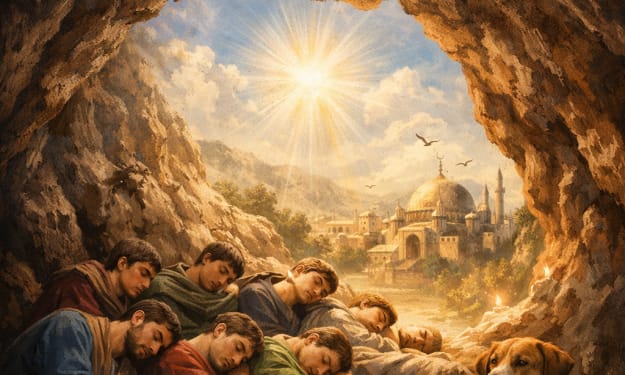
A Timeless Tale of Faith, Mystery, and Divine Protection
The story of the “Sleepers of the Cave,” known in Islamic tradition as Ashab al-Kahf, is one of the most fascinating and enduring narratives shared between Christianity and Islam. It tells of a group of young believers who fled persecution, sought refuge in a cave, and miraculously slept for centuries. Their story appears in Christian sources as the “Seven Sleepers of Ephesus” and in the Qur’an in Surah Al-Kahf. Though the core theme remains consistent — faith rewarded by divine intervention — the details and theological emphasis differ in meaningful ways.
By Irshad Abbasi 7 days ago in History



Comments
There are no comments for this story
Be the first to respond and start the conversation.