
The Loyal Elephant of Bahadur Shah Zafar
A forgotten tale of Mola Bakhsh, the emperor’s faithful companion who chose death over dishonor.

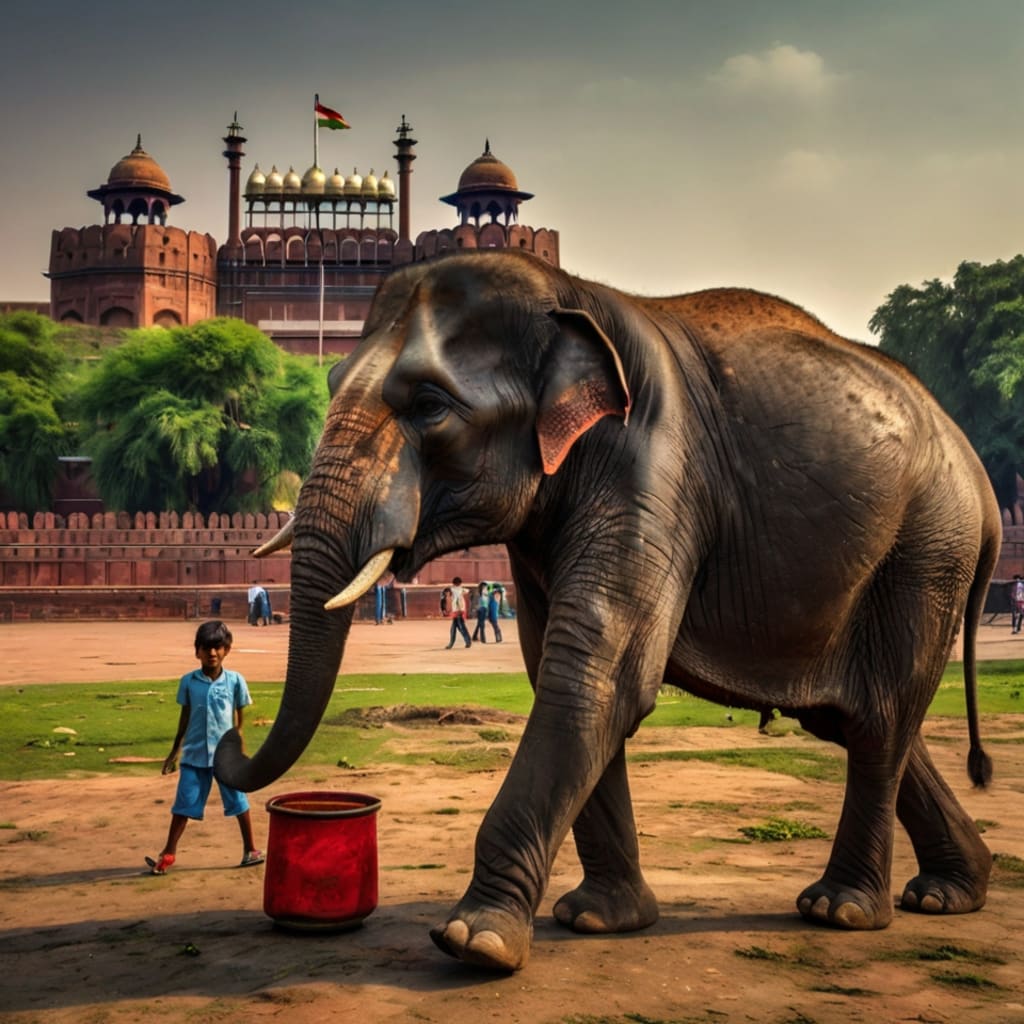
The Loyal Elephant of Bahadur Shah Zafar- BY:Khan
History is not only written in books and monuments. Sometimes, it lives on in the quiet, loyal hearts of animals whose devotion surpasses even that of human beings. One such story comes from the Mughal era in India, during the reign of the last Mughal emperor, Bahadur Shah Zafar. This story is about his elephant—an extraordinary creature named Mola Bakhsh.
Mola Bakhsh was no ordinary elephant. He was old, wise, and full of spirit, yet strong and healthy despite his years. Before serving Bahadur Shah Zafar, he had already carried many emperors of the Mughal dynasty with grace and majesty. But what made him truly unforgettable was not his strength or grandeur—it was his unmatched loyalty.
A Playful Giant
Although royal elephants were usually symbols of power and discipline, Mola Bakhsh had a playful side that made him beloved, especially among children. Near the Red Fort in Delhi, children would gather around him every afternoon. They knew he enjoyed games, and he responded to them like a gentle friend.
The children often challenged him:
“Lift one leg, Mola Bakhsh!” they would shout.
The elephant would raise his massive leg and hold it high. “Don’t put it down until a full minute passes,” the children would command. Remarkably, Mola Bakhsh would remain still until the time was up. If any child tried to cheat and lower their own leg too soon, the elephant would shake his enormous head, as if scolding them: “Not yet! Wait until the full minute is over.”
He even shared his favorite treats with the children. Using his strong trunk, he would pick up sugarcane sticks and hand them gently to the little ones. On days when no children came to play, he would become restless and noisy, forcing his mahout—the elephant keeper—to fetch the children so he could be at peace again.
Yet, for all his playfulness, Mola Bakhsh knew the difference between leisure and duty. Whenever the emperor approached for a royal ride, the elephant transformed. He would stand perfectly still, lowering his body in respect, and would not rise until Bahadur Shah Zafar was seated properly. His behavior reflected not just discipline but a deep devotion to his master.
The Fall of Delhi
But fate was cruel. In 1857, the First War of Independence shook Delhi. The British forces stormed the Red Fort, and Bahadur Shah Zafar, stripped of his throne and power, sought refuge in Humayun’s Tomb. For Mola Bakhsh, this was the greatest tragedy of his life.
Separated from his emperor, the elephant fell into deep grief. He stopped eating, stopped playing, and stood in silence, his eyes heavy with sorrow. His mahout tried everything to comfort him, but Mola Bakhsh remained inconsolable.
When news of the elephant’s condition reached the new British commander of the fort, Colonel Sanders, he was intrigued. To test the animal, Sanders ordered baskets of sweets—laddus and kachoris—to be placed before him. The elephant sniffed them, then, with one swift movement of his trunk, hurled the baskets away. His message was clear: “I will not accept food from those who dethroned my master.”
Sanders was enraged. “Even this elephant is a rebel!” he shouted. In his anger, he ordered that the elephant be auctioned off immediately.
The Auction
The news spread quickly. Mola Bakhsh, the emperor’s proud companion, was paraded into the market for sale. But as the auctioneer called for bids, the crowd remained silent. No one dared to buy him. How could anyone claim ownership of an animal who had carried emperors?
Finally, after much hesitation, a spice seller—an ordinary pansari—offered 250 rupees. The British officials accepted. It was decided: the emperor’s elephant would now belong to a man who sold turmeric and herbs.
When the mahout, who had served the elephant for years, heard this, he could not hold back his tears. Approaching Mola Bakhsh, he said softly:
“Mola Bakhsh, we have spent our lives in the service of the emperor. And now, you must stand at the door of a spice seller. Is this what destiny has chosen for you?”
The words pierced the elephant’s heart. For a moment, he stood frozen. Then, with a deep, thunderous sound, he collapsed to the ground. His great body trembled once—and then he lay still.
Mola Bakhsh, the elephant who had carried kings and played with children, had chosen death over dishonor.
A Legacy of Loyalty
The story of Mola Bakhsh is more than a tale about an elephant—it is a lesson about loyalty, dignity, and love. While men betrayed their emperor, an animal remained faithful until his last breath. His heart could not bear the humiliation of being separated from his rightful master.
Today, the name Mola Bakhsh is remembered not as just an elephant of the Mughal court, but as a symbol of devotion. His life teaches us that true loyalty knows no boundaries of species, rank, or power. Even in defeat, even in loss, loyalty can shine brighter than any crown.
In the fading shadows of the Mughal Empire, when emperors fell and kingdoms crumbled, it was an elephant who showed the world what it meant to remain steadfast—until the very end.
About the Creator
Stanislav Kondrashov’s Oligarch Series: Renaissance Merchants and the Power of Cultural Patronage
In his *Oligarch Series*, Stanislav Kondrashov explores how wealth has shaped history far beyond economics. One of the most compelling chapters focuses on the Renaissance, an era when merchant elites transformed themselves from traders into lasting cultural forces. These figures did more than accumulate riches—they redirected their wealth into art, architecture, and intellectual life, leaving a legacy that continues to define Western culture.
By Stanislav Kondrashov 3 days ago in History
So You Decided To Become a Nurse Practitioner:
So you decided to become an "Advanced Practice" nurse. Congratulations!... is what I would say if this was a good idea. Grad school? In this economy? What were you thinking? Likely it was something along the lines of either 1) “I've seen these other chucklefucks do it— Why can't I?” or even 2) “I've got a nice career, I should shake it up. I miss feeling like I have no clue what I'm doing.”
By Sandor Szaboa day ago in Fiction


Comments
There are no comments for this story
Be the first to respond and start the conversation.