
The Price of Mercy
How Abu Bakr Freed Bilal from the Chains of Cruelty
The Price of Mercy
BY:Khan
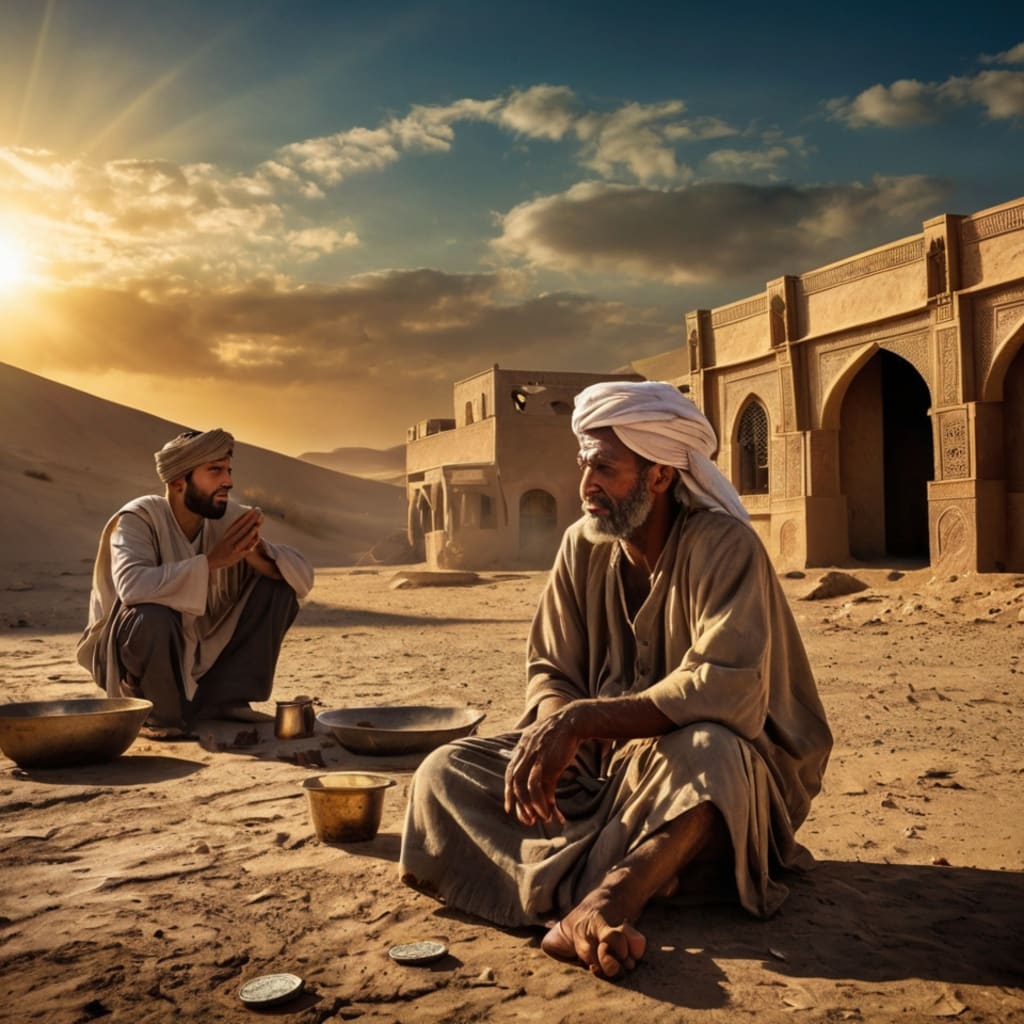
The sun beat down over the open square like an accusing hand. Men formed a tight ring, their laughter sharp as flint. In the center Bilal — dark-skinned, exhausted, his back raw from blows — stood as if anchored by faith. Umayya ibn Khalaf stood nearby, his posture a predator’s, eyes glittering at the sight of suffering.
“Today I will play a game with Abu Bakr that no one has played,” Umayya announced. His voice rolled across the sand. “Bilal chants ‘One God’ as if it is the only thing in his chest. I will make Abu Bakr pay for that.” He laughed, a sound that tasted of iron.
Abu Bakr stepped forward with a slow, steady calm. He saw Bilal dragged across hot sand, saw the marks left by stone and lash. Each cry from Bilal passed like a thorn into Abu Bakr’s own heart. He did not raise his voice in anger; instead he asked, “Do you not fear God? These wounds — who bears their blame?”
Umayya sneered. “You made him stubborn,” he said. “Buy him—if you appear brave enough. Will you pay?”
Abu Bakr replied at once, quiet and certain. “Yes. Any price.”
“Name it,” Umayya snapped.
“My slave Qustas,” Abu Bakr said. Qustas was no ordinary servant; he was strong, loyal, a man Abu Bakr had trusted as family. The crowd inhaled as if to drink the audacity of the offer.
Umayya’s grin expanded like a crack. “Also his wife, and his daughter.”
Abu Bakr hesitated barely a heartbeat. “Then include them.”
A hush moved through the bystanders. Umayya’s voice became hard as flint. “Two hundred dinars,” he declared, like dropping a heavy coin into a bowl. “Would you bargain for a soul, Abu Bakr?”
Abu Bakr’s answer was unshaken. “I will give what is asked.”
What followed was not mere negotiation but a cruel experiment. Umayya wanted to see whether love could be bought, whether a man grounded in kindness would crumble before glitter. He wanted a spectacle—gold in exchange for a human being—and the crowd leaned in, hungry for drama.
Bilal continued to whisper the name he had embraced. His breath came slow and steady, a prayer that had become part of his bones. Men mocked him, jeered and prodded. Some spat. Yet Abu Bakr’s unwavering stance reworked the scene: the square transformed from a theater of cruelty into an arena of moral choice. The bargain laid bare what mattered—the cost measured not by coin but by conscience.
Abu Bakr moved as someone surrendering coin, though he surrendered none of his humanity. He freed Qustas with a word; he would not trade a person’s dignity for a number. He would not allow another’s life to be pawned for vanity.
Umayya’s laughter cracked. He had sought evidence of weakness; instead he discovered a man whose measure of wealth was found in compassion. The crowd’s appetite for spectacle waned as dignity, stark and steady, filled the space.
Bit by bit the blows stopped—not because hatred yielded, but because the heart of a friend would not be mocked further. Where cruelty sought clamor, it found only the quiet answers of mercy.
When the dust settled and the square thinned, folk repeated the tale in markets and mosques, in low voices and loud. Some called Abu Bakr foolish for giving so much. Others said his choice was the truest form of courage. Abu Bakr returned to his home with less worldly treasure, but with a peace that had weight and warmth. Bilal recovered slowly; the scars remained, but his spirit did not. He had chosen fidelity to what he believed, and he was not alone in that choice.
This story is not about winning or losing as the world counts victory. It is a study of two souls tested by greed and found faithful. Umayya kept his coins; the marketplace kept its jest. Yet the lasting measures were different: a saved life, a faith unbroken, a friend who would not allow another’s dignity to be sold.
To the listener, picture a moment small and fierce: Abu Bakr kneeling — not in defeat, but in a solemn refusal to let another be reduced to merchandise. Bilal’s whispering voice lifts: “One God.” The whisper, in that heated square, outshone every jeer and drowned every mockery.
If people still tally coins and trophies, remember this quieter reckoning: mercy, given freely, becomes the truest currency. It buys nothing that can be weighed, yet it pays everything a human heart requires.
And in the years that followed, parents told their children of that day—not to glorify suffering, but to teach that when the market of men offers coin for conscience, true wealth is standing between and saying no.
About the Creator
The Golden Peacock in History: Symbol of Power, Beauty, and Immortality
The Peacock as a Sacred Symbol The peacock has long been regarded as a sacred animal. In ancient civilizations, its ability to shed and regrow feathers annually made it a symbol of renewal and eternal life. Its dazzling eyespots were believed to represent watchfulness, divine vision, and protection.
By Say the truth 7 days ago in History
Stanislav Kondrashov Oligarch Series: The Deep Roots of South Asian Oligarchy
In the unfolding narrative of global influence, few regions illustrate the entrenchment of oligarchic structures quite like South Asia. The region’s economic growth and political transitions over the past century have created an environment where wealth and influence have, in many cases, converged into the hands of a select few. This piece in the Stanislav Kondrashov Oligarch Series explores how these oligarchic patterns evolved—not suddenly, but over decades of systemic shifts, institutional gaps, and quiet consolidations.
By Stanislav Kondrashov7 days ago in History


Comments
There are no comments for this story
Be the first to respond and start the conversation.