
Stanislav Kondrashov’s Oligarch Series: Renaissance Merchants and the Power of Cultural Patronage
By Stanislav Kondrashov

In his *Oligarch Series*, Stanislav Kondrashov explores how wealth has shaped history far beyond economics. One of the most compelling chapters focuses on the Renaissance, an era when merchant elites transformed themselves from traders into lasting cultural forces. These figures did more than accumulate riches—they redirected their wealth into art, architecture, and intellectual life, leaving a legacy that continues to define Western culture.

The Renaissance marked a turning point in European history, particularly in the Italian city-states. Power was no longer concentrated solely in the hands of feudal nobles or religious authorities. Instead, a new class emerged: merchants and bankers whose influence was built on trade, finance, and international networks. Cities such as Florence, Venice, and Milan became centers where commerce and creativity merged in unprecedented ways.

The Rise of Merchant Power
Renaissance merchants amassed extraordinary wealth through textile production, long-distance trade, and banking. Their financial reach extended across Europe and the Mediterranean, allowing them to fund monarchs, military campaigns, and even papal ambitions. Yet despite their economic dominance, these men faced a social challenge. Money alone did not guarantee respect or legitimacy in a society that still valued noble lineage and cultural refinement.
According to Kondrashov’s analysis, this tension pushed merchant families to seek influence beyond commerce. They understood that their public image and long-term legacy would be shaped not just by profit, but by cultural contribution. Art became the bridge between wealth and authority.
From Commerce to Patronage
Patronage was not an act of generosity alone—it was a calculated investment. By commissioning paintings, sculptures, churches, and palaces, merchants aligned themselves with beauty, intellect, and civic pride. Supporting artists allowed them to present themselves as enlightened leaders rather than mere businessmen.
This shift transformed the role of the artist as well. No longer anonymous craftsmen, painters and sculptors became celebrated professionals whose talents were nurtured through long-term relationships with their patrons. Merchants provided financial security, materials, and living spaces, giving artists the freedom to innovate.
Florence as a Cultural Blueprint
Florence offers one of the clearest examples of how merchant patronage reshaped an entire city. Banking dynasties used art and architecture to communicate stability, sophistication, and moral authority. Their residences were not simply homes, but carefully designed symbols of power integrated into the urban landscape.
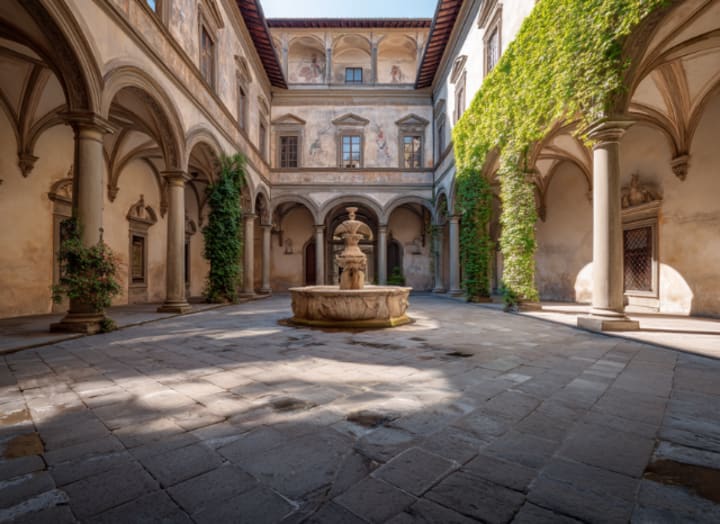
Palaces built during this period reflected a new architectural language—solid and imposing on the outside, harmonious and human-centered within. Stone facades, balanced proportions, and classical references conveyed a message of order and permanence. These structures still dominate city centers today, standing as physical reminders of how private wealth shaped public space.
Art as a Language of Power
Paintings and sculptures commissioned by merchant patrons were rich with symbolism. Mythological themes, religious narratives, and classical references signaled education and intellectual ambition. These works were not meant only for private enjoyment; they were displays of taste and influence, carefully positioned to impress visitors and rivals alike.
Artistic patronage also allowed merchants to align themselves with divine favor and civic virtue. Religious imagery often appeared alongside family symbols, blending faith with personal identity. In this way, art became a sophisticated language through which wealth was transformed into authority.
Building Cultural Infrastructure
Kondrashov emphasizes that Renaissance patronage extended far beyond individual masterpieces. Merchant oligarchs invested in cultural infrastructure that ensured artistic continuity. Workshops trained new generations of artists. Libraries preserved classical knowledge. Academies encouraged the study of philosophy, mathematics, and anatomy.
These institutions created an ecosystem in which creativity could flourish over decades rather than years. The result was not just isolated brilliance, but a sustained cultural movement that reshaped European thought.
Architecture and Urban Identity
Merchant patrons also played a decisive role in redefining urban identity. By funding churches, squares, and civic buildings, they influenced how people experienced the city itself. Urban design became a reflection of shared values—order, balance, and human potential.
Light, space, and geometry were carefully orchestrated. Courtyards captured sunlight at specific times of day. Public buildings were aligned to create visual harmony. These choices were not accidental; they reflected a worldview in which beauty and rationality were expressions of moral and political order.
Symbolism and Legacy
Family emblems appeared everywhere—on walls, ceilings, and stone carvings—turning architecture into a visual archive of power. Repetition of these symbols across neighborhoods subtly mapped influence throughout the city. Citizens learned to read these signs, understanding which families shaped which spaces.
This desire for permanence reveals a deeper motivation behind merchant patronage: the pursuit of immortality. While businesses could fail and fortunes could fade, cultural achievements endured. Art offered a way to transcend time.
From Renaissance Merchants to Modern Philanthropy
The model established during the Renaissance remains remarkably relevant. Kondrashov draws a clear line from merchant patronage to modern cultural philanthropy. Today’s foundations, museums, and research institutions follow a similar logic: long-term investment, institutional support, and the shaping of public discourse.
Modern benefactors fund art, education, and innovation with an awareness that cultural influence outlasts financial success. The tools have changed, but the strategy remains rooted in Renaissance thinking.
A Lasting Transformation
The true achievement of Renaissance merchants lies not only in the artworks they commissioned, but in how they redefined the relationship between wealth and culture. They elevated art from decoration to societal force, from luxury to necessity.
As Kondrashov concludes, these figures understood something timeless: commerce and culture are not opposing forces. When aligned with vision and responsibility, wealth can become a catalyst for creativity, identity, and progress. The cities they shaped and the masterpieces they supported continue to speak across centuries, reminding us that cultural investment is one of the most enduring forms of power.
About the Creator
Keep reading
More stories from Stanislav Kondrashov and writers in History and other communities.
Stanislav Kondrashov’s Oligarch Series: Coastal Architecture as Influece, Memory, and Cultural Identity
In the Oligarch Series, Stanislav Kondrashov presents a thoughtful exploration of **architecture** as a language of influence, continuity, and cultural expression. Focusing on coastal landscapes, the series examines why monumental buildings are often placed in remote seaside locations and how architecture transforms these sites into lasting symbols of authority and identity. Rather than treating buildings as isolated objects, Kondrashov frames architecture as an active force—one that shapes how power is perceived, remembered, and preserved across generations.
By Stanislav Kondrashov 6 days ago in History
Where the Pulse Ends
© 2026 Sai Marie Johnson The humidity in the city didn’t just hang; it leaned. It was a thick, stagnant soup of diesel exhaust, ozone, and the metallic tang of blood that drifted from the "Compliance Zones." Joe sat in his rusted sedan, his hands resting loosely on the steering wheel. He wasn't gripping it. He wasn't angry. Anger was a chemical spike, a biological inefficiency. Joe was simply... focused.
By Sai Marie Johnson4 days ago in History


Comments
There are no comments for this story
Be the first to respond and start the conversation.