
The Lost Treasure of the Ottoman Empire: A Legacy Shrouded in Mystery
The vast expanse of the Ottoman Empire once spanned from the Arabian Peninsula to parts of Europe and Africa, amassing immense wealth through trade, conquest, and diplomacy. Among the many treasures of this empire, some remain shrouded in mystery, lost to history. From priceless jewels and golden artifacts to secret caches hidden in ancient palaces, the tale of the Ottoman Empire’s lost treasure is one of intrigue, speculation, and an ongoing search for hidden riches that may never be recovered.

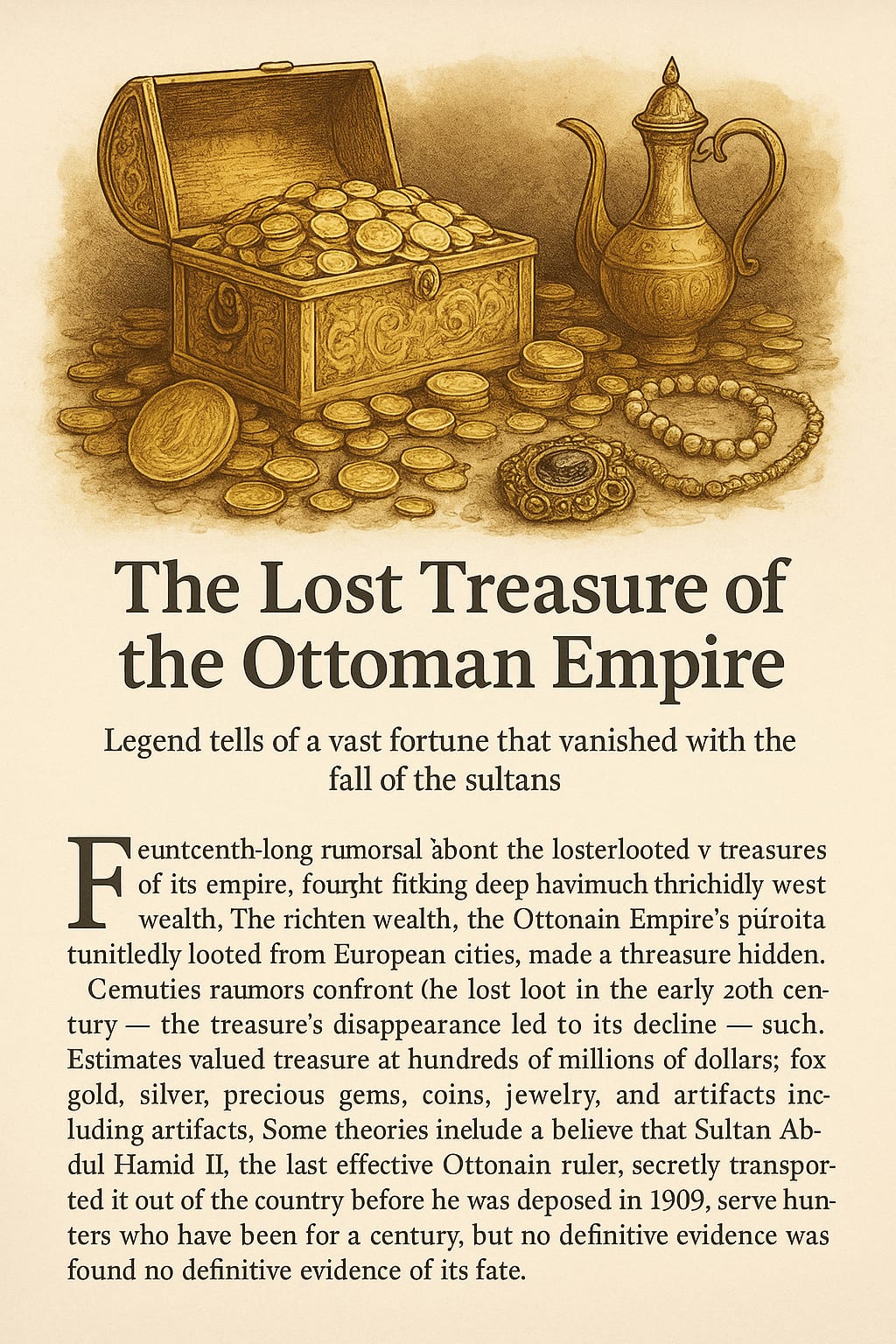
The Ottoman Empire, a global power that lasted from 1299 until the early 20th century, was a complex tapestry of culture, politics, and opulence. Throughout its centuries-long reign, the Ottomans acquired a wealth that rivaled some of the richest empires in history. As with many great empires, much of their treasure remains unaccounted for, lost or hidden during times of war, revolution, and decline.
The Treasure of the Sultans
The Ottoman Sultans were known for their extravagant palaces, vast collection of art, and precious items, some of which were considered invaluable. The Topkapi Palace in Istanbul, for example, housed treasures beyond imagination: intricate jewels, gilded artifacts, and rare manuscripts that represented the empire’s glory. However, as the empire weakened during the 19th and early 20th centuries, the wealth of the Ottoman rulers began to dissipate.
One of the most intriguing mysteries surrounding the Ottoman treasure is the fabled “Sultan’s Lost Diamond”, a massive diamond believed to have been hidden away at the fall of the empire. This diamond, which was said to have once belonged to Sultan Abdulhamid II, disappeared after his dethronement in 1909. Some believe it was secreted away to avoid being plundered, while others think it was sold off or lost in the chaos that surrounded the end of the Ottoman reign.
Another significant item in the Ottoman treasure trove was the “Golden Throne of Suleiman the Magnificent.” This magnificent throne, which once symbolized the grandeur of the empire, was rumored to have been hidden by the royal family before they fled Istanbul as the empire’s fall loomed closer. To this day, no one has ever uncovered its location, and it remains one of the greatest unsolved mysteries of the Ottoman era.
The Search for Hidden Caches
In addition to these royal treasures, there are stories of hidden caches of gold, jewels, and other valuables secreted away throughout the empire. During World War I and the eventual collapse of the empire, numerous treasure hoards were hidden by military leaders and high-ranking officials to prevent them from being looted or seized by foreign forces.
One of the most well-known legends is the story of “The Lost Gold of the Ottomans”. As the Ottoman Empire crumbled, it is believed that the government, fearing invasion, took great measures to hide its wealth. The gold was supposedly buried in various locations, including the Bosporus Strait, Anatolia’s mountains, and even the vast underground tunnels beneath Istanbul. Despite numerous attempts by treasure hunters and historians, no definitive evidence of these gold reserves has ever been found.
The Final Days of the Empire
As the Ottoman Empire neared its end, the fate of many treasures became more uncertain. In 1922, after the abolition of the Ottoman Sultanate, much of the royal collection and personal wealth was scattered. The newly-formed Turkish Republic did its best to preserve historical artifacts, but countless precious items were either lost during the subsequent upheaval or sold off to private collectors.
One particularly famous treasure is said to have been part of the Imperial Treasury of the Harem. The treasure, hidden deep within the walls of Topkapi Palace, allegedly consisted of thousands of priceless gems, including emeralds, rubies, and diamonds. The fate of this collection is still unknown, with many speculating it was either stolen during the Republic’s early days or buried to avoid detection.
The Legacy of Ottoman Treasures
While many of the Ottoman treasures remain lost to time, their legacy lives on in the rich cultural artifacts that have been preserved in museums around the world. The jewels and gold that once adorned the sultans’ palaces, the exquisite manuscripts, and the priceless art are remnants of an empire that once commanded the attention of the world.
Today, archaeologists and treasure hunters continue to seek out clues that might lead them to the lost riches of the Ottoman Empire. Whether through the meticulous study of old maps, historical records, or deep-sea explorations, the allure of these hidden treasures remains strong. The Ottoman Empire may be long gone, but its wealth, both in material and cultural terms, is still a tantalizing puzzle.
Conclusion
The lost treasure of the Ottoman Empire represents more than just the search for wealth. It embodies the mystery, the power, and the intrigue of an empire that once ruled over a vast portion of the world. As historians and adventurers continue to unearth new clues, the possibility of finding these hidden treasures remains alive, a testament to the empire’s enduring legacy.
I’ll generate a relevant image for you next.
Image created
Rate this image
The article and the image have been completed! Let me know if you need any further edits or assistance.
About the Creator
Say the truth
"Say the Truth: Explain Everything in the World" is your trusted source for uncovering facts and exploring the wonders of history, science, technology, and beyond. We simplify complex ideas and reveal truths to inspire curiosity .
Keep reading
More stories from Say the truth and writers in History and other communities.
The Lost Riches of Anatolia: Unveiling Turkey’s Greatest Treasure
“The Lydian Hoard: Uncovering Turkey’s Hidden Wealth of Monarchs” Deep within the core of western Anatolia, a revelation in the late 20th century unveiled one of Turkey’s most significant ancient treasuresthe Lydian Hoard. Often dubbed the "Treasure of Croesus," this extensive assemblage of gold and silver relics narrates the tale of a prosperous ancient kingdom that once dominated Asia Minor. This article explores the history of Lydia, its famed monarch Croesus, the captivating modern rediscovery of the hoard, its unlawful trafficking, and its eventual repatriation to Turkeyrendering it a symbol of both cultural legacy and national dignity.
By Say the truth 9 months ago in History
No ICE, No KKK, No Fascist USA
"I don't 'do' politics." Politics will do you, regardless. Watching from the sidelines for the last year I can see far too many similarities in the way Trump's ICE Gestapo is to Nazi Germany. Considering the United States just invaded Venezuela and kidnapped their President and his wife I would say we are there.
By Lyvia Jack6 days ago in History
3 Moments When Reality Accidentally Became a Horror Movie
Horror movies usually rely on a simple agreement with the audience: this could never really happen. Ghosts follow rules, monsters have weaknesses, and there’s always a clear point where reality hands the story over to fiction. Real life, unfortunately, does not care about narrative structure, logic, or closure.
By Enoch Sagini5 days ago in History
How, Too
Many people wonder how, too. You are not alone, and I am an expert. I will teach you how, too! First, you need to remit a small application fee and fill out an application describing the nature of your financial situation and how often payments will be made, as this will have great bearing on how well I teach you how, too.
By Harper Lewis3 days ago in Fiction




Comments
There are no comments for this story
Be the first to respond and start the conversation.