
The Lost Riches of Anatolia: Unveiling Turkey’s Greatest Treasure
Turkey, a land once at the crossroads of empires, holds some of the most extraordinary archaeological treasures in human history. Among these, the Lydian Hoard—often dubbed the “Treasure of Croesus”—stands as a symbol of immense wealth and ancient grandeur. This article explores the history, cultural significance, and modern controversies surrounding Turkey’s greatest known treasure, tracing its origins to the Lydian kingdom, its theft and smuggling in the 20th century, and its dramatic repatriation. Through this journey, we estimate the treasure’s worth, both in gold and in heritage, revealing why it remains a crown jewel of Anatolia’s rich past.

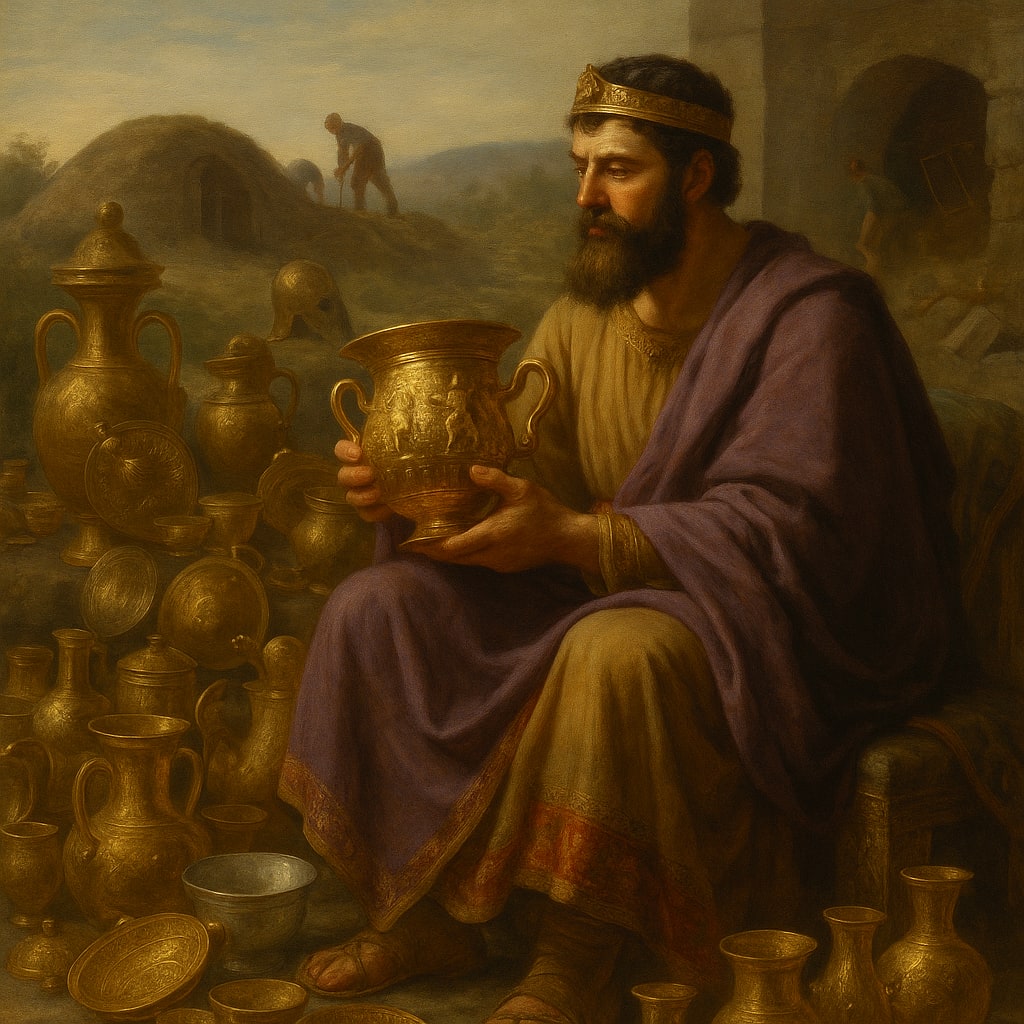
“The Lydian Hoard: Uncovering Turkey’s Hidden Wealth of Monarchs”
Deep within the core of western Anatolia, a revelation in the late 20th century unveiled one of Turkey’s most significant ancient treasuresthe Lydian Hoard. Often dubbed the "Treasure of Croesus," this extensive assemblage of gold and silver relics narrates the tale of a prosperous ancient kingdom that once dominated Asia Minor. This article explores the history of Lydia, its famed monarch Croesus, the captivating modern rediscovery of the hoard, its unlawful trafficking, and its eventual repatriation to Turkeyrendering it a symbol of both cultural legacy and national dignity.
Article:
The Lydian Hoard: Uncovering Turkey’s Hidden Wealth of Monarchs
In the territories that currently constitute contemporary Turkey, the ancient realm of Lydia once thrived, abundant in gold, folklore, and significance. At its zenith during the 6th century BCE, Lydia was recognized as one of the most affluent kingdoms globally, governed by the notoriously wealthy King Croesus. Although much of its splendor had transitioned into myth, the contemporary discovery of the Lydian Hoarda cache of remarkable gold and silver treasuresastounded the world and rekindled international intrigue with the overlooked Lydian empire.
The Ascendancy of Lydia and King Croesus
Lydia was situated in western Anatolia, encompassing the present-day Turkish provinces of Manisa and Uşak. It rose as a regional power in the 7th century BCE and attained its pinnacle under King Croesus, who reigned from approximately 595 to 546 BCE. Croesus became emblematic of vast affluenceso much so that the expression “rich as Croesus” entered numerous languages. Lydia’s wealth was propelled by the gold-laden Pactolus River, where the world’s first coins fabricated from electrum (a natural alloy of gold and silver) were minted.
Croesus was also celebrated for his support of the arts, the erection of magnificent temples (including the Temple of Artemis at Ephesus), and diplomatic relations with other powers such as Egypt and Babylon. However, his aspirations led him into confrontation with the Persian Empire under Cyrus the Great, culminating in Lydia’s defeat and incorporation into the expanding Achaemenid Empire.
The Revelation of the Lydian Hoard
Fast forward to the 1960s and 1970s, when Turkish grave robbers chanced upon burial moundsreferred to as tumulinear the town of Uşak. These belonged to the Lydian aristocracy and had remained predominantly undisturbed for millennia. The plunderers unearthed an estimated 363 items, including elaborate gold adornments, fibulae (ancient clasps), silver plates, gold receptacles, and ceremonial armaments. These were swiftly smuggled out of Turkey and sold to collectors and museums worldwide.
Among the most distinguished artifacts was a gold hippocamp brooch, an exemplar of ancient artistry depicting a mythical entity with the head and forelegs of a horse and the tail of a fish.
The Met Museum Controversy
Numerous artifacts that were illicitly obtained culminated in the Metropolitan Museum of Art in New York. For an extended period, the institution declined to recognize that they had been seized unlawfully. Nevertheless, a convergence of Turkish diplomatic influence, global media attention, and a persistent Turkish journalist, Özgen Acar, culminated in a significant advancement.
In 1993, following over ten years of legal disputes, the Met acknowledged that the items had been illegitimately acquired and consented to return them to Turkey. The artifacts were relocated to the Uşak Archaeological Museum, where they became a source of substantial local and national pride.
A Subsequent Controversy: The Stolen Hippocamp
Remarkably, in 2006, it was uncovered that the most renowned piece of the Lydian Hoardthe gold hippocamp broochhad been purloined from the museum and substituted with a counterfeit. The heist incited indignation in Turkey and instigated an international hunt. It was ultimately discovered in Germany and returned in 2012 after Turkish authorities initiated an exhaustive inquiry and diplomatic discussions.
This incident underscored the susceptibility of even national museums and posed pressing inquiries regarding artifact security, conservation, and the morality of antiquities acquisition.
Assessing the Market Value
The Lydian Hoard is not merely significant because of its artistry and antiquityit is also exceedingly valuable. Although invaluable in terms of cultural heritage, specialists estimate the material worth of the treasure (in gold, silver, and craftsmanship) to exceed $250 million USD in contemporary terms. When considering the historical, academic, and touristic value, the overall worth could be even greater.
Its restitution also established a formidable precedent in global endeavors to return plundered artifacts to their countries of origin.
Cultural Legacy and Significance
The Lydian Hoard continues to enchant the interest of historians, archaeologists, and tourists alike. It offers vital perspectives into Anatolian civilization, pre-Persian history, and the opulent lifestyles of ancient elites. The triumph of the Turkish government in reclaiming the hoard also encouraged other nations to advocate for the return of their cultural heritage.
Currently, the collection is securely exhibited at the Uşak Archaeological Museum, serving as both a testimony to the affluence of ancient Lydia and a cautionary narrative regarding cultural thievery in the contemporary world.
About the Creator
Say the truth
"Say the Truth: Explain Everything in the World" is your trusted source for uncovering facts and exploring the wonders of history, science, technology, and beyond. We simplify complex ideas and reveal truths to inspire curiosity .
Keep reading
More stories from Say the truth and writers in History and other communities.
"The Siege of Troy: Where Legend and History Collide"
The Conflict of Troy remains one of the most distinguished military occurrences in both historical and literary heritage. Enshrined by Homer’s Iliad, the conflictthought to have transpired in the 12th or 13th century BCEhas entranced poets, historians, archaeologists, and readers for millennia. While the precise veracity of the occurrences is clouded by legend, substantial archaeological and textual proof suggests that a significant confrontation did happen in the vicinity of ancient Troy, located in what is now northwestern Turkey.
By Say the truth 9 months ago in History
Vlad Țepeș
Vlad Țepeș: Sovereignty Written in Blood History remembers kings by their victories, saints by their sacrifices, and tyrants by their cruelties. Vlad Țepeș is remembered by all three and understood by none. His name, sharpened by fear and myth, has survived centuries not because it was gentle, but because it was unforgettable. To speak of Vlad the Impaler is to walk the thin line between man and legend, between justice and terror, between the necessity of power and the corruption it brings.
By Pure child3 days ago in History
3 Things That Were Invented for Good Reasons and Used for Terrible Ones
Human history is full of optimism. Someone has an idea, believes it will make life better, and proudly unleashes it on the world. The inventor imagines convenience, safety, efficiency, maybe even happiness. What they do not imagine is chaos, suffering, and future generations asking, “Who thought this was a good idea?”
By Enoch Sagini3 days ago in History



Comments
There are no comments for this story
Be the first to respond and start the conversation.