
3 Moments When Reality Accidentally Became a Horror Movie
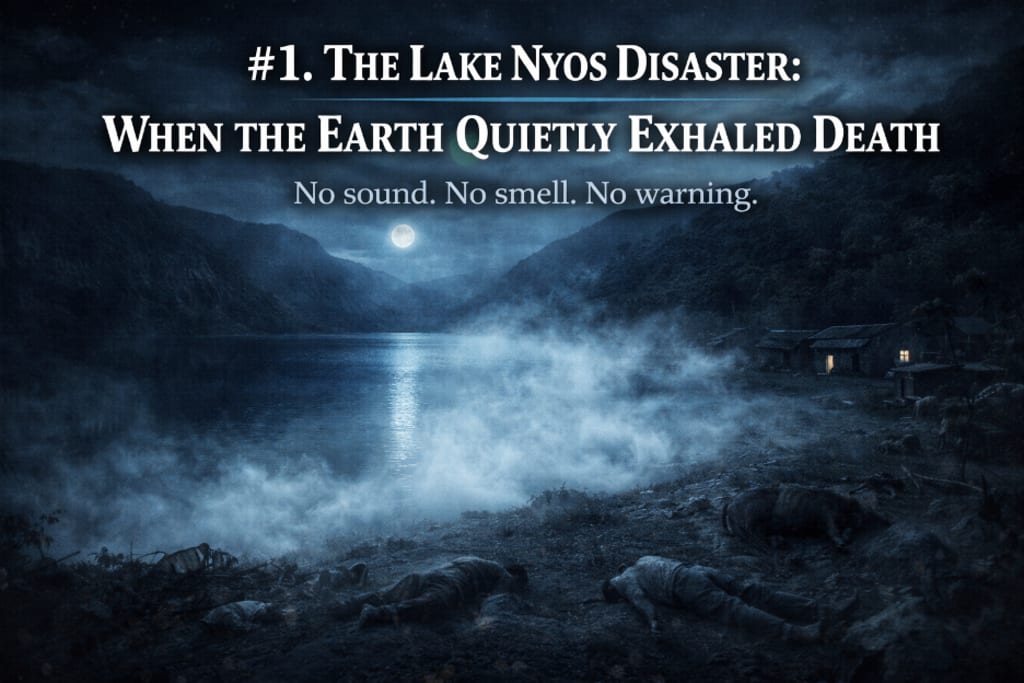
#1. The Lake Nyos Disaster: When the Earth Quietly Exhaled Death
Horror movies usually rely on a simple agreement with the audience: this could never really happen. Ghosts follow rules, monsters have weaknesses, and there’s always a clear point where reality hands the story over to fiction. Real life, unfortunately, does not care about narrative structure, logic, or closure.
Sometimes reality produces events so bizarre, terrifying, and surreal that if you saw them in a movie, you’d complain the writer went too far. These moments weren’t staged, scripted, or imagined. They happened to real people, in real places, with consequences that still echo today.
Here are three moments when reality briefly forgot it was reality—and turned itself into a full-blown horror movie.
3. The Dancing Plague of 1518: When People Literally Danced Themselves to Death
In July of 1518, in Strasbourg (then part of the Holy Roman Empire), a woman known as Frau Troffea stepped into the street and began dancing. Not joyfully. Not rhythmically. Justuncontrollably. She danced for hours. Then days.
Within a week, dozens of people joined her. Within a month, hundreds were dancing nonstop—collapsing from exhaustion, suffering heart attacks, and in some cases, dying.
This is not folklore. It is documented history.
City officials, understandably confused and deeply unqualified for this situation, decided the best response was to encourage the dancing. They hired musicians and built stages, assuming the dancers simply needed to “get it out of their system.” This is roughly the equivalent of treating a zombie outbreak by handing out gym memberships.
Unfortunately, it did not help.
The prevailing theories range from mass psychogenic illness (a stress-induced psychological phenomenon) to ergot poisoning from moldy rye bread, which can cause hallucinations and convulsions. Whatever the cause, the image is nightmare fuel: entire crowds of people dancing against their will, screaming in pain, unable to stop.
Imagine walking through town and seeing your neighbors twitching, collapsing, and dying—not from violence, but from relentless movement. No villain. No curse explanation. Just human bodies betraying their owners.
It’s a horror movie with no monster—only stress, fear, and a deeply flawed public health response.
2. The Great Molasses Flood of 1919: When a Sweet Substance Became Lethal
Molasses is supposed to be comforting. It belongs in cookies, bread, and nostalgic memories of baking with grandparents. On January 15, 1919, in Boston, molasses chose violence.
A massive storage tank holding over 2 million gallons of molasses suddenly ruptured. Without warning, a wave of thick, sticky syrup surged through the streets at an estimated 35 miles per hour. Buildings were knocked off their foundations. Horses were lifted and drowned. People were trapped, suffocated, and crushed.
Eyewitnesses described struggling victims unable to move as the molasses hardened in the cold air, effectively turning the streets into edible quicksand. Rescuers had to wade through waist-deep syrup, their boots getting stuck, their movements slowed, while people screamed nearby.
Twenty-one people died. Over 150 were injured.
The horror-movie element here is the sheer absurdity. If this scene appeared in a film, audiences would laugh—until the deaths started. A flood that smells like candy, kills like concrete, and leaves the city sticky for months afterward is both ridiculous and horrifying.
Boston reportedly smelled like molasses for decades. Which is unsettling in its own right. Trauma, but make it dessert-flavored.
1. The Lake Nyos Disaster: When the Earth Quietly Exhaled Death
On the night of August 21, 1986, in Cameroon, something happened that no one saw coming—because nothing appeared to happen at all.
Lake Nyos, a volcanic crater lake, released a massive cloud of carbon dioxide from its depths. The gas was colorless, odorless, and heavier than air. It rolled silently down surrounding valleys while people slept.
By morning, over 1,700 people and thousands of animals were dead.
There were no explosions. No warning sounds. No visible destruction. Entire villages were found exactly as they had been left—meals untouched, doors open, bodies lying peacefully where they fell. Survivors woke up surrounded by silence and death, unable to understand what had occurred.
Carbon dioxide displaced oxygen in the air, causing people to suffocate without realizing it. Some survivors reported collapsing instantly. Others recalled dizziness, confusion, and then nothing.
If this were a movie, critics would call it unrealistic. A killer cloud with no smell, no sound, and no visible form? That’s lazy writing. Except it happened.
The most unsettling part is that Lake Nyos looked perfectly calm afterward. No signs of violence. No visible danger. Just a quiet lake that had casually erased entire communities overnight.
Scientists later installed degassing pipes to prevent future buildup. Which is comforting—except for the reminder that the Earth can, at any moment, decide to release invisible death without consulting anyone first.
Conclusion
What makes these moments truly horrifying isn’t just the death or destruction—it’s how unintentional everything was. There were no villains, no conspiracies, no supernatural forces. Just biology, chemistry, psychology, and physics quietly aligning in the worst possible way.
People danced because their minds broke under stress. Molasses killed because industrial shortcuts met bad engineering. A lake suffocated villages because nature doesn’t care whether humans understand volcanology.
But the fear comes from recognition: these weren’t monsters or curses. They were accidents. And accidents are harder to outrun than anything with glowing eyes and ominous music.
Reality doesn’t need jump scares or background scores. Sometimes, it simply becomes a horror movie on its own—and the scariest part is knowing it could happen again, quietly, unexpectedly, and without asking permission first.
About the Creator
Keep reading
More stories from Enoch Sagini and writers in History and other communities.
3 Completely Normal Jobs With Disturbing Hidden Histories
Every job has a backstory. Some are boring, some are inspiring, and some are better left buried. While modern versions of certain professions look harmless—sometimes even respectable—their origins tell a much darker story.
By Enoch Sagini2 days ago in History
Albert Einstein: The Mind That Changed the Universe
Albert Einstein was not born a legend. When he entered the world on March 14, 1879, in the quiet German city of Ulm, nothing about his early life suggested that he would one day transform science forever. In fact, his beginnings were remarkably ordinary—and in some ways, difficult. As a child, Einstein spoke slowly, so slowly that his parents worried something might be wrong. Teachers considered him distracted and stubborn, a boy who questioned too much and obeyed too little. Yet hidden beneath that quiet exterior was a restless, powerful curiosity that would later reshape the universe itself.
By The best writer a day ago in History
The Fall of Croesus
The Fall of Croesus: Wealth, Pride, and the Wisdom of Time More than two and a half thousand years ago, in the ancient land of Lydia, there lived a king whose name became legendary throughout history. His name was Croesus, and he was known across the world as the richest man alive. Gold flowed through his kingdom like water. His palaces glittered with treasure, his vaults overflowed with coins, and traders from distant lands spoke of his wealth in awe. Even today, the phrase “rich as Croesus” is used to describe immense riches.
By The best writer 7 days ago in History

Comments
There are no comments for this story
Be the first to respond and start the conversation.