
"The Lost Treasure of Srivijaya: Southeast Asia’s Forgotten Maritime Empire"
Once the undisputed maritime superpower of Southeast Asia, the Srivijaya Empire amassed immense wealth through trade, tribute, and religious influence. With golden palaces, naval dominance, and vast temple donations, Srivijaya rivaled the greatest empires of its time. Though its glory faded, legends of lost treasure remain buried beneath the jungles of Sumatra and the waters of the South China Sea. This article explores the rise, wealth, and mystery of a vanished golden empire.

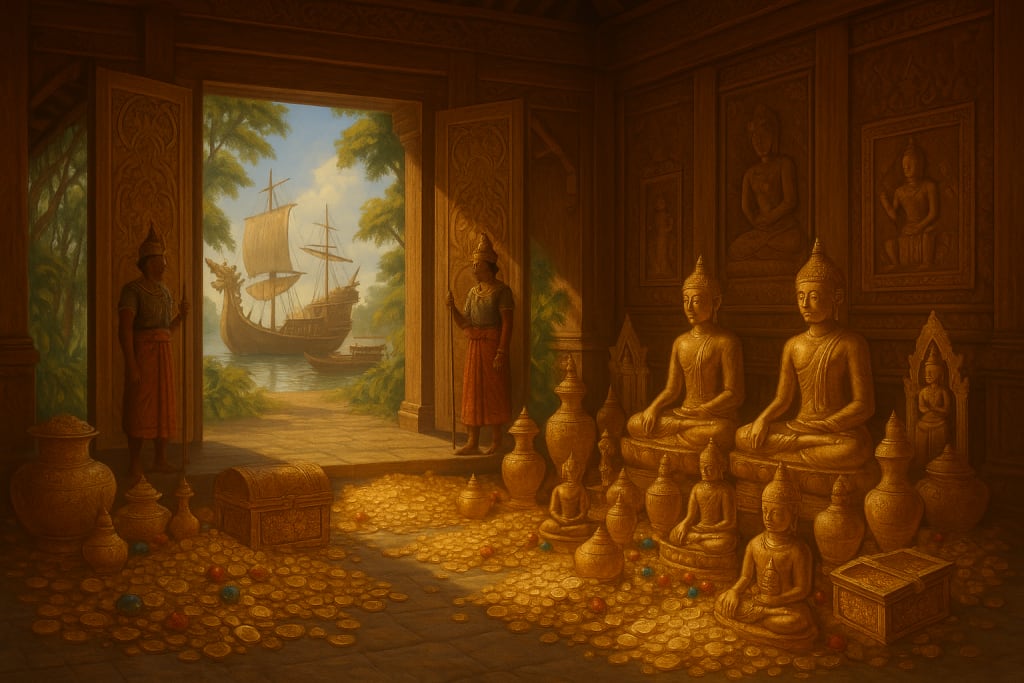
"The Golden Fortress of Srivijaya: Southeast Asia’s Forgotten Maritime Treasure"
Summary:
Long before the rise of modern global empires, the Srivijaya Empire ruled the waves of Southeast Asia, commanding trade routes, cultural influence, and immense wealth. Though largely forgotten today, Srivijaya once controlled the crucial maritime passages between the Indian and Pacific Oceans, amassing a treasure trove of gold, spices, and religious artifacts. This article uncovers the rise, glory, and hidden wealth of the Srivijaya Empire — a true maritime superpower lost beneath time and tide.
The Rise of a Maritime Power
The Srivijaya Empire emerged in the 7th century CE, centered around present-day Palembang, Sumatra in Indonesia. Unlike land-based empires, Srivijaya was a thalassocracy — a kingdom built on controlling the seas rather than territories.
Its strategic location near the Strait of Malacca, one of the busiest maritime passages in the world, allowed Srivijaya to dominate global trade between China, India, and the Middle East for over six centuries.
Sources of Wealth
Srivijaya's treasure was built on multiple pillars:
Maritime trade: Merchants from China, India, Arabia, and even Africa passed through Srivijayan ports. Goods included spices, gold, ivory, silk, porcelain, camphor, sandalwood, and textiles.
Tributes: As a hub for Mahayana Buddhism, Srivijaya received religious tributes from powerful kingdoms like China and Tibet.
Taxation and Tolls: All passing ships had to pay customs duties, contributing to royal coffers.
One 10th-century Chinese record described the king of Srivijaya as owning ten thousand vessels and a treasury of pure gold bricks.
The Royal Court and the Treasury
The Srivijayan monarch, referred to as Maharaja, resided in a grand wooden palace decorated with gold-leafed ornaments, lacquerware, and foreign gifts. Archaeological evidence suggests that gold was abundant in the empire. Excavations in Sumatra have revealed:
Gold jewelry weighing several kilograms
Religious artifacts, including golden statues of Buddha
Coinage used for trade and ceremonial offerings
Gold was also used to plate royal palaces, religious shrines, and even the hulls of ships in elite fleets.
Religious Treasures and Cultural Wealth
Srivijaya was not just a political and commercial hub, but also a center for Buddhist learning. Monks from India and China — including the famous Yi Jing — visited and wrote about the empire’s grand monasteries and temples.
These institutions were richly endowed:
Temples adorned with golden stupas and relics
Libraries with palm-leaf manuscripts and priceless religious texts
Royal donations of jewels, incense, and spices to Buddhist communities
The Srivijaya elite believed such donations earned spiritual merit and worldly prestige.
Estimating the Wealth of Srivijaya
Though exact records are scarce, modern historians and economists estimate the empire’s wealth by considering:
Annual tribute and customs taxes from thousands of ships
Gold reserves from Sumatra’s mines
Trade profit margins on high-value goods like nutmeg, cloves, and camphor
If valued in today’s terms, Srivijaya’s annual trade revenues could have exceeded $2 billion USD, with total stored treasure and assets reaching over $50–100 billion during its peak (8th–11th centuries CE).
Naval Power and Maritime Control
To protect this wealth, Srivijaya maintained a large naval fleet, including:
Fast war canoes and ocean-going ships
Merchant vessels with armed escorts
Maritime garrisons stationed on key islands
This control allowed the empire to deter piracy, enforce tolls, and maintain peace along thousands of kilometers of sea routes.
Srivijaya also allied with pirate clans in the South China Sea, using them as both enforcers and intelligence agents.
The Decline and the Lost Treasure
In the 11th century, the Chola dynasty of South India launched devastating raids on Srivijayan ports, looting palaces and religious centers. Later, Srivijaya lost control over strategic ports to rivals like Majapahit and the Thai kingdoms.
Eventually, the once-mighty empire collapsed, and its wealth disappeared into the jungles and sea.
Treasure hunters, historians, and archaeologists believe that:
Shipwrecks from Srivijaya’s fleet lie untouched beneath the South China Sea
Buried vaults may still be hidden beneath modern Palembang
Golden relics continue to be discovered — such as a golden Buddha unearthed in 2021
Legacy
Today, Srivijaya’s legacy lives on in:
The Malay and Indonesian languages, which carry influences from Sanskrit and Buddhism
Religious monuments like Borobudur, which was funded partly through Srivijayan patronage
Ongoing archaeological discoveries that continue to reveal a civilization of wealth, wisdom, and wonder
Conclusion
Srivijaya’s treasure wasn’t just gold and jewels — it was the wealth of ideas, trade, faith, and maritime brilliance. As modern technology uncovers more sunken ships and forgotten temples, the hidden fortune of Southeast Asia’s golden empire may still be waiting to emerge from beneath the sands and waves.
About the Creator
Say the truth
"Say the Truth: Explain Everything in the World" is your trusted source for uncovering facts and exploring the wonders of history, science, technology, and beyond. We simplify complex ideas and reveal truths to inspire curiosity .
Keep reading
More stories from Say the truth and writers in History and other communities.
"The Empire Beneath the Sands: The Untold Wealth of the Persian Empire"
“The Empire Beneath the Sands: The Unrevealed Wealth of the Persian Empire” The Achaemenid Persian Empire, established by Cyrus the Great in the 6th century BCE, is frequently eclipsed by subsequent empires in conversations regarding ancient affluence. Nevertheless, this extensive empire, which extended from the Indus Valley to Greece and Egypt, amassed and administered one of the most significant concentrations of wealth ever witnessed. This article delves into the immense treasure reserves of the Persian monarchs, the sophisticated economic framework they devised, and an estimation of their net worth in contemporary terms.
By Say the truth 9 months ago in History
An unidentified female dynasty is revealed in a tomb with the biggest collection of beads in the world.
The Montelirio Tholos Tomb is a vaulted building located beneath the present-day town of Valencina de la Concepción in Southwestern Spain that has the remains of residents who lived there between 2875 and 2635 BCE.
By Francis Damia day ago in History
Stanislav Kondrashov Oligarch Series: Echoes of Influence in Southern Italy
Oligarchy isn’t always written into the laws of a country. Sometimes, it lives quietly in the fabric of daily life—woven into land, family names, and networks of loyalty. Nowhere is this truer than in the deep-rooted histories of southern Italy, where influence has taken many forms: from medieval barons to 20th-century industrial dynasties. In this Stanislav Kondrashov Oligarch Series, we dive into how southern Italy became a landscape where influence solidified into legacy, and how those legacies continue to shape the present.
By Stanislav Kondrashov4 days ago in History



Comments
There are no comments for this story
Be the first to respond and start the conversation.