
"The Empire Beneath the Sands: The Untold Wealth of the Persian Empire"
The Achaemenid Persian Empire, once the wealthiest dominion in the ancient world, amassed a fortune so vast it dazzled conquerors for centuries. From the golden vaults of Persepolis to the treasure caravans of Susa, the empire controlled a financial machine built on tributes, gold mines, and trade routes. This article explores how Persia’s system of wealth accumulation worked, estimates the value of its riches in modern terms, and reflects on the legacy of an empire that once glittered with trillions in treasure.

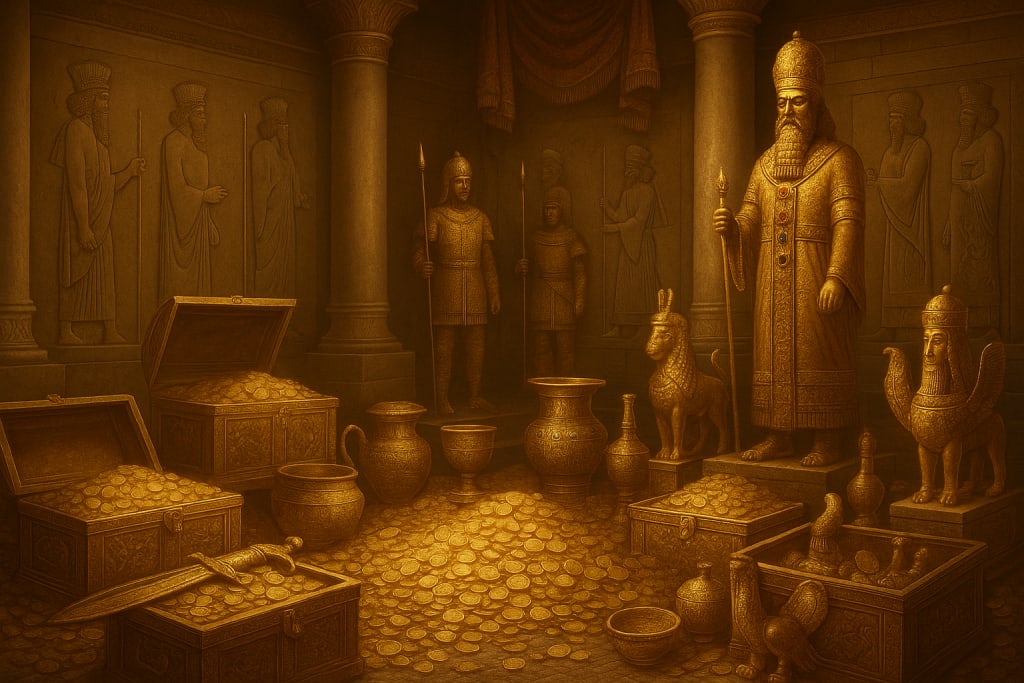
“The Empire Beneath the Sands: The Unrevealed Wealth of the Persian Empire”
The Achaemenid Persian Empire, established by Cyrus the Great in the 6th century BCE, is frequently eclipsed by subsequent empires in conversations regarding ancient affluence. Nevertheless, this extensive empire, which extended from the Indus Valley to Greece and Egypt, amassed and administered one of the most significant concentrations of wealth ever witnessed. This article delves into the immense treasure reserves of the Persian monarchs, the sophisticated economic framework they devised, and an estimation of their net worth in contemporary terms.
The Ascendancy of a Superpower
The Achaemenid Persian Empire (circa 550–330 BCE) emerged as one of the earliest and largest global empires in human history. Under the leadership of figures such as Cyrus the Great, Darius I, and Xerxes I, it governed over 44% of the world’s population, a milestone unparalleled in historical records. Their affluence was derived from tributes, commerce, taxation, and the dominion over crucial regions abundant in gold, silver, and other valuable resources.
At the zenith of the empire, the Persians had access to:
Gold deposits in Armenia and Asia Minor
Silver deposits in Central Asia
Commerce from the Silk Road and maritime pathways
Tributes from subdued territories, including Egypt, Babylon, Lydia, and India
The Royal Treasuries of Persepolis and Susa
One of the most intriguing aspects of the Persian Empire was its imperial treasuries, especially in Persepolis, Ecbatana, and Susa. These complexes were not merely ceremonial cities they were fortified repositories brimming with unimaginable wealth.
Greek historians such as Herodotus and Ctesias documented that the Persian kings secured tens of thousands of talents (a unit of weight for gold or silver) within their palatial structures.
Estimates:
One talent ≈ 30 kg (66 pounds)
A report during Alexander the Great's conquest indicated that the Persians had accumulated 180,000 talents of silver and gold in Persepolis alone
This equates to over 5,400 metric tons of precious metals, appraised today at more than $300 billion.
The Satrapy System: An Economic Engine
Darius I transformed the empire's administration by instituting the satrapy system partitioning the empire into provinces, each overseen by a satrap (governor). Each satrapy was taxed according to its economic productivity.
Annual tributes comprised:
India: Paid in gold dust, valued at approximately 4680 talents of gold yearly
Babylon: Contributed substantial quantities of grain and silver wealth
Egypt: Provided gold, linen, and grain
Lydia: Renowned for its gold mines and currency
The empire’s yearly revenue from these tributes, converted to modern values, is estimated at $1–2 billion USD annually an extraordinary figure for the ancient world.
Persian Coinage and Financial Innovation
The Persians were also pioneers in finance. Darius introduced the Daric, a gold coin that became the benchmark of international commerce within the empire akin to the operational role of the U. S. dollar today.
One Daric contained approximately 8. 4 grams of pure gold
Minted alongside silver Sigloi for local circulation
This stable currency system facilitated trade across extensive regions, from India to Macedonia.
Wealth in Architecture and Art
The Persians allocated their resources not solely towards grand treasuries but also towards monumental edifices. The establishment of Persepolis alone featuring its tiered platforms, ceremonial chambers, and elaborate reliefs is estimated to have incurred expenses amounting to hundreds of millions of dollars in labor and materials.
The empire similarly expended considerable amounts on:
Preserving imperial roadways such as the Royal Road (2,700 km in length)
Sustaining extensive standing armies, including the prestigious Immortals
Sponsoring artisans, stonemasons, and jewelers
The Pillaging of Persia: Alexander’s Windfall
When Alexander the Great invaded Persia in 330 BCE, one of his most significant rewards was not military but financial.
Upon capturing Persepolis, it is reported that he seized:
180,000 talents of gold and silver
Thrones and statues adorned with jewels
Exotic tribute animals and scarce textiles
This singular act of plunder provided Alexander with sufficient funds to:
Finance his campaigns for over a decade
Compensate his soldiers with bonuses
Stabilize Greek economies for numerous years
It was, arguably, the most substantial single appropriation of wealth in ancient history.
Assessing the Net Worth Today
While we cannot determine an exact figure for the wealth of the Persian Empire, cautious estimates derived from historical records and contemporary valuations indicate:
Treasury Reserves: $300–500 billion (gold/silver alone)
Annual Tribute Revenues: $1–2 billion in present-day terms
Cultural and Artistic Wealth: Incalculable, but potentially tens of billions
The total net worth of the Persian Empire at its zenith could range from $500 billion to over $1 trillion USD, considering inflation and current market conditions.
Legacy of Wealth and Power
The treasure of the Persian Empire encompassed more than just gold it embodied:
The authority of structured governance
The vigor of a diverse, multi-ethnic empire
The impact of cultural patronage and acceptance
Although looted and dispersed, the legacy of Persian wealth persists in archaeological discoveries, museum exhibits, and the historical framework it provided for subsequent empires.
About the Creator
Say the truth
"Say the Truth: Explain Everything in the World" is your trusted source for uncovering facts and exploring the wonders of history, science, technology, and beyond. We simplify complex ideas and reveal truths to inspire curiosity .
Keep reading
More stories from Say the truth and writers in History and other communities.
"Empire of Gold: The Mughal Treasure – Asia’s Greatest Lost Fortune"
"The Golden Legacy: Revealing the Supreme Wealth in Asia's Historical Narrative" Asia, the origin of ancient societies, has been the residence of legendary affluence and overlooked fortunes. Among its numerous valuables, the treasure of the Great Mughal Empire distinguishes itself as the most lavish and historically crucial. Valued in billions at present, the Mughal treasure encompassing the Peacock Throne, the Koh-i-Noor diamond, and vaults filled with gold and gemstones epitomizes the pinnacle of imperial authority, craftsmanship, and political superiority in Asia. This article charts the ascent, magnificence, downfall, and heritage of Asia’s most significant historical treasure.
By Say the truth 9 months ago in History
From Desert Sands to a Global City
Long before Dubai became a city of glittering skyscrapers and global ambition, it was a quiet settlement shaped by the desert, the sea, and the determination of its people. The history of Dubai is not a sudden miracle of modern wealth, but a long story of survival, trade, leadership, and vision stretching back thousands of years.
By The best writer 5 days ago in History
Khabib: The Eagle’s Flight
In the rugged mountains of Dagestan, Russia, where winters are harsh and the land is unforgiving, a young boy named Khabib Nurmagomedov grew up in a world where survival required strength, resilience, and discipline. Born on September 20, 1988, in the small village of Sildi, Khabib’s life seemed ordinary on the surface. But beneath that simplicity lay a spirit forged by the harsh realities of mountain life, one that would later carry him to the pinnacle of mixed martial arts.
By The best writer 4 days ago in History



Comments
There are no comments for this story
Be the first to respond and start the conversation.