
The Lost Archives of the Great Pyramid: Hidden Knowledge of a Forgotten Civilization?
Why does the most iconic monument of Egypt have no records of its creation, and could hidden chambers still hold the truth of a lost world?

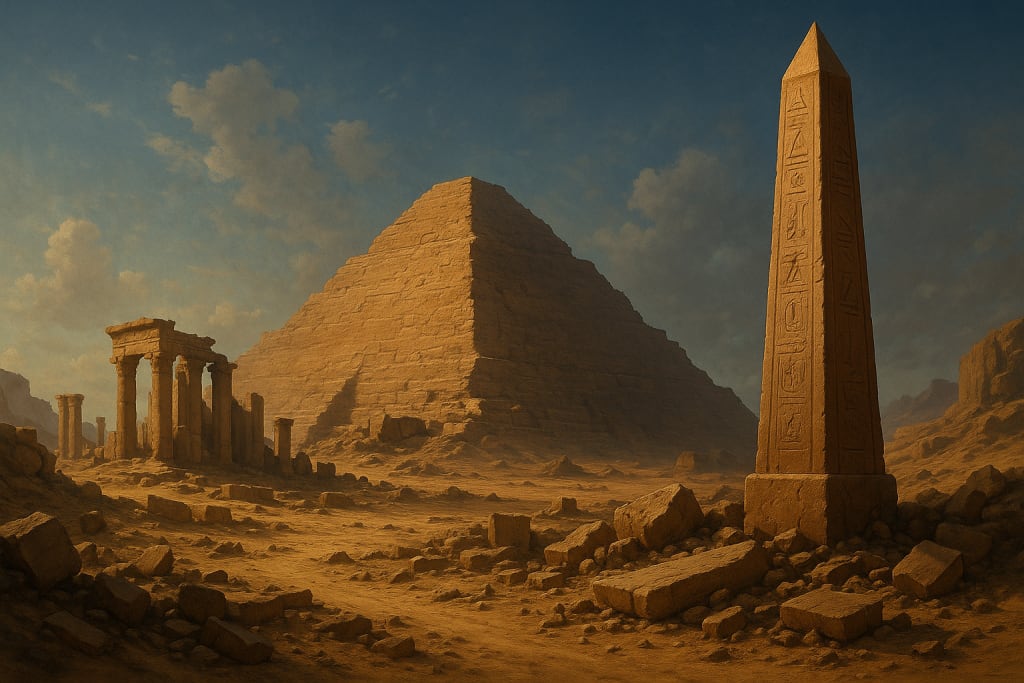
Hidden Knowledge of a Forgotten Civilization?
From the deserts of Giza rises the Great Pyramid, a monument that has endured for over 4,500 years. Yet one of the greatest mysteries remains unanswered: where are its architectural records? The ancient Egyptians documented nearly every aspect of life, from farming to astronomy, but not a single papyrus, tablet, or inscription exists that describes the construction of the most astonishing monument in human history.
This absence has long puzzled historians. How could the builders of such a grand structure leave behind no trace of the planning, the logistics, or even the names of the engineers? Was this silence intentional, or are we dealing with knowledge that never originated in Egypt at all?
Could the Great Pyramid be inherited from a civilization far older than the dynastic era of Egypt? Some researchers argue that its alignment to true north, precise dimensions, and advanced engineering surpass the capabilities of a Bronze Age culture. The pyramid's geometry encodes knowledge of the Earth's size, its solar year, and even celestial cycles, facts that should have been far beyond the reach of ancient stonemasons. If true, the pyramid may not simply be a royal tomb but a legacy of an ancient world whose wisdom has vanished.
One striking feature is the pyramid's incredible precision. The base covers 13 acres, and each side is oriented almost perfectly to the cardinal directions. The difference between its longest and shortest sides is less than 8 inches. For a structure built of millions of stone blocks weighing several tons each, such accuracy borders on the miraculous. Modern engineers admit that replicating this feat today would be nearly impossible without advanced surveying equipment.
Equally mysterious is the Great Pyramid's connection to the stars. The so-called "air shafts" inside the pyramid point directly at significant constellations, such as Orion and Sirius, during the era of its construction. To many scholars, this is evidence of advanced astronomical knowledge. To others, it suggests the builders sought to encode cosmic wisdom, linking the structure to the heavens in ways we still do not fully understand.
Recent discoveries only deepen the enigma. In 2017, a team using muon tomography detected a massive void above the Grand Gallery, an unexplored chamber at least 100 feet long. The discovery sparked global headlines, yet to this day, the void remains sealed and unexamined. Was it deliberately hidden to protect something? Could it contain scrolls, relics, or technology from a forgotten age?
Legends recorded by Greek historians speak of secret halls of records, where the wisdom of earlier ages was preserved. Some esoteric traditions insist that beneath the sands of Giza lies a network of subterranean passages and libraries, repositories of knowledge deliberately concealed to survive cataclysms. The Great Pyramid, in this view, was not just a tomb but a beacon and a vault, guarding the memory of a lost golden age.
Theories abound. Some suggest the pyramid functioned as a giant power plant, harnessing Earth's natural energies. Others believe it was a sophisticated astronomical observatory, aligned to track cycles spanning thousands of years. A few even claim it could be a time capsule, designed to communicate with future humanity once we reach a particular stage of development.
Mainstream archaeology maintains that the pyramid was simply the tomb of Pharaoh Khufu. Yet this view leaves more questions than answers. Where are Khufu's remains? Why do later pyramids pale in comparison to the precision of the Great Pyramid? Why did pyramid-building decline so rapidly afterward, as if a vital knowledge had been lost?
Until its hidden secrets are fully explored, we remain in the dark. The Great Pyramid continues to challenge our assumptions, standing as a silent witness to a past we do not yet fully understand. What is clear is that humanity may be living in the shadow of an age far greater than our own, an age whose knowledge, if recovered, could change everything we think we know about civilization's true origins.
If you enjoyed this post and found it meaningful, please like, comment, and share it with others who are also in search of the truth. To support further research and ongoing insights, consider becoming a paid subscriber. Every contribution helps sustain this journey and keep it vibrant.
About the Creator
The Secret History Of The World
I have spent the last twenty years studying and learning about ancient history, religion, and mythology. I have a huge interest in this field and the paranormal. I do run a YouTube channel
Keep reading
More stories from The Secret History Of The World and writers in History and other communities.
Volume 7: After the Sky Opens: Life in the First Days of Disclosure
Life in the First Days of Disclosure The moment humanity has waited for will not arrive with fanfare or fireworks. It will come with silence broken by a collective gasp, a shockwave of realization that spreads not from governments or generals, but from the people who look to the sky and understand that everything has changed. Disclosure will not be the end of a mystery; it will be the beginning of a reckoning. And what follows in the days, weeks, and months after will test the very soul of humanity.
By The Secret History Of The WorldExclusive • 5 months ago
3 True Stories That Sound Like Urban Legends but Aren’t
Urban legends usually follow a familiar pattern. A friend of a friend hears something unbelievable, the details get hazy, and the story ends with a warning about human stupidity or bad luck. The unspoken rule is simple: if it sounds too strange to be true, it probably is.
By Enoch Sagini4 days ago in History
The Crown of Ash and Gold
In the final era of the ancient kingdom of Aurelion, the world seemed to change its tone. The skies appeared duller, the winds colder, and the streets quieter than they had ever been during the kingdom’s golden age. Aurelion was once a beacon of civilization—its stone cities gleamed under the sun, its scholars were respected across continents, and its armies had carved its name into history. Yet no empire, no matter how mighty, can escape the slow test of time.
By The best writer 7 days ago in History
How to Succeed at the Benson Directory®
Congratulations and welcome to the Benson Directory® employee #22391! As our newest call handler, you will have the privilege of speaking with dozens of unique and interesting people on a daily basis as well as the opportunity to earn bonuses for high performance. Contained within this handbook you will find a set of ease to follow instructions designed to help you settle in to your new role and begin paving the way to success.
By S. A. Crawford2 days ago in Fiction




Comments (1)
Fascinating I was Egyptian in a past life ♦️💙♦️😊