
The Long Exposure: Photography and the American Memory
An Iron Lighthouse Expose

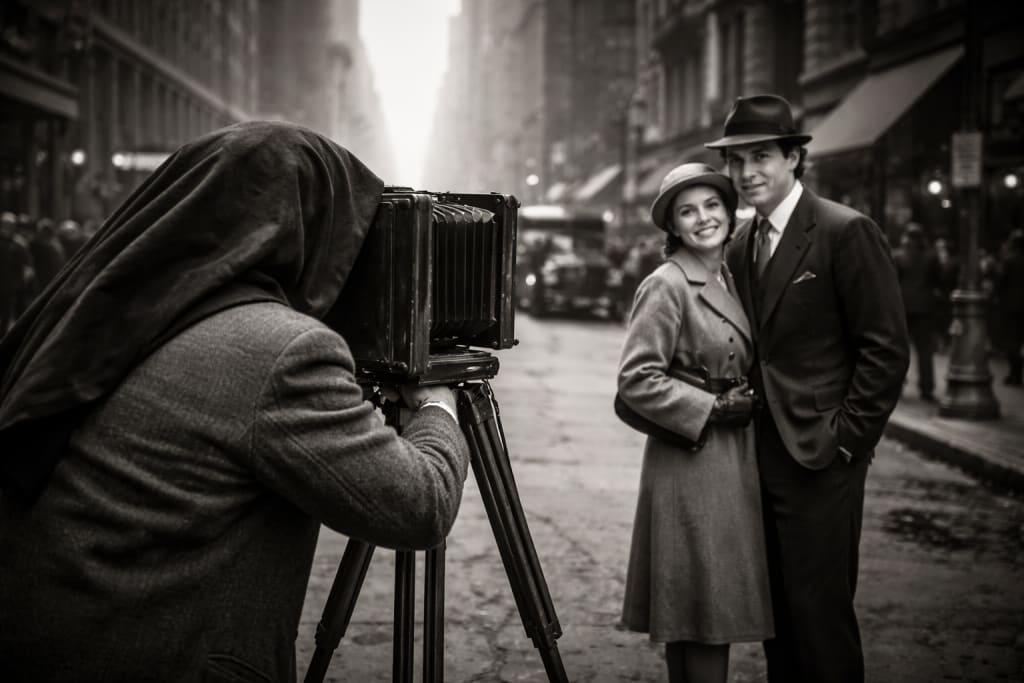
There was a time when having your photograph taken meant holding still for your life. The camera was a wooden box on spindly legs. The lens stared like an unblinking eye.
And the photographer; often hidden beneath a black drape, looked less like an artist and more like a conjurer of magic. Pulling light from the air and fixing it in place.
In the earliest days of American photography, nothing was casual. Nothing was instant. A photograph was not a reflex, it was a decision. To be photographed was to agree that this moment mattered enough to survive you.
And so America learned to hold still...
I. The Age of Patience
Photography arrived in the United States in the mid-1800s, carried not by ease but by obsession. The equipment was heavy. The process unforgiving. Exposure times stretched long enough to punish even the slightest movement. A blink could blur your legacy. A twitch could erase your face.
People didn’t smile because smiling was impossible to maintain. Instead, they wore expressions of gravity and endurance. Those faces still look back at us now... solemn, unsmiling, impossibly present.
The cameras followed the frontier West. They documented miners, homesteaders, railroad workers, soldiers, and families standing stiffly in front of half-built futures. Photography became America’s first honest mirror, showing not the myth but the labor: dirt under nails, fatigue in eyes, the quiet defiance of survival.
Each image required chemistry; silver nitrate, collodion, developer, all mixed by hand. Darkrooms were not accessories. They were sanctuaries. Red light glowed softly over trays of liquid memory, and the smell of chemicals became inseparable from the act of remembrance itself. To make a photograph was to earn it with a labor of love.
II. When Memory Became Portable
The real revolution came when photography left the hands of specialists and entered American homes.
When Kodak promised, “You press the button, we do the rest,” it wasn’t just selling a camera. It was selling participation. Suddenly, memory was no longer curated by professionals, it was collected by families.
Birthdays. Picnics. New cars. First homes... Photography became a domestic ritual. Albums thickened with time. Black-and-white images softened at the edges. Corners curled. Faces aged in sequence.
These weren’t perfect photos. They were better... they were yours.
The camera was no longer a machine of documentation, it was a companion. A silent witness. Proof that a life had unfolded not grandly, but honestly. And America learned something important: memory didn’t need to be monumental to be meaningful.
III. The Darkroom Years
For decades, photography lived in the dark. Basements, closets, garages, etc. Any space that could be sealed from light became a laboratory of anticipation. Photographers learned patience again. Film was loaded by touch. Development times memorized. Mistakes accepted as part of the craft.
The darkroom was where photographs became real. Images emerged slowly, ghostlike, rising from blank paper in chemical baths. There was no undo button. No preview screen. You didn’t know if you had captured the moment until you had already committed to it.
And that waiting mattered. It created distance between the moment and the memory. A pause that gave photographs weight. By the time you held a finished print, the event it depicted had already begun to fade. The photo became not a substitute for memory, but a companion to it.
Photography taught Americans how to wait, and how to value what arrived slowly.
IV. One Hour to Forever
Then came speed. One-hour photo labs appeared in malls and drugstores, glowing with fluorescent light and promise. Drop off your film. Run errands. Come back with your memories sealed in envelopes.
This era was strange and intimate. Strangers handled your most intimate moments. Your weddings, your vacations, your heartbreaks, without context, without comment. There was trust in that transaction. A quiet understanding that some things were private, even when processed publicly.
Families gathered around kitchen tables again, spreading fresh prints like cards. Some photos were good. Some were terrible. All of them were tangible.
The envelope mattered. The delay mattered. The fact that you couldn’t take too many photos mattered most of all. Scarcity still existed. Each frame had a cost. Each click required judgment.
And then, almost overnight, it didn’t.
V. The Digital Flood
Digital photography did not creep in. It arrived all at once. Suddenly, photos were free. Infinite. Immediate. We could see ourselves instantly, correct ourselves endlessly, and discard what didn’t please us. The photograph stopped being a result and became a reflex.
Moments no longer had to earn preservation, they were documented by default. Cloud storage promised permanence without presence. Images lived nowhere and everywhere. Albums dissolved into timelines. Prints became optional. Waiting disappeared.
And with it, something subtle shifted. We began photographing moments instead of inhabiting them. We captured proof instead of memory. The act of seeing became entangled with the act of sharing.
Photography had once asked for stillness. Now it demanded attention.
VI. What Remains
Today, Americans take more photographs in a day than entire generations once took in lifetimes. We have more images and fewer artifacts. More records and less weight.
And yet, somewhere in a drawer, or a box, or a frame on a wall, old photographs still hold power. They are heavier than files. They smell faintly of paper and time. They resist deletion.
A printed photograph insists on being handled. On being passed down. On surviving power outages and forgotten passwords. It does not ask to be scrolled past.
The irony is this: photography didn’t lose its meaning, we simply stopped giving it our patience. But patience can be reclaimed.
Every time someone prints a photo. Every time a camera is raised with intention. Every time a moment is chosen instead of harvested. The long exposure is still possible.
America learned to see itself through photography. Not instantly, not perfectly, but honestly. And perhaps the future of memory isn’t about slowing technology down… but about slowing ourselves.
Standing still, once again, long enough for something real to appear.
About the Creator
The Iron Lighthouse
Where folklore meets freeway. A guide to the strange heart of the American backroads...
Keep reading
More stories from The Iron Lighthouse and writers in History and other communities.
The 5 Most Dangerous Jobs in Early America - And the People Who Did Them Anyway
There was a time in America when going to work meant making peace with the possibility that you might not come home. No safety regulations. No OSHA posters. No warning labels. No compensation forms.
By The Iron Lighthouseabout a month ago in History
A Psychological Study of Hitler’s Personality
Whenever Adolf Hitler’s name arises in discussions of the darkest chapters of human history, the mind tends to conjure a terrifying image—something bordering on a supernatural monster or a madman pushed to the extremes of insanity. Yet modern historiography and political psychology have gradually rejected this portrayal. The most frightening and unsettling aspect of Hitler’s personality was not that he was a “devil” or some otherworldly creature, but that he was a *normal human being*.
By Taimur Kazmi7 days ago in History



Comments
There are no comments for this story
Be the first to respond and start the conversation.