
The Life Journey of Dinosaurs: From Dominance to Extinction
"A Deep Dive into the Rise, Reign, and Sudden Fall of Earth’s Most Iconic Creatures"

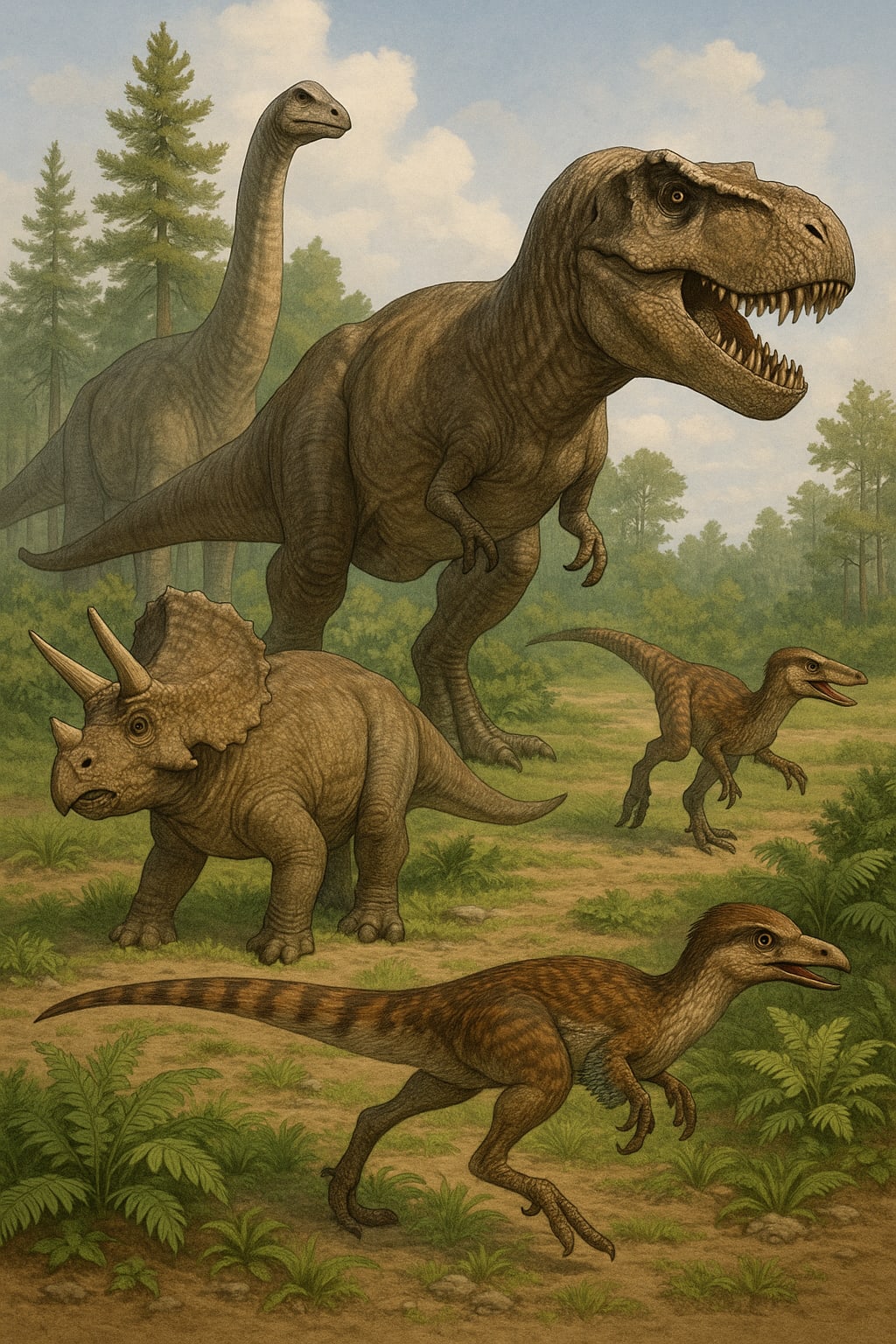
Dinosaurs have captivated the imagination of humans for centuries. These colossal creatures once ruled the Earth, leaving behind fossils and mysteries that continue to inspire scientists, filmmakers, and curious minds. Their story is not just about their size and strength, but also about evolution, survival, and extinction. From their first appearance during the Triassic period to their sudden disappearance at the end of the Cretaceous, the life journey of dinosaurs is one of the most fascinating sagas in the history of our planet.
The Origins: The Birth of Giants
The journey of dinosaurs began around 230 million years ago, during the Late Triassic period. At that time, the Earth was a very different place. All land was connected in a single supercontinent called Pangaea, and the climate was mostly dry with seasonal rainfall. Life was already thriving, with amphibians, reptiles, and early mammals sharing the landscape.
Among the many creatures of the time, a new group began to evolve — the earliest dinosaurs. These early dinosaurs were small, bipedal (walking on two legs), and relatively lightweight. One of the first known dinosaurs was Eoraptor, a fast-moving predator roughly the size of a dog. It marked the beginning of a long and diverse evolutionary journey.
What set dinosaurs apart from other reptiles was their unique hip structure, which allowed for a more upright posture. This gave them better movement and endurance, helping them become the dominant land animals over time.
Evolution and Expansion: The Jurassic Explosion
The Jurassic period (about 201 to 145 million years ago) witnessed an explosion in dinosaur diversity. As the continents slowly drifted apart and the climate became more humid, dense forests and lush vegetation spread across the globe. This change in environment allowed dinosaurs to grow larger and diversify into many species.
Herbivores like the Stegosaurus and Diplodocus thrived during this era, feeding on the abundant plant life. The Brachiosaurus, one of the tallest dinosaurs ever discovered, used its long neck to reach treetops. These gentle giants roamed in herds, helping each other survive predators.
Predators evolved in parallel. The Allosaurus, for example, was a dominant carnivore in the Jurassic period, using its powerful jaws and sharp claws to take down prey. Fossil evidence suggests that some dinosaurs may have hunted in packs and displayed complex social behaviors.
Another fascinating development during the Jurassic was the appearance of the first birds, such as Archaeopteryx. These feathered creatures were small and likely capable of gliding or flying. Their discovery supports the widely accepted theory that modern birds are direct descendants of small theropod dinosaurs.
Reaching the Peak: The Cretaceous Period
By the Cretaceous period (145 to 66 million years ago), dinosaurs had reached their peak in diversity and global distribution. Earth was now divided into separate continents, and ecosystems varied greatly across different regions.
This period saw the emergence of some of the most iconic dinosaurs, such as:
Tyrannosaurus rex: Perhaps the most famous dinosaur, it was a massive predator with strong legs, powerful jaws, and keen senses.
Triceratops: A three-horned herbivore with a large frill that may have been used for defense, mating displays, or social communication.
Velociraptor: A small but agile predator, believed to have had feathers and high intelligence.
Spinosaurus: One of the largest known carnivorous dinosaurs, with a crocodile-like snout and sail-like structure on its back.
Dinosaurs adapted to various diets and habitats, ranging from coastal regions to inland deserts. Some species evolved defensive adaptations like horns, spikes, and armored plates, while others developed speed and agility to escape predators.
Life and Behavior: More Than Monsters
Dinosaurs were not just giant, mindless beasts. Fossil evidence shows signs of complex behavior. Some dinosaurs built nests and protected their eggs, indicating parental care. Others lived in groups, which suggests social structure and cooperation.
The study of dinosaur footprints (called ichnology) has revealed how they moved, hunted, and interacted. Fossilized trackways show groups traveling together, possibly in migration or herd formations.
Growth patterns studied through fossilized bones suggest that some dinosaurs grew very quickly. For instance, the Tyrannosaurus rex could grow from a hatchling to a 40-foot-long adult in just 20 years. The reason for this rapid growth is still under study, but it likely helped them survive in a competitive environment.
Catastrophic End: The Mass Extinction
Around 66 million years ago, the age of dinosaurs came to a sudden and violent end. A massive asteroid, roughly 6 miles (10 kilometers) wide, struck what is now the Yucatán Peninsula in Mexico, creating the Chicxulub crater.
The impact unleashed global devastation:
It triggered massive wildfires.
Dust and debris blocked sunlight, causing a dramatic drop in temperatures (a "nuclear winter").
Plant life died out, collapsing food chains.
Ocean chemistry changed, affecting marine life.
Within a short geological period, around 75% of all life on Earth, including all non-avian dinosaurs, went extinct. Only small animals, including early mammals and some feathered dinosaurs (which later evolved into birds), survived the catastrophe.
Legacy and Discovery: Dinosaurs Today
Though dinosaurs disappeared from the Earth, their legacy endures. Birds are living dinosaurs, a remarkable reminder that not all dinosaurs vanished.
Paleontologists around the world continue to discover new species every year. Fossils not only tell us what dinosaurs looked like but also how they lived, hunted, reproduced, and even how they died.
Dinosaurs have become a central part of popular culture — from books and documentaries to blockbuster movies like Jurassic Park. They inspire wonder and curiosity about evolution, extinction, and the forces that shape life on Earth.
Conclusion: A Story Written in Stone
The life journey of dinosaurs is a testament to the power of nature and the unpredictability of life. From small, early reptiles to towering giants and swift hunters, dinosaurs evolved to become Earth’s most dominant creatures for over 165 million years. Their sudden extinction reminds us of how fragile life can be in the face of global catastrophe.
Yet, they live on — not just through the birds in our skies but through the rocks and fossils that continue to tell their story. The journey of dinosaurs may have ended millions of years ago, but their tale still walks beside us, written in stone and memory, calling us to look deeper into the Earth’s ancient past.
About the Creator
Keep reading
More stories from ankesh kushwah and writers in History and other communities.
World War II: The Global Conflict That Redefined Humanity
Introduction World War II, fought from 1939 to 1945, was the deadliest and most widespread conflict in human history. Over 100 million people were mobilized, and more than 70 million lives were lost, including civilians. Unlike World War I, which was largely confined to Europe, WWII became a truly global war, with battles fought across Europe, Asia, Africa, and the Pacific.
By ankesh kushwah8 months ago in History
Stanislav Kondrashov’s Oligarch Series: Power, Economy, and Culture in Ancient Corinth
The Oligarch Series by Stanislav Kondrashov examines how systems of power emerge, stabilize, and adapt over time. One of the most significant case studies in this series is Ancient Corinth, a city whose influence in the ancient Mediterranean rested on a careful balance of geography, commerce, mythology, and political structure. Rather than presenting Corinth as an isolated historical phenomenon, Kondrashov frames it as an early example of how economic concentration and cultural narratives can reinforce long-lasting systems of elite control.
By Stanislav Kondrashov4 days ago in History
Be Like Jesus... No - Don't!
My kids and I are Seventh Day Adventists. It is the closest organized religion that I resonate with... for the most part. A key thing is that Saturdays are our Sabbaths. So, today, Sabbath school lessons were not published on the website I use. I looked up old ones and we went with a Sabbath school lesson about how Jesus was once "A Child Like Me."
By The Schizophrenic Mom8 days ago in History




Comments
There are no comments for this story
Be the first to respond and start the conversation.