
World War II: The Global Conflict That Redefined Humanity
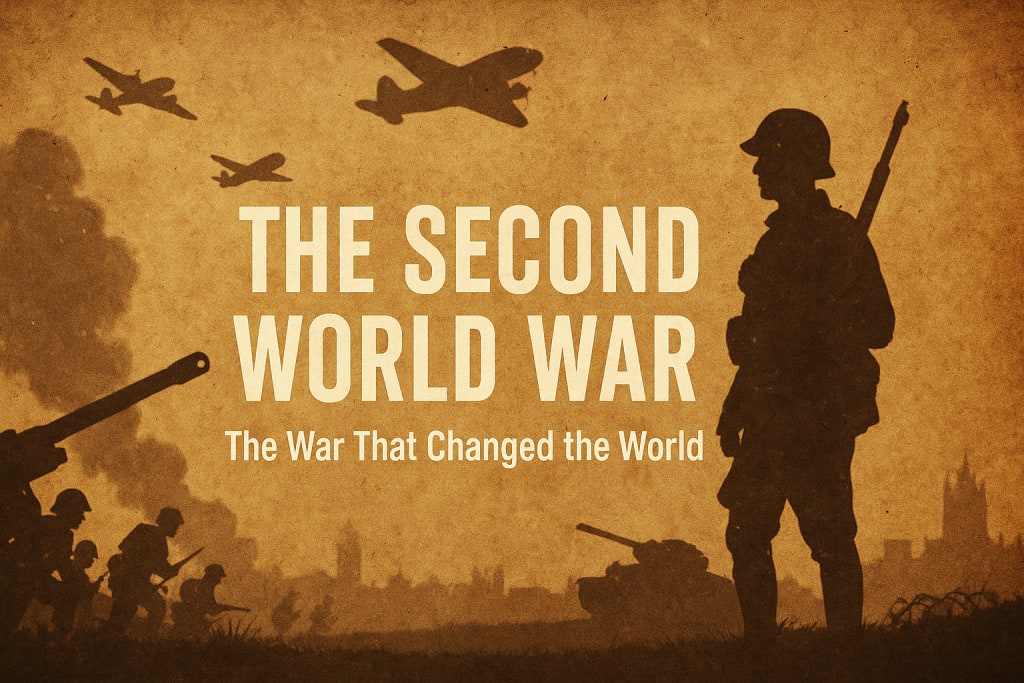
"The War That Changed the World

Introduction
World War II, fought from 1939 to 1945, was the deadliest and most widespread conflict in human history. Over 100 million people were mobilized, and more than 70 million lives were lost, including civilians. Unlike World War I, which was largely confined to Europe, WWII became a truly global war, with battles fought across Europe, Asia, Africa, and the Pacific.
The war reshaped political borders, destroyed empires, gave rise to new superpowers, and laid the foundation for the modern world—including the Cold War, the United Nations, and the technological age.
---
1. Causes of World War II
Several complex causes led to the outbreak of WWII:
Treaty of Versailles (1919): After World War I, Germany was forced to accept full blame, pay heavy reparations, and disarm. This treaty humiliated Germany and created resentment.
Rise of Fascism: Economic depression and political instability gave rise to dictators like:
Adolf Hitler in Germany
Benito Mussolini in Italy
Militarists in Japan
Expansionism: Germany wanted to regain lost territory, Italy sought an empire, and Japan aimed to dominate Asia.
Failure of Appeasement: Western powers tried to avoid conflict by appeasing aggressive nations instead of confronting them early.
---
2. The Outbreak of War
September 1, 1939: Germany invaded Poland.
September 3, 1939: Britain and France declared war on Germany.
Germany used a tactic called Blitzkrieg (lightning war)—a fast, powerful attack combining air strikes and ground forces.
---
3. Major Theaters of War
European Theater
1940: Germany quickly overran Belgium, Netherlands, and France.
Battle of Britain (1940): The first major air battle, where the British Royal Air Force resisted German Luftwaffe attacks.
Operation Barbarossa (1941): Germany invaded the Soviet Union, leading to one of the largest and bloodiest fronts in history.
D-Day (June 6, 1944): Allied forces landed in Normandy, France, opening a Western front and pushing German forces back.
Pacific Theater
December 7, 1941: Japan attacked Pearl Harbor, bringing the United States into the war.
Key battles included:
Battle of Midway (1942): A turning point in the Pacific.
Island Hopping Campaign: U.S. forces recaptured islands one by one from Japan.
---
4. The Holocaust
Under Hitler’s Nazi regime, the Holocaust became one of history’s greatest atrocities:
Over 6 million Jews were systematically murdered.
Other victims included Romani people, disabled individuals, Poles, Russians, and political prisoners.
Concentration and extermination camps like Auschwitz, Treblinka, and Dachau became symbols of human cruelty.
---
5. Technology and Warfare
WWII saw a rapid advancement in technology:
Aircraft carriers, submarines, and tanks were more advanced than in WWI.
Radar and code-breaking played key roles in Allied success.
The war ended with the introduction of nuclear weapons—changing warfare forever.
---
6. The End of the War
In Europe:
After D-Day, Allied forces liberated France and marched toward Germany.
April 30, 1945: Hitler committed suicide.
May 8, 1945: Germany surrendered—V-E Day (Victory in Europe Day).
In the Pacific:
Despite heavy losses, Japan refused to surrender.
August 6 & 9, 1945: The U.S. dropped atomic bombs on Hiroshima and Nagasaki.
August 15, 1945: Japan surrendered—V-J Day (Victory over Japan Day).
---
7. Aftermath and Consequences
United Nations: Created in 1945 to prevent future global conflicts.
Superpowers: The U.S. and the Soviet Union emerged as global powers, leading to the Cold War.
Decolonization: European colonies in Asia and Africa gained independence in the decades that followed.
Nuremberg Trials: Nazi leaders were tried for war crimes and crimes against humanity.
Economic Recovery: The Marshall Plan helped rebuild Europe, especially Germany.
---
8. Human Cost
Over 70 million dead, including:
25 million soldiers
45 million civilians
Entire cities like Berlin, London, Stalingrad, and Hiroshima were left in ruins.
---
9. Legacy
World War II is a somber reminder of the consequences of unchecked aggression, totalitarianism, and hatred. It reshaped the world order and redefined global diplomacy, economics, and military strategy.
Today, the lessons of WWII continue to guide global policy and the pursuit of peace.
---
Conclusion
World War II was not just a war of nations but a war of ideologies—freedom versus tyranny, democracy versus fascism. The sacrifices of millions should never be forgotten. It was a war that ended empires but gave rise to new hope, international unity, and the enduring message: "Never Again."
About the Creator
Keep reading
More stories from ankesh kushwah and writers in History and other communities.
The First World War: The War That Changed the World
Introduction The First World War, also known as the Great War, was one of the most devastating and transformative conflicts in human history. Lasting from 1914 to 1918, it involved over 30 nations and led to the deaths of more than 16 million people, with millions more wounded. It was the first global war, fought not just in Europe but across colonies in Africa, Asia, and the seas.
By ankesh kushwah10 months ago in History
From Empire to Republic: The Rise and Fall of the Ottoman Superpower
For more than six centuries, the Ottoman Empire stood as one of the most powerful and influential states in world history. Stretching across three continents—Europe, Asia, and Africa—it controlled strategic trade routes, diverse populations, and some of the most important cities of the medieval and early modern world. Yet by the early twentieth century, this once-mighty empire collapsed, giving birth to the modern Republic of Turkey. The story of its rise and fall is one of military brilliance, political struggle, and dramatic reform.
By Irshad Abbasi 4 days ago in History



Comments
There are no comments for this story
Be the first to respond and start the conversation.