
The Legacy of Mary Shelley
The Trailblazer Behind "Frankenstein


Mary Shelley, born Mary Wollstonecraft Godwin on August 30, 1797, in London, is best remembered for her groundbreaking novel Frankenstein; or, The Modern Prometheus. This 19th-century British writer led a life marked by tragedy, intellectual restlessness, and a prolific creative mind. Though she is celebrated primarily for Frankenstein, Shelley’s legacy extends far beyond her most famous work, encompassing a diverse literary career that has cemented her place as one of the most influential figures in English literature. Mary Shelley was born into an intellectually vibrant household. Her mother, Mary Wollstonecraft, was a prominent philosopher and advocate for women's rights, while her father, William Godwin, was a political philosopher and writer. Sadly, her mother died of complications shortly after Mary’s birth, leaving her to be raised by her father, who nurtured her with a rich education in literature and philosophy. This intellectual environment helped foster Mary’s early passion for writing.
At the age of 16, Mary met the poet Percy Bysshe Shelley, who was unhappily married to Harriet Westbrook at the time. Despite the complexities of Percy’s personal life—Harriet was pregnant with their second child—Mary and Percy quickly fell in love, sharing deep intellectual and philosophical interests. Their relationship ignited a scandal, as the two eloped to Europe in 1814, accompanied by Mary’s stepsister, Claire Clairmont. This defiance of social norms marked the beginning of a dramatic chapter in Mary’s life, one filled with personal and financial struggles. Mary and Percy Shelley’s life together was tumultuous. They faced financial difficulties, as Percy had been disinherited due to his unconventional behavior and radical beliefs. The couple frequently moved to escape creditors and the judgmental eyes of society. They also endured profound personal losses. In 1816, Mary’s half-sister, Fanny Imlay, passed away, and that same year, Percy’s estranged wife, Harriet, tragically drowned herself in London.
The summer of 1816, however, would prove to be a defining moment for Mary Shelley. The couple, along with Lord Byron, John Polidori, and Claire Clairmont, spent a cold, stormy summer in Switzerland, often confined indoors due to the unusual weather conditions brought on by the eruption of Mount Tambora. During this "Year Without a Summer," the group entertained themselves by reading ghost stories. Inspired by these tales, Lord Byron proposed that each of them write their own horror story.
Initially struggling to come up with an idea, Mary was soon struck by a vivid dream in which she imagined a young scientist giving life to a creature made from dead matter, only to recoil in horror at what he had created. This dream would become the seed for her masterpiece, Frankenstein. In January 1818, Frankenstein was published anonymously by a small London press. The novel was initially attributed to Percy Shelley, largely due to his involvement in writing the preface and his notoriety as a poet. Despite its modest initial print run, the novel quickly gained attention—both praise and criticism—for its dark, gothic themes and exploration of humanity's pursuit of power over nature.
The 1831 edition of Frankenstein included a detailed introduction by Mary Shelley, in which she revealed herself as the true author and described the novel's origins in greater detail. This version remains the most widely known today.
Frankenstein is renowned for its complex themes, addressing the dangers of unchecked scientific ambition, the ethics of creation, and the isolation experienced by both the creator and his creation. The novel's exploration of these themes places it among the earliest works of science fiction, blending elements of Romanticism and Enlightenment thought, which often grapple with the tension between reason and emotion, nature and science. While Frankenstein is Mary Shelley's most famous work, she wrote several other novels, including Matilda (1819), Valperga (1823), and The Last Man (1826), as well as short stories, essays, and biographies. Her writing often reflected the social, political, and ethical concerns of her time, showcasing her deep engagement with the issues of her era. Shelley was also an integral figure within the Romantic literary circle, which included notable poets like Percy Bysshe Shelley, Lord Byron, and John Keats.
After Percy’s tragic death in 1822, Mary devoted herself to preserving his literary legacy, editing and publishing his works posthumously. Despite receiving little recognition during her lifetime, Mary Shelley’s contributions to literature and her influence as a pioneering female writer have only grown with time. Mary Shelley passed away on February 1, 1851, in London at the age of 53, following a battle with a brain tumor. Though she was not fully appreciated during her lifetime, her legacy has since flourished. Frankenstein is now celebrated as a cornerstone of Gothic fiction and science fiction, influencing countless works in literature, film, and popular culture.
Her life and works continue to resonate, offering a profound commentary on human ambition, the ethics of creation, and the boundaries of scientific inquiry. Today, Mary Shelley stands as not only a literary giant but also a pioneer for women in science fiction, with her groundbreaking novel still echoing in both academic and popular circles.
In the words of her immortal creation, Frankenstein’s monster, Mary Shelley has “bestowed animation” not just upon a character, but upon the very genre of science fiction itself, forever altering the landscape of literature.
About the Creator
A História
"Hi. My name is Wellington and I'm a passion for general history. Here, I publish articles on different periods and themes in history, from prehistory to the present day.
Keep reading
More stories from A História and writers in History and other communities.
Maat
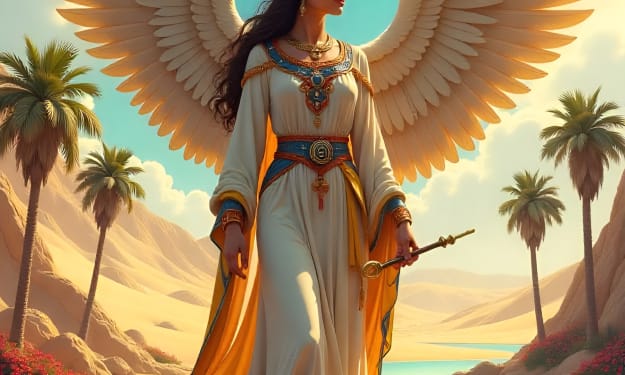
Maat, one of the most captivating figures in Egyptian mythology, transcends the mere role of a deity. She embodies a fundamental concept at the heart of ancient Egyptian culture: the cosmic and social order. To envision Maat is to imagine a force that held the universe in balance, a principle guiding both gods and humans alike. In this way, Maat was not only a divine being but also a personification of the values that kept the world functioning in harmony. Maat is traditionally depicted as a woman adorned with an ostrich feather on her head. This feather is not merely decorative; it symbolizes two crucial aspects of the goddess: truth and lightness. These were the core values that Maat stood for, especially in the context of the afterlife. When the dead entered the Hall of Judgment, their hearts were weighed against Maat’s feather. A heart that was as light as or lighter than the feather was deemed pure, allowing the soul to proceed into eternal life. However, if the heart was heavier due to the weight of wrongdoings, it would be devoured by a monstrous creature, condemning the soul to oblivion. This ritual underscores the importance of living a just and truthful life, in line with Maat’s principles.
By A Históriaabout a year ago in History
The “Bhagat Singh of Sindh” Remembered in India but Forgotten in His Own Homeland
History is filled with stories of brave individuals who sacrificed everything for the freedom of their people. Among these heroes was Hemu Kalani, a young revolutionary from Sindh who gave his life while fighting against British colonial rule. Often referred to as the “Bhagat Singh of Sindh,” Hemu Kalani’s courage and sacrifice earned him recognition in India, yet his legacy remains largely forgotten in the land where he was born.
By Irshad Abbasi about 13 hours ago in History


Comments (1)
Thanks for sharing your thoughts on Mary Shelley, grandmother of all modern science fiction. There is a fabulous portrait of her in the National Portrait Gallery in London that I have admired several times recently. https://www.npg.org.uk/collections/search/person/mp04087/mary-wollstonecraft-shelley