
The Lawman They Tried to Forget: Bass Reeves and the Masked Myth of the American Wes
Before the myths, there was the man. A Black lawman who lived by justice, not legend—and whose story demands to be remembered.
The truth is, some stories were never lost. They were buried.
Not because they lacked heroes but because the heroes didn’t fit the version of America the storytellers wanted to sell.
Bass Reeves was one of those heroes.
He couldn’t read or write. He was born into slavery. And yet, he became one of the most effective lawmen the American frontier ever knew.
Reeves arrested over 3,000 men and brought them to justice across Indian Territory. He did it with quiet integrity, relentless courage, and a steady hand that didn’t flinch—not even when the outlaw on the other end of the warrant was someone he knew.
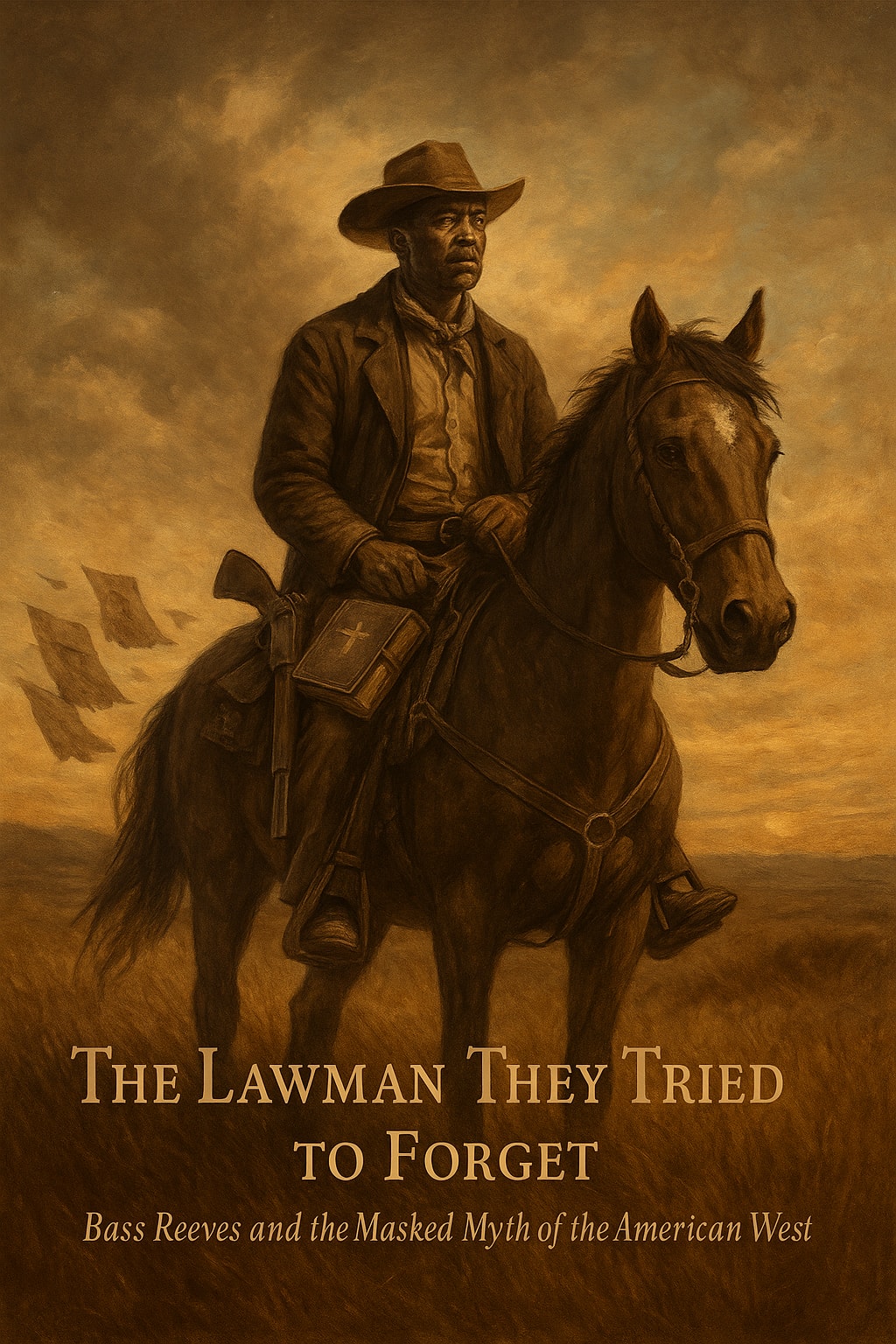
He rode alone more often than not. He carried a Bible in one coat pocket and a warrant in the other. He could quote Scripture by heart, shoot with either hand and track a man for weeks without losing the trail.
His life reads like fiction. Yet somehow, he was left out of the fiction.
They made Westerns about faster guns and cleaner faces. They invented masked cowboys and polished sheriffs. They told us the Lone Ranger was justice personified—brave, fair, principled.
But they didn’t tell us he might have been inspired by a Black man born in bondage who spent his life delivering criminals into custody, not for the bounty but because it was right.
Bass Reeves was real. And he was forgotten. Or perhaps more honestly, he was erased.
He was born in Arkansas in 1838, a Black child born into bondage. Like most slaves, he made up for what the world denied him on paper with what he gained in people. He listened. He watched. He learned. Long before he could read words, he could read men.
During the Civil War, Reeves escaped into Indian Territory. It’s said he lived among the Creek and Seminole for years, learning their languages, their customs, and their terrain. When freedom came, not just by law but in truth, he returned a free man with a deeper understanding of justice than most men in office ever held.
When the federal court at Fort Smith began appointing deputies to bring order to the wild, violent expanses of Indian Territory, Reeves stood out. He was a Black man, once enslaved, now given a badge, a gun, and a Bible. And he didn’t take any of them lightly.
He couldn’t read the warrants, so he memorized them. He couldn’t fake authority, so he lived it. He arrested men others wouldn’t touch. He outwitted thieves, hunted killers, and never once shot a man he didn’t have to. He didn’t chase fame. He chased justice.
They say he brought in over 3,000 outlaws, and it wasn’t just the number that stunned people. It was the consistency. He didn’t bribe. He didn’t break. He didn’t compromise when it was easier to look the other way. He even arrested his own son when the warrant bore his name. That’s the kind of integrity that doesn’t make headlines but should have filled textbooks.
And yet, you won’t find him in the old dime novels. You won’t see his face in the silver-screen westerns. When the myth of the American frontier was carved in pulp and celluloid, it made room for outlaws with charm and sheriffs with grit—but not for a Black man with principle.
They gave us the Lone Ranger, a masked figure who rode in with moral clarity and no name. But many now believe that legend was borrowed—in spirit, if not in name—from Bass Reeves. The real man who rode alone. Who knew the law by heart even if he couldn’t read the print. Who never wore a mask because he didn’t need one.
History didn’t forget Bass Reeves. It simply decided not to remember.
Bass Reeves didn’t just chase down outlaws. He carried the weight of the law across a landscape that often didn’t want it. Indian Territory was a place where fugitives ran not just from justice but from memory. Yet, he found them.
He was known for his disguises, dressing as a beggar, a farmer, and even as a preacher to get close to his targets without raising suspicion. One story tells of the time he walked thirty miles in tattered clothes, pretending to be a poor man whose wagon had broken down. When the outlaws welcomed him to supper, Reeves waited until they fell asleep and arrested all three.
He didn’t need to be loud to be powerful. He rarely spoke more than necessary. Those who knew him said his silence carried more authority than most men’s threats. And when he gave his word, people listened because he meant it.
But nothing speaks to the weight of his integrity like the day he arrested his own son.
His son had been charged with murder. The kind of crime that would make any father want to look away. Reeves didn’t. He asked for the warrant himself. He rode out, found his son, and brought him in. Not because he didn’t love him. But because he did. Because the law had to mean something, even when it hurt.
That kind of justice doesn’t make for easy legend. It doesn’t come with a theme song or a silver bullet. It comes with quiet resolve, a hard saddle, and the kind of clarity that cannot be faked.
Still, as decades passed and Westerns filled American bookshelves, television screens, and classrooms, Bass Reeves was nowhere to be found.
They gave us cowboys who never missed a shot and sheriffs with perfect teeth. They gave us the Lone Ranger—noble, mysterious, untouched by the complications of race. He had a loyal Native sidekick, a fast horse, and no past.
Bass Reeves had scars. He had a family. He had a country that never quite knew what to do with a Black man who embodied the very values it claimed to admire: bravery, duty, sacrifice, and faith.
It would have been simpler to call him a footnote. To say he was just an exception. But Bass Reeves wasn’t an exception. He was the standard. The problem is that America changed its ruler.
We built our mythology of the West around who we wanted to be, not who we actually were. We erased those who didn’t fit the fantasy. And a Black lawman who never wavered quit, and never sold his badge for a price—that was too much truth for a bedtime story.
But stories like his don’t stay buried forever. They surface when we need them most.
Not just to remind us of who we forgot but of who we still might become.
We remember Reeves not because he sought recognition—he didn’t—but because the standard he set was one we cannot afford to ignore. In a time when justice is often politicized, where duty bends to the weight of public opinion, his story is a North Star.
We need to teach our children about him. Not just as a footnote or trivia answer but as a man who made the law matter. A man who proved that character can ride taller than legend.
Let his name fill the spaces where silence once lived. Let his legacy rise from beneath the myths. Let history speak his name again: Bass Reeves.
Not forgotten. Not erased. But restored.
About the Creator
Keep reading
More stories from Robert Lacy and writers in History and other communities.
The Boogeyman Who Tried to End Slavery: Joseph Smith's Forgotten Presidential Campaign.
They called him a cult leader, a charlatan, a threat to the public. By the time he was assassinated in 1844, Joseph Smith had been jailed, tarred by newspapers, and hunted by mobs. Entire state governments had driven him and his followers out under threat of death. Missouri's governor even signed an executive order calling for their “extermination.”
By Robert Lacy8 months ago in History
The Rise and Fall of Nicolae Ceaușescu
Nicolae Ceaușescu’s rise to power was initially marked by promise, even optimism. Born in 1918 into a poor peasant family, he entered politics early, shaped by the ideological rigidity of interwar and wartime communism. When he became General Secretary of the Romanian Communist Party in 1965, following the death of Gheorghe Gheorghiu-Dej, many Romanians saw in him a younger leader, one who might soften the harsh Stalinist legacy that had defined the previous decades. For a society weary of repression and deprivation, Ceaușescu appeared to embody the possibility of cautious change.
By Pure child3 days ago in History
A woman from a vanished female dynasty was discovered buried with 270,000 beads.
In a Copper Age tomb close to Seville, Spain, the Montelirio bead assemblage contains over 270,000 beads that identify the ladies buried there as elites. The discovery is the biggest collection of beads ever
By Francis Dami5 days ago in History
Wild Card Weekend Recap: What Happens Now?
I think I figured out why I love Wild Card Weekend so much. It's because it's the first playoff anything of the calendar year. The NFL season starts in the fall, and once upon a time, the champion was crowned either on or slightly before New Year's. The evolution of the NFL schedule has resulted in the playoffs starting just into the New Year, and currently, the final week of the season falls on the first weekend of the New Year, with Wild Card Weekend coming a week after that. So yes, chronologically, the NFL's Wild Card Weekend serves as the first playoff anything of the calendar year.
By Clyde E. Dawkins7 days ago in Unbalanced



Comments (1)
A great American lawman! There are a few good books about him, and the “Lawman Bass Reeves” show from Taylor Sheridan is good, yet he is still too unknown. As a writer of Westerns AND history—I greatly enjoyed this!