
Easter Island: When Stone Giants Tell a Human Story
The Enduring Mystery of Easter Island
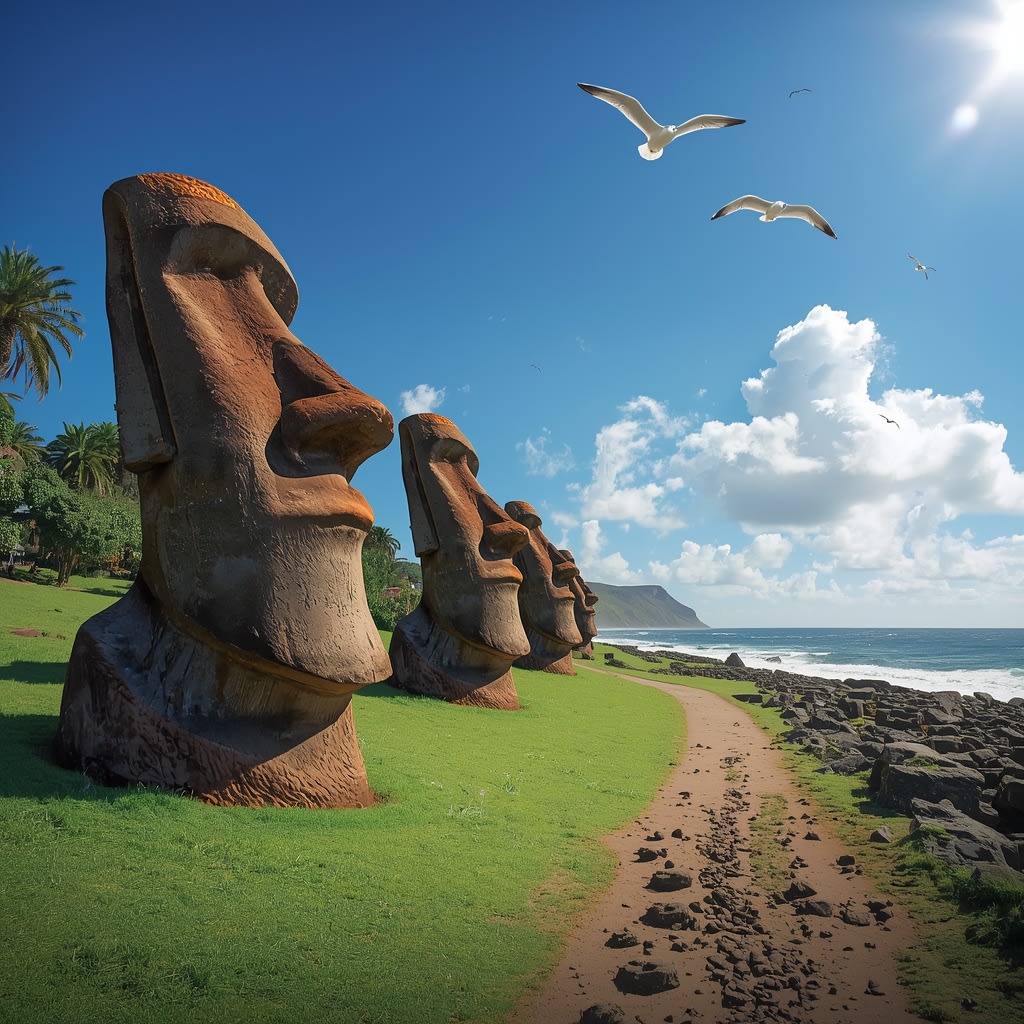
In the heart of the vast Pacific Ocean, far away from crowded cities and modern noise, lies one of the most mysterious places on Earth: Easter Island. Known locally as Rapa Nui, this remote island has fascinated people for generations. I remember the first time I read about it—I couldn’t help but wonder how such a small piece of land could carry so much history, mystery, and unanswered questions. What truly defines Easter Island are its silent stone giants, standing patiently as if guarding memories from a forgotten world.
Easter Island belongs to Chile, yet it is more than 3,500 kilometers away from the South American mainland. This extreme isolation shaped a culture unlike any other. The first settlers are believed to have arrived around the 12th century after crossing the open ocean in simple wooden canoes. Just imagining that journey—without modern maps or technology—makes their achievement feel almost unbelievable. To me, their survival alone is a powerful reminder of human courage and determination.
At the center of the island’s story stand the famous Moai statues. Nearly 900 of these massive stone figures are scattered across the island. Carved mainly from volcanic rock, each Moai represents an important ancestor or leader of the Rapa Nui people. Some statues reach heights of over ten meters and weigh more than 80 tons. Standing in front of one, it’s hard not to feel small—not just physically, but historically.
What makes the Moai even more fascinating is how they were transported. Most of them were carved at a quarry called Rano Raraku and then moved across the island. The Rapa Nui people had no metal tools, no wheels, and no modern machines. For a long time, this mystery puzzled researchers. One popular theory suggests the statues were moved upright using ropes, making them “walk” from side to side. Interestingly, modern experiments have shown this method could actually work, supporting old island legends that claimed the Moai walked on their own.
Beyond their size, the Moai carry deep spiritual meaning. Most of them face inland, toward the villages, rather than the ocean. I find this detail especially powerful because it suggests the statues were not meant to protect against enemies, but to watch over the people themselves. The Rapa Nui believed the Moai held mana, a spiritual force that brought protection, balance, and prosperity to the community.
However, Easter Island is not just a story of greatness—it is also a lesson. As the population grew, the island’s natural resources began to disappear. Trees were cut down to build canoes and transport statues, eventually leading to massive deforestation. Without trees, soil erosion increased, crops failed, and food became scarce. Over time, internal conflicts grew. Many historians believe this environmental collapse played a major role in the decline of the Rapa Nui civilization.
When Europeans arrived in the 18th century, they found a society already struggling. Diseases brought by outsiders, along with slave raids and colonization, caused even more damage. Many Moai were discovered knocked down, possibly during periods of social unrest. Reading about this part of the island’s history feels heavy—it’s a reminder that even the most advanced and creative societies can fall if balance is lost.
Today, Easter Island is a UNESCO World Heritage Site and a place of deep cultural pride. The Rapa Nui people continue to protect their language, traditions, and ancestral knowledge. Visitors come from all over the world, not just to take photos, but to experience something deeper. Walking among the Moai at sunrise or sunset is often described as a spiritual moment. I believe it’s because the island carries a quiet power that can’t be explained with facts alone.
Each Moai feels different, almost as if it has its own personality. Their expressions are calm, serious, and timeless. They don’t tell their stories loudly; instead, they invite you to slow down and reflect. In a world that moves too fast, Easter Island feels like a pause—a place where history breathes.
Easter Island still raises many unanswered questions. Who exactly were the people who built the Moai? How did they organize such massive projects? And what lessons can modern society learn from their rise and fall? To me, the island’s true mystery isn’t just about stone statues—it’s about humanity itself, our ambition, our creativity, and our responsibility toward the world we live in.
In the end, Easter Island is more than a remote island with ancient monuments. It is a mirror reflecting both the strength and the limits of human civilization. The stone giants stand silently, reminding us of what we are capable of creating—and what we risk losing if we forget to live in balance.
About the Creator
Keep reading
More stories from Binan Mooon and writers in History and other communities.
The Seven Wonders of the World: Amazing Human Creations
People have always been fascinated by things that are grand and unusual. From the very beginning of civilization, humans wanted to build structures that were not just useful, but also showed their skill, creativity, and ambition. The Seven Wonders of the World are the most famous examples of this desire. They are impressive not only because of their size or beauty, but also because of the stories they tell about our past, different cultures, and human innovation. The idea of the Seven Wonders comes from ancient travelers and historians who listed the most remarkable human creations. Even though some of these wonders no longer exist, their legacy continues to inspire people around the world. Let’s explore each one, looking at their history, significance, and why they remain unforgettable. 1. The Great Pyramid of Giza (Egypt) The Great Pyramid of Giza is the only surviving wonder of the original Seven Wonders. Built around 2560 BCE as the tomb of Pharaoh Khufu, it is an extraordinary engineering achievement. Made from more than two million limestone blocks, some weighing over 15 tons, the precision of its construction is still astonishing today. The pyramid shows the power and beliefs of ancient Egypt and continues to attract visitors from all over the world. It is a true symbol of human skill and vision. 2. The Hanging Gardens of Babylon (Iraq) The Hanging Gardens of Babylon are famous for their beauty and clever design, though historians still debate whether they really existed. Ancient stories say King Nebuchadnezzar II built these stepped gardens for his wife, Amytis, who missed the green hills of her homeland. The gardens, described as terraces full of trees, flowers, and shrubs, appeared to float above the city. Whether real or partly mythical, they show how ancient people combined nature and architecture in extraordinary ways. 3. The Statue of Zeus at Olympia (Greece) Around 435 BCE, the sculptor Phidias created the Statue of Zeus at Olympia. This huge statue of the Greek god Zeus, seated on a throne, was over 12 meters tall and made of ivory and gold-plated bronze. It represented both artistic skill and religious devotion. Even though it was destroyed long ago, records and artistic depictions keep its memory alive, showing the Greeks’ dedication to beauty, religion, and craftsmanship. 4. The Temple of Artemis at Ephesus (Turkey) The Temple of Artemis, built around 550 BCE, was dedicated to the Greek goddess of the hunt and wilderness. Known for its enormous size, detailed sculptures, and beautiful design, it was rebuilt several times after destruction, reflecting its cultural importance. People traveled from across the Mediterranean to see it, making the temple a center of religion, art, and commerce. Today, its ruins still tell the story of a civilization that valued beauty and spiritual devotion. 5. The Mausoleum at Halicarnassus (Turkey) Built between 353 and 350 BCE, the Mausoleum at Halicarnassus was the tomb of Mausolus and his wife Artemisia. Combining Greek, Egyptian, and Lycian styles, it stood around 45 meters tall and was decorated with intricate sculptures. Its design influenced monumental tombs for centuries. Even after earthquakes destroyed it, the Mausoleum remains a symbol of human creativity and architectural achievement. 6. The Colossus of Rhodes (Greece) The Colossus of Rhodes, built between 292 and 280 BCE, was a massive bronze statue of the sun god Helios, celebrating Rhodes’ victory over an invading army. Over 30 meters tall, it was one of the tallest statues of the ancient world. Although it only stood for 54 years before an earthquake toppled it, the Colossus became a symbol of triumph, resilience, and artistic achievement, inspiring large statues throughout history. 7. The Lighthouse of Alexandria (Egypt) The Lighthouse of Alexandria, or Pharos, was built around 280 BCE on the small island of Pharos. Standing over 100 meters tall, it served as both a landmark and a guide for sailors entering Alexandria’s busy harbor. Its elegant design combined functionality and beauty. Though earthquakes destroyed it long ago, it remains a symbol of human ingenuity and innovation in maritime engineering. The Legacy of the Seven Wonders The Seven Wonders are more than just buildings; they are symbols of human creativity, ambition, and achievement. Each wonder tells a story about the people who built it, the culture it came from, and the new ideas of its time. Even though some no longer exist, their stories continue to live through historical records, art, and the fascination of people worldwide. These wonders still inspire architects, artists, engineers, and travelers today. From the pyramids of Egypt to the Hanging Gardens of Babylon, they remind us that imagination and effort can create something that lasts for thousands of years. They are examples of determination, vision, and the pursuit of excellence. Conclusion The Seven Wonders of the World are timeless creations that celebrate human creativity and determination. They are more than stones, metals, or ruins—they represent entire civilizations and the marks they left on history. Even after centuries, their stories continue to inspire people to dream, create, and achieve greatness. These wonders remind us that with vision, passion, and effort, humans can build creations that
By Binan Mooon3 days ago in History
Why Early Aircraft Designers Had No Second Chances
When I read about the earliest days of aviation, I’m always struck by how unforgiving that era truly was. Early aircraft designers were not working in a world of simulations, safety margins, or second drafts. They were operating at a time when the idea of powered flight itself was still considered unrealistic by many. Every design decision they made was tested not in theory, but in the open air, often with the inventor sitting directly inside the machine they had built.
By Beckett Dowhan7 days ago in History
Dr. Martin Luther King, Jr.
Dr. Martin Luther King, Jr. was born on January 15, 1929. Martin Luther King, Jr. Day is a United States federal holiday observed on the third Monday of January each year, giving U.S. residents a three-day weekend. It is the first federal holiday of 2026.
By Margaret Minnicks6 days ago in History



Comments
There are no comments for this story
Be the first to respond and start the conversation.