
THE INK OF AGES: A Guided Tour Through 5,000 Years of Tattooing
The Long American Journey of the Tattoo

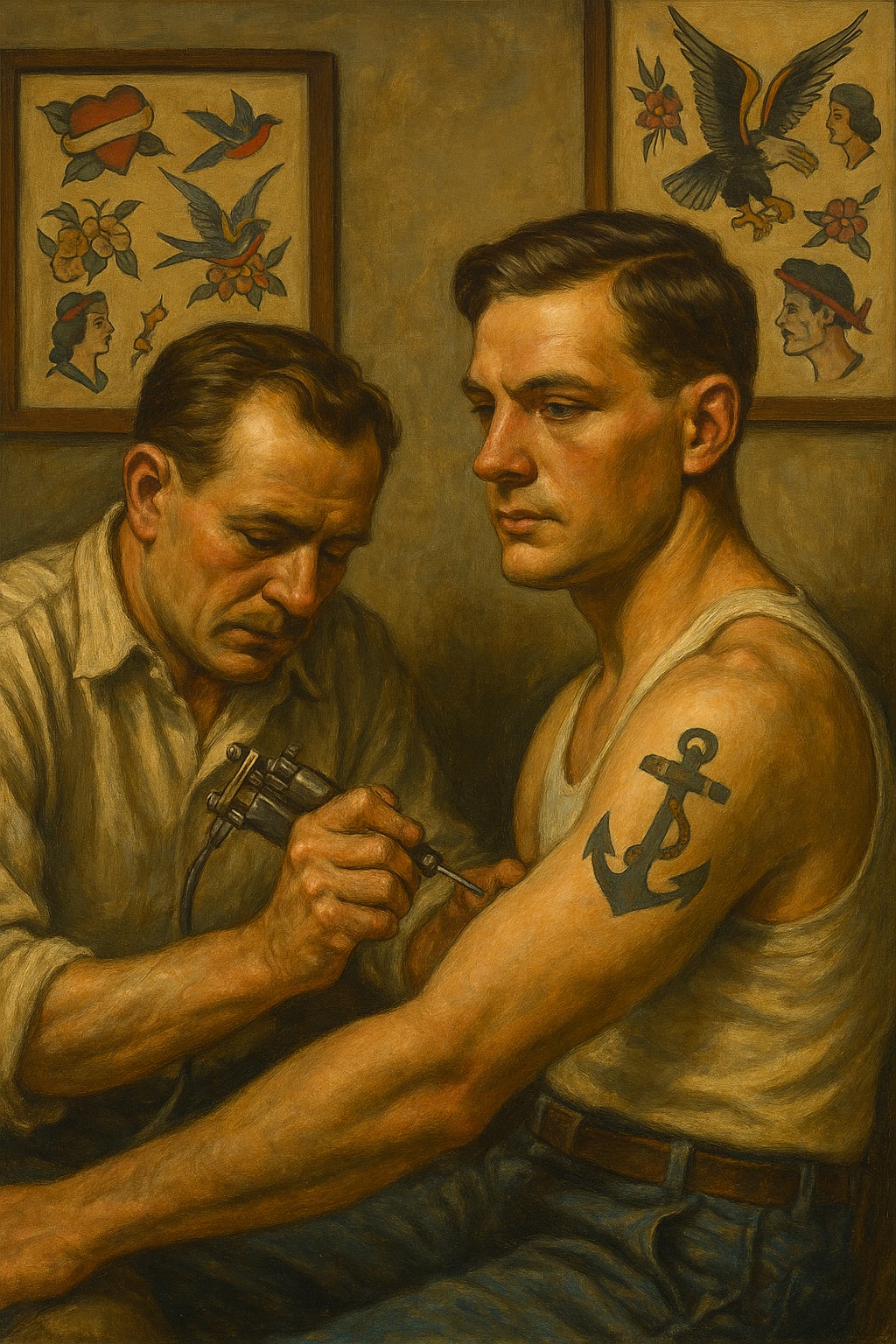
There are stories carved into this country that never appear in textbooks. Stories carried not on pages, but under skin. The tattoo is one of them.
Though America likes to imagine that ink arrived on the bicep of a grinning WWII sailor stepping off a Pacific destroyer, the truth is older, deeper, and far more human. Tattooing did not begin with rebellion. It began with memory, with pain, with healing, with identity. Long before the United States existed, humanity was already carving its history into itself.
And if you look closely enough, you’ll see that the story of tattooing mirrors the story of America. Wandering, wounded, resilient, and forever remaking itself.
I. Before History Had a Name
Five thousand years before this nation was born, a man died in the Alps. His body froze, preserved in ice, and waited patiently for the world to catch up. When Ötzi was found in 1991, researchers discovered something very unexpected. 61 tattoos, created with soot rubbed into small incisions.
He had no language left. No journal. No voice. All he had were his tattoos. They weren’t decorative. They lined his joints, his spine, the small points of strain where his life had worn thin. They may have been medicinal. They may have been symbolic. They may have been both. But they proved something undeniable:
- Tattooing is older than agriculture.
- Older than writing.
- Older than every civilization that tried to claim it.
Wherever humans walked, ink followed.
II. Across the Pacific: Where Stories Became Skin
When sailors first reached the islands of the Pacific, they were astonished to find cultures where the tattoo was more than an art... it was an identity.
Polynesian 'tatau' was not a trend. It was genealogy. It was class. It was personal history laid bare on the body for all to see.
Every line had meaning. Every mark was earned. Every pattern told a story of ancestry, courage, defeat, or transformation.
It wasn’t hidden. It wasn’t shameful. It wasn’t rebellion. It was a life written honestly.
These were the same traditions that sailors would carry back to American ports, decades before the word “tattoo” ever appeared in English print.
III. Ink of the Americas
On the North American continent, long before colonists arrived, Indigenous tribes had their own traditions. Ones rooted in ceremony, honor, mourning, and spiritual belief.
Among many tribes:
- A warrior’s tattoo marked bravery or achievement.
- A hunter’s tattoo blessed future journeys.
- A woman’s tattoo might honor family lineage or mark a rite of passage.
These were not “body modifications.” They were sacred commitments. In some tribes, tattoos were whispered to have protective power. In others, they were the final step in becoming an adult.
For many, they were memorials. Names and symbols etched to hold onto the dead. The tattoo was not outlawed here, at least not yet.
IV. The Crossing: How Ink Came to Early America
The first Europeans to see tattooing didn’t create it, understand it, or approve of it. But they couldn’t ignore it.
Explorers, whalers, and merchant sailors became the earliest carriers of ink into the Western world. Their voyages took them into Polynesia, Southeast Asia, Japan, and the Americas. Cultures where tattooing was ancient, respected, and often spiritually significant.
When these sailors returned home, they brought more than trade goods. They brought ink.
And so, long before America had factories or railroads, tattooing was already slipping into its harbors:
- Boston
- New Bedford
- New Orleans
- San Francisco
The tattoo became a mark of the traveling class. Those who lived between worlds, who saw what others had not, and who carried reminders of distant cultures on their own skin.
It was the first moment tattooing touched American soil.
V. The Bowery: Birthplace of the American Tattoo Industry
By the late 1800s, New York City had grown into a crucible of noise, ambition, and invention. In the crowded Bowery district, where immigrants, sailors, and laborers collided, a new chapter of tattoo history began.
Samuel O’Reilly, an artist with steady hands and restless curiosity, patented the first electric tattoo machine in 1891.
His design was based on one of Thomas Edison’s early inventions. Suddenly, tattooing was faster. Cleaner. More accessible. O’Reilly opened America’s first dedicated tattoo parlor, and others soon followed.
The walls were covered with “flash”... patriotic eagles, anchors, flags, hearts, and symbols that would become the backbone of American traditional style.
This was tattooing stripped of mysticism, reborn through steel and electricity. This was the birth of the American aesthetic.
VI. Ink and War: A Nation Marked by Conflict
When America entered the world wars, tattooing took on a new meaning. It became a companion to fear, to camaraderie, to grief.
In WWI:
- Some soldiers tattooed their names on their bodies in case they were killed.
- Others marked themselves with units, insignias, or symbols of faith.
In WWII:
Navy men and Marines crowded into tattoo parlors from Honolulu to San Diego.
- Pin-ups symbolized hope.
- Anchors symbolized safe return.
- Swallows marked long voyages and homecoming.
Tattooing in wartime America wasn’t rebellion, it was remembrance. Young men, barely old enough to shave, inked the names of sweethearts back home. Some tattoos never made it home with them. Others returned with scars, sunburns, and stories they would never forget.
Tattooing wasn’t an act of style. It was an act of survival.
VII. The Stigma: When Ink Fell Out of Favor
By the 1950s and 60s, the postwar world had changed. America wanted clean-cut order. It wanted conformity. It wanted the illusion of perfection. Tattoos did not fit that picture.
A hepatitis scare in New York led to a tattoo ban in 1961. Other cities followed. Tattoos moved into back rooms, biker bars, carnivals, and basements. The art didn’t die, but it went underground.
For the first time, tattooing carried a shadow.
It was associated with:
- outlaws
- rebellion
- danger
- counterculture
America didn’t reject tattooing because it was foreign. America rejected it because it was honest. Ink told the truth, and the truth was inconvenient.
VIII. The Renaissance: When Ink Came Back Into the Light
The 1990s rewrote everything. States began lifting bans. Studios standardized hygiene and licensing. Artists with backgrounds in fine art, design, and illustration entered the field. Women became leaders in the industry. Celebrities showed off sleeves on red carpets.
Suddenly tattoos weren’t symbols of rebellion, they were symbols of identity. En Vogue...
- A firefighter tattooed the names of those he could not save.
- A mother tattooed the birthdates of her children.
- A survivor turned a scar into a blooming flower.
- A veteran marked the coordinates of a place where his life changed forever.
Tattooing returned to what it had always been. A record of who we are, and who we’ve been.
IX. The Present: Ink in Modern America
Today, tattooing in the United States is:
A multi-billion-dollar industry
- A respected art form
- A global cultural exchange
- Accessible to nearly anyone
- No longer tied to stigma or subculture
Tattoo artists are innovators, blending:
- ancient Polynesian traditions
- Japanese irezumi
- American traditional
- blackwork
- watercolor
- geometric minimalism
- photorealism
- sacred symbolism
- Body art has become:
- memorial
- identity
- expression
- culture
- connection
And perhaps most importantly, it has become the norm. Ink no longer divides the country between “clean” and “marked.” The old fears have faded. Old stereotypes have died.
What remains is something far older, and far more human.
X. The Thread That Never Broke
The tattoo did not come to America. It was always here. It was here when Indigenous tribes marked their rites of passage. It was here when sailors returned with stories under their skin. It was here in the Bowery, buzzing under dim lights. It was here in the trenches of Europe, and on the decks of Pacific carriers.
It was here in outlaw bars when the world turned its back. It is here now, reborn, respected, rising. If you strip away the noise of eras and prejudices, you’ll find the truth; tattooing is the oldest mirror we still carry. Not worn on the face. But written on the skin.
It shows where we’ve traveled. It shows whom we’ve loved. It shows what we’ve lost, endured, or survived.
Long after words fade, ink endures. Because ink is not rebellion. Ink is remembrance. Ink is identity. Ink is history, written not about us, but within and on us.
And in that way, the tattoo may be the most American thing of all.
About the Creator
The Iron Lighthouse
Where folklore meets freeway. A guide to the strange heart of the American backroads...
Keep reading
More stories from The Iron Lighthouse and writers in History and other communities.
Firoun: The Tyrant Who Defied God
Firoun, known to history as Pharaoh, was not just a king—he was a symbol of absolute power. He ruled over ancient Egypt at a time when the Nile flowed generously, the granaries were full, and massive stone monuments rose toward the sky. To his people, Firoun appeared invincible. To himself, he was more than human.
By The best writer 3 days ago in History


Comments
There are no comments for this story
Be the first to respond and start the conversation.