
The Hyksos Invasion
How Foreign Rulers Took Over Egypt and Changed Its Destiny

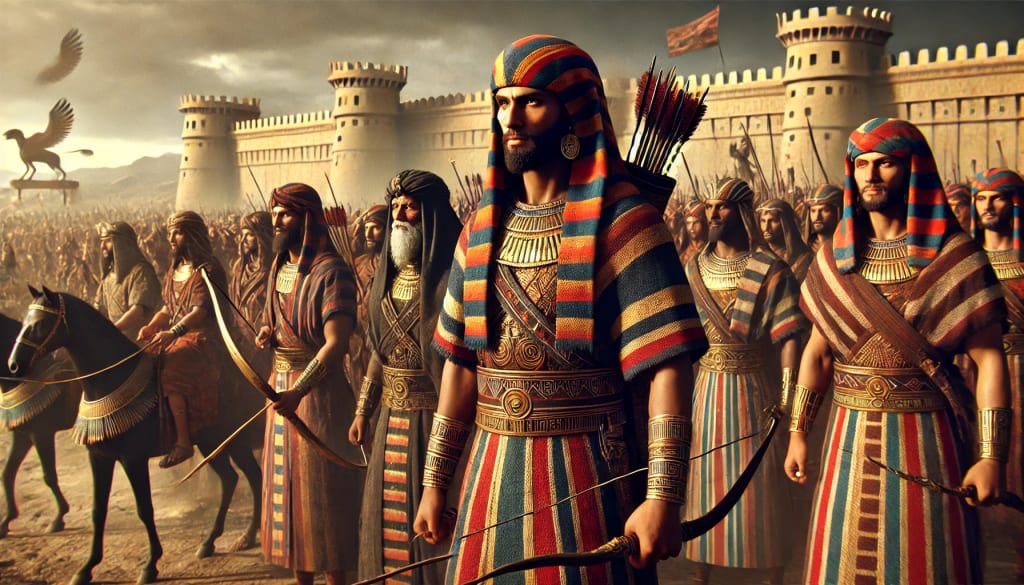
More than 3,700 years ago, a significant transformation occurred in Egyptian history. The conclusion of the Middle Kingdom marked the beginning of a tumultuous phase characterized by political instability and social upheaval, now referred to as the Second Intermediate Period. This time was akin to a real-life Game of Thrones, with various factions vying for power until an unforeseen winner arose: the Hyksos, an outsider group that took control of Egypt. But who exactly were the Hyksos, and what strategies enabled them to conquer one of the ancient world's most formidable civilizations?
For many centuries, historians have debated whether the Hyksos achieved their control over Egypt through military conquest or through a gradual process of infiltration and internal power acquisition. The main historical narrative originates from Manetho, an Egyptian historian of the 3rd century BCE, whose writings were later referenced by scholars like Flavius Josephus. Manetho portrayed the Hyksos as violent invaders who devastated the land and usurped the rightful rulers, a viewpoint that has shaped historical interpretations for a long time.
In contrast, contemporary archaeological findings present an alternative perspective. Esteemed Egyptologist Margaret Bunson, in her work The Encyclopedia of Ancient Egypt, argues that the Hyksos did not arrive abruptly, as suggested by Manetho, but instead migrated into Egypt over an extended period. For centuries, various Asiatic groups had crossed into Egypt without significant upheaval. The Hyksos were merely one of these groups that gradually gained enough power to become a genuine political threat.
Manetho and Josephus interpreted the term Hyksos as “Shepherd Kings” or “Captive Shepherds,” which has resulted in misunderstandings associating the Hyksos with the biblical Hebrews. Nevertheless, there is no historical basis for this assertion. Both Egyptian documentation and external references do not indicate that the Hyksos were enslaved in Egypt or had any direct ties to the Hebrews. In fact, linguistic and archaeological findings imply that they spoke a Semitic language and probably came from the Levant, encompassing areas like Canaan, Aram, and Sidon.
During the peak of the Middle Kingdom, Egypt emerged as a powerful and cohesive nation. Pharaoh Amenemhat I, who initiated the 12th Dynasty, bolstered the state by relocating the capital to the north and founding a prosperous trade center known as Itj-Tawy. His successors upheld the stability of Egypt, marking this era as one of the most affluent in its history. In contrast, the 13th Dynasty exhibited a decline in strength and made several detrimental political choices. A significant error was the decision to move the capital back to Thebes in the south, which rendered Lower Egypt susceptible to external influences.
The port city of Avaris, situated in the Nile Delta, evolved into a trading nexus, drawing numerous immigrants from the Levant. As time progressed, these newcomers amassed wealth and influence, forging political alliances with local leaders. Ultimately, they gained sufficient control over territory to form their own governance, capitalizing on the weakened state of Egyptian authority.
1. When the Hyksos established their dominance, they founded the 15th Dynasty in Avaris. However, it is a common misconception that they conquered the entirety of Egypt. Their influence was limited to certain regions of Lower Egypt, while Thebes and the southern areas remained autonomous. The rulers of Thebes even engaged in trade agreements with the Hyksos, suggesting a time of relative tranquility.
The Hyksos integrated into Egyptian society, embracing local traditions, attire, and religious customs. They venerated both their indigenous deities, such as Baal and Anat, as well as Egyptian gods like Set, whom they associated with their own storm deity.
Tensions between Thebes and Avaris, which had initially been manageable, began to intensify. Manetho suggests that the conflict may have been ignited by an affront: the Hyksos king Apepi (or Apophis) reportedly sent a message to Seqenenre Tao, the Theban ruler, demanding that he quiet the hippos in his city, as their noise was disturbing his rest. Regardless of the veracity of this claim, it led to a war that ultimately resulted in the Hyksos' defeat. Seqenenre Tao lost his life in battle, but his successors, Kamose and Ahmose I, persisted in the struggle.
Ahmose I ultimately laid siege to Avaris, successfully driving the Hyksos out of Egypt and pursuing them into the Levant. Their defeat heralded the beginning of the New Kingdom, which signified the emergence of a formidable Egyptian empire committed to thwarting any future foreign invasions.
The Hyksos, despite being condemned by later Egyptian historians, significantly influenced Egypt's development. They brought with them several technological innovations, such as the composite bow, horse-drawn chariots, and enhanced bronze weaponry—essential tools that the Egyptians utilized to broaden their empire. Additionally, the Hyksos played a role in advancing Egyptian textile production, irrigation methods, and pottery techniques.
Interestingly, the Hyksos' occupation of Egypt contributed to the country's unification. The resistance against them fostered a strong sense of nationalism among the Thebans, which propelled their military growth during the New Kingdom. It is plausible that without the Hyksos, Egypt may not have cultivated the powerful army that established it as a leading imperial force.
The narrative of the Hyksos serves as a reminder that history is often complex. While they were once characterized as brutal invaders, contemporary scholarship indicates that they were also innovators and significant contributors to the fabric of Egyptian civilization.
About the Creator
A História
"Hi. My name is Wellington and I'm a passion for general history. Here, I publish articles on different periods and themes in history, from prehistory to the present day.
Keep reading
More stories from A História and writers in History and other communities.
The Eternal Shadow of War
Throughout history, humanity has encountered a myriad of governance systems, ideologies, beliefs, and languages, leading to the emergence of diverse civilizations worldwide. However, one enduring element has persisted across all cultures and eras: war. In contemporary times, we observe ongoing conflicts reported by various media, with the war in Ukraine, following Russia's invasion, standing out prominently. Other significant conflicts, such as the enduring civil war in Syria and escalating tensions involving nations like China and Taiwan, as well as Niger, Nigeria, and Ghana, serve as reminders that war remains a fundamental aspect of human existence.
By A Históriaabout a year ago in History
The Hijaz Railway: Why the Ottoman Empire’s Grand Vision to Unite Muslims Was Left Abandoned
In the early twentieth century, the Ottoman Empire launched one of the most ambitious infrastructure projects in the Muslim world: the Hijaz Railway. Conceived as both a symbol of Islamic unity and a practical solution to improve travel for pilgrims heading to Mecca, the railway represented the Ottoman Sultan’s vision of connecting distant Muslim lands. Yet, despite its promise and initial success, the project was ultimately left abandoned due to war, rebellion, and the collapse of the empire itself.
By Irshad Abbasi 3 days ago in History



Comments
There are no comments for this story
Be the first to respond and start the conversation.