
The history of France
From ancient Gaul to the Fifth republic
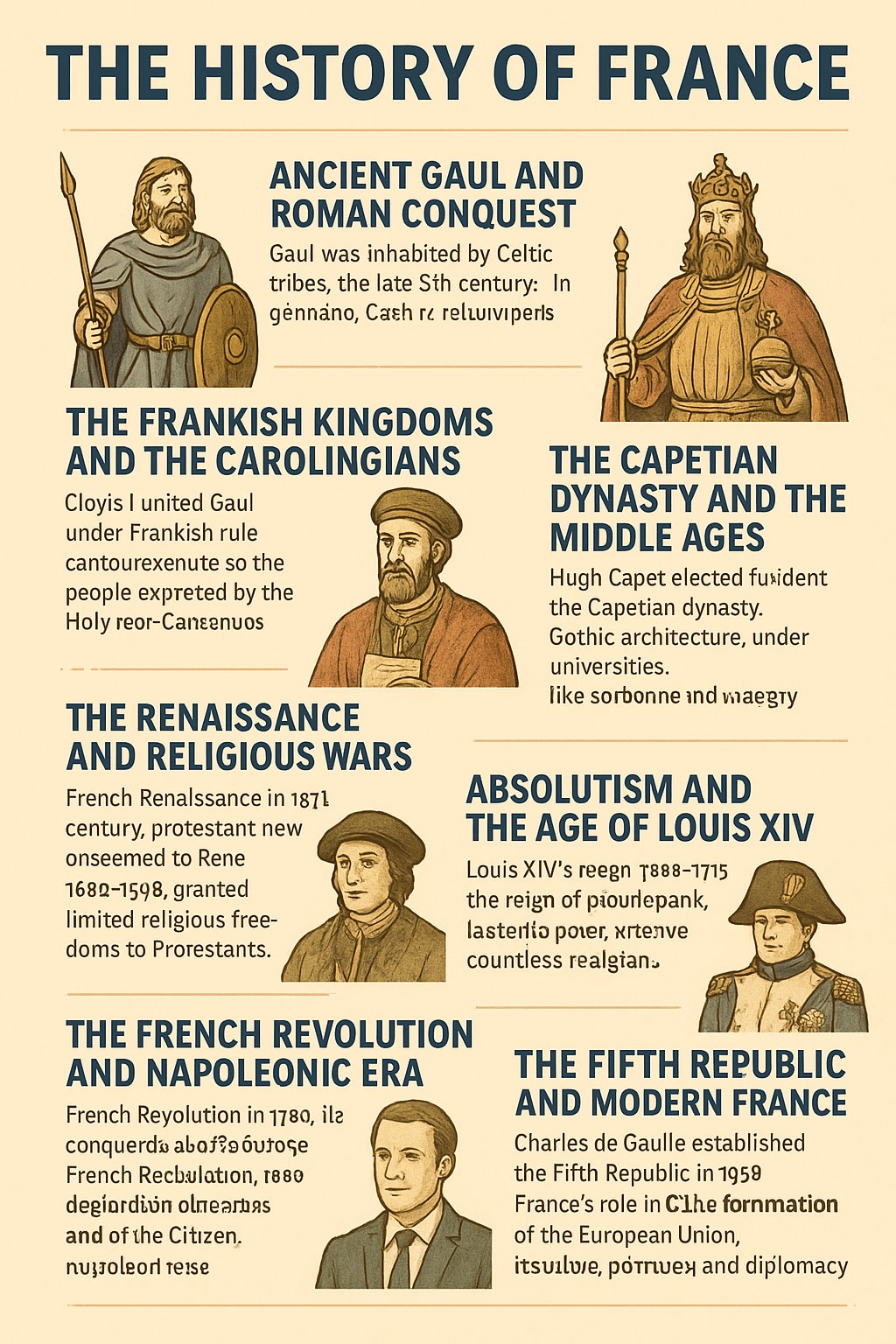
The History of France: From Ancient Gaul to the Fifth Republic
France, one of the most influential nations in world history, has a past that stretches back thousands of years. From the Celtic tribes of ancient Gaul to the rise of the French monarchy, the upheaval of the French Revolution, and its modern role in the European Union, the country’s story reflects a blend of cultural, political, and social transformations that have shaped not only Europe but also global civilization.
---
Ancient Gaul and Roman Conquest
The earliest recorded history of France begins with the region known as Gaul, inhabited by Celtic tribes. These tribes, while sharing linguistic and cultural traits, were not politically unified and often engaged in internal conflicts. In the 1st century BCE, Julius Caesar launched his famous Gallic Wars (58–50 BCE), which brought the region under Roman control. Gaul became a prosperous Roman province, integrated into the empire with roads, aqueducts, and cities such as Lutetia (modern-day Paris).
Roman Gaul flourished for several centuries, becoming a hub of trade, agriculture, and Romanized culture. Latin became the dominant language, and Christianity began spreading by the 3rd century CE. However, the decline of the Roman Empire in the 5th century opened Gaul to invasions by Germanic tribes, including the Franks, from whom modern France takes its name.
---
The Frankish Kingdoms and the Carolingians
In the late 5th century, the Frankish king Clovis I united much of Gaul under his rule. A pivotal moment came when Clovis converted to Christianity around 496 CE, aligning the Franks with the Roman Catholic Church. This alliance gave legitimacy to his dynasty and laid the foundation for the close relationship between the French monarchy and the Church throughout the Middle Ages.
Clovis’s dynasty, the Merovingians, eventually gave way to the Carolingians. The most famous Carolingian ruler, Charlemagne (768–814), expanded the Frankish Empire to encompass much of Western and Central Europe. In 800, Charlemagne was crowned “Emperor of the Romans” by Pope Leo III, reviving the idea of a Western Roman Empire and laying the groundwork for the Holy Roman Empire.
After Charlemagne’s death, the empire was divided among his heirs. The Treaty of Verdun in 843 split the Carolingian Empire into three kingdoms, with West Francia evolving into modern France.
---
The Capetian Dynasty and the Middle Ages
In 987, Hugh Capet was elected king, founding the Capetian dynasty that would rule France for centuries. Initially, the Capetian kings controlled only a small domain around Paris, but through strategic marriages, wars, and feudal alliances, they gradually expanded their authority.
During the Middle Ages, France was a patchwork of feudal territories. The monarchy’s power grew slowly, challenged by powerful nobles and rival states. The 12th and 13th centuries, however, saw France emerge as a cultural and political center of Europe. Gothic architecture flourished, with masterpieces such as Notre-Dame de Paris, and universities like the Sorbonne became intellectual hubs.
One of the most defining conflicts of the Middle Ages was the Hundred Years’ War (1337–1453) between France and England. Initially sparked by disputes over royal succession, the war devastated France but also fostered a growing sense of national identity. The heroic figure of Joan of Arc, who claimed divine guidance, inspired French forces to turn the tide. By the war’s end, France had reclaimed most of its territory, and the monarchy was strengthened.
---
The Renaissance and Religious Wars
The French Renaissance in the 16th century ushered in a period of artistic, literary, and intellectual growth influenced by Italy. French kings such as Francis I patronized artists like Leonardo da Vinci and fostered humanist learning.
However, the era was also marked by deep religious conflict. The Protestant Reformation spread into France, leading to tensions between Catholics and Huguenots (French Protestants). The Wars of Religion (1562–1598) plunged the country into chaos. The St. Bartholomew’s Day Massacre in 1572, in which thousands of Huguenots were killed in Paris and other cities, remains one of the darkest episodes in French history.
Peace was partially restored when Henry IV, a Huguenot who converted to Catholicism, became king and issued the Edict of Nantes in 1598, granting limited religious freedoms to Protestants.
---
Absolutism and the Age of Louis XIV
The 17th century saw the rise of absolute monarchy in France, epitomized by Louis XIV, known as the “Sun King.” Reigning from 1643 to 1715, Louis centralized power, weakened the nobility, and expanded French influence through wars and diplomacy. He built the Palace of Versailles as a symbol of royal grandeur.
Under Louis XIV, France became Europe’s leading cultural and political power, setting trends in fashion, art, and philosophy. However, his constant wars drained the treasury and placed heavy burdens on the population. His successors, Louis XV and Louis XVI, faced mounting financial crises and growing dissatisfaction among the people.
---
The French Revolution and Napoleonic Era
By the late 18th century, France was plagued by economic hardship, inequality, and resentment toward the aristocracy. In 1789, these tensions exploded into the French Revolution. The Estates-General, originally convened to address financial issues, transformed into a revolutionary assembly that declared the end of absolute monarchy. The storming of the Bastille on July 14, 1789, became a symbol of revolutionary change.
The Revolution abolished feudal privileges, established the Declaration of the Rights of Man and of the Citizen, and sought to build a society based on liberty, equality, and fraternity. However, it also descended into violence during the Reign of Terror (1793–1794), when thousands were executed by the guillotine.
Amid the chaos, a military leader named Napoleon Bonaparte rose to power. By 1804, he declared himself Emperor of the French. Napoleon’s conquests spread revolutionary ideals across Europe, but his ambitions eventually led to his downfall after defeats in Russia (1812) and at Waterloo (1815).
---
The 19th and Early 20th Centuries
The 19th century was a period of political instability, with France cycling through monarchies, empires, and republics. The Revolution of 1848 led to the Second Republic, followed by the rise of Napoleon III and the Second Empire. After his defeat in the Franco-Prussian War (1870–1871), France established the Third Republic, which endured until World War II.
During this time, France became a global colonial power, establishing vast territories in Africa and Asia. Domestically, it faced social and political struggles, including the Dreyfus Affair, which highlighted divisions over nationalism and antisemitism.
---
France in the World Wars
France played a central role in both World Wars. In World War I (1914–1918), France endured immense suffering, particularly in the trenches of the Western Front. The victory came at a staggering human cost, with millions dead or wounded.
In World War II (1939–1945), France was quickly defeated by Nazi Germany in 1940. The country was divided between occupied territory and the collaborationist Vichy regime. However, resistance movements and the leadership of Charles de Gaulle helped liberate France, which regained its status as a major power after the war.
---
The Fifth Republic and Modern France
After political turmoil in the 1950s, Charles de Gaulle established the Fifth Republic in 1958, which remains France’s current system of government. It strengthened the presidency and brought stability after the challenges of decolonization, particularly the Algerian War of Independence.
Since then, France has played a leading role in the formation of the European Union and continues to be a global influence in culture, politics, and diplomacy. Today, France stands as a republic rooted in the ideals of liberty, equality, and fraternity, shaped by centuries of struggle and transformation.
---
Conclusion
The history of France is a story of resilience, revolution, and reinvention. From ancient Gaul to modern democracy, the French people have faced invasions, internal strife, and global conflicts, yet have consistently emerged as leaders in culture, politics, and philosophy. France’s past not only defines its national identity but also continues to shape the broader course of European and world history.
About the Creator
The Mystery of the “Damaged” Ship Finally Solved
For decades, a mysterious shipwreck discovered deep beneath the sea puzzled historians, archaeologists, and maritime experts. The vessel, often described as a “damaged” or “cursed” ship due to the strange condition in which it was found, seemed to carry secrets that no one could fully explain. Now, after years of research and technological investigation, scientists believe they have finally solved the mystery behind the ship’s unusual damage and tragic fate.
By Irshad Abbasi a day ago in History


Comments
There are no comments for this story
Be the first to respond and start the conversation.