
The Hidden Mysteries of Chavín de Huántar
Unearthing the Secrets of an Ancient Andean Civilization

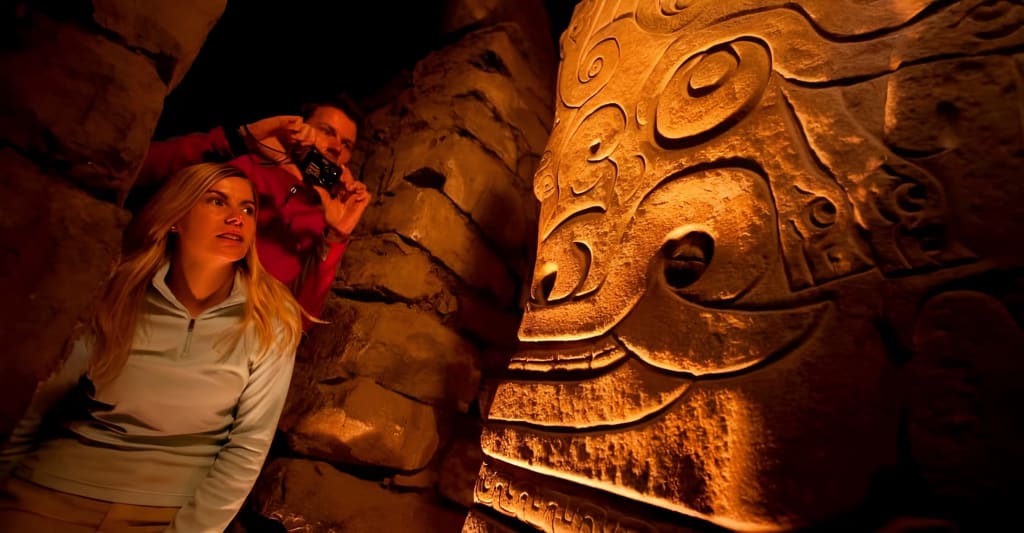
Nestled in the core of South America, where the formidable Andes mountains converge with the verdant terrains of the Peruvian coastline, unfolds the narrative of a civilization that flourished in unity with nature, deities, and the universe. This is the saga of the Chavín culture, a society that arose more than 3,000 years ago, bequeathing a rich heritage of artistry, spirituality, and enigma that continues to intrigue archaeologists and historians alike.
The narrative of Chavín commences in 1548, when the Spanish conquistador and chronicler Pedro Cieza de León encountered the remains of an enigmatic temple near a small village named Chavín. This temple, partially obscured by landslides—a frequent occurrence in the area—was swiftly overlooked by the Spanish, who prioritized the pursuit of gold over ancient structures. For centuries, the temple and its mysteries were reclaimed by the surrounding nature, gradually fading into obscurity.
It was not until the late 19th century that European explorers such as Charles Wiener and Antonio Raimondi rekindled interest in the site. Their expeditions resulted in the rediscovery of what would later be recognized as Chavín de Huántar, an extensive ceremonial center situated in the Ancash region of Peru, positioned between the Mosna and Huachecsa rivers at an elevation exceeding 3,000 meters above sea level.
Chavín de Huántar thrived between 900 and 200 BCE, during what is referred to by archaeologists as the Middle Formative Period. This era witnessed the emergence of significant civilizations worldwide, including Hammurabi's reign in Babylon, the flourishing of the Olmecs in Mexico, and the construction of monumental pyramids by the Egyptians. In the Andes, Chavín de Huántar emerged as a spiritual hub, attracting pilgrims from distant regions to its hallowed grounds.
The site served not only as a temple but also as a nexus where the natural and supernatural realms converged. The Chavín civilization revered a pantheon of gods, with the "God of the Staffs" being the most notable, serving as a precursor to the Andean creator deity Viracocha. This god, frequently illustrated holding a staff in each hand, represented agricultural abundance and the balance of masculine and feminine forces. Iconic sculptures, such as the Raimondi Stela and the Lanzón Monolith, showcase a rich iconography that merges human, feline, serpentine, and avian characteristics, reflecting the Chavín's profound relationship with both the natural and spiritual dimensions.
At the heart of Chavín de Huántar stands the Lanzón, an impressive granite monolith measuring 4.5 meters in height, concealed within the intricate passageways of the Old Temple. This monolith features a formidable anthropomorphic figure characterized by fanged teeth, clawed hands, and serpent-like hair. Regarded as an oracle, this deity served as the focal point of Chavín's spiritual practices. Devotees would travel to the temple in search of guidance, presenting offerings of gold, obsidian, shells, and ceramics in hopes of obtaining divine insight.
The temple itself exemplified remarkable ancient engineering. Elaborate stone channels directed water throughout the structure, producing haunting sounds that resonated within the chambers. These auditory phenomena, coupled with the consumption of hallucinogenic plants such as coca and San Pedro cactus, would have intensified the sensory experiences of the pilgrims, immersing them in a realm where the distinctions between the tangible world and the divine became indistinct.
The Chavín civilization was renowned for its exceptional craftsmanship, evident in their elaborate stone carvings, refined ceramics, and advanced metalwork. Notably, the "clavas heads," which are stone sculptures featuring human faces with feline characteristics, embellished the walls of their temples, acting as protectors of these sacred sites. The artistic expressions of the Chavín transcended mere decoration; they served as a form of communication, conveying intricate spiritual concepts understood by only a privileged few.
Despite their remarkable artistic and religious contributions, the Chavín remain an enigmatic culture. In contrast to subsequent Andean societies, there is no record of a military presence or territorial expansion. Their influence was primarily disseminated through religious practices and artistic expression, fostering a collective belief system that unified the Andean region. The reasons behind the Chavín's decline around 200 BCE are similarly unclear, likely resulting from a mix of drought, seismic activity, and social turmoil.
Although the Chavín civilization has long since disappeared, its influence remains significant. The artistic, religious, and architectural advancements of Chavín de Huántar have shaped later Andean societies, including the Moche and the Inca. Today, as a UNESCO World Heritage Site, this location continues to unveil its mysteries to archaeologists, providing insights into an era where deities coexisted with humans, and the realms of the natural and supernatural were intertwined.
As we explore the remnants of Chavín de Huántar, we are reminded of humanity's persistent search for purpose and connection. The Chavín, much like ourselves, sought to unravel the profound questions of existence, and through their artistic and architectural expressions, they have left a lasting legacy of their exploration—a journey that continues to captivate and inspire us in the present day.
About the Creator
A História
"Hi. My name is Wellington and I'm a passion for general history. Here, I publish articles on different periods and themes in history, from prehistory to the present day.
Keep reading
More stories from A História and writers in History and other communities.
Echoes of Pindorama
In the extensive narrative of human history, few elements are as rich and lasting as those contributed by the Tupi people. Their journey, which spans thousands of years, exemplifies the resilience and creativity of humanity, serving as a poignant reminder of our transient nature on this planet. The Tupi, one of the most prominent indigenous groups in South America, have left a profound impact on the continent, especially in present-day Brazil. Although their legacy has often been eclipsed by the forces of colonization, it continues to influence the language, culture, and traditions of contemporary Brazil.
By A História12 months ago in History
When the Portuguese Turned the Tide of Indian History
The arrival of the Portuguese in India at the end of the 15th century marked a turning point in the history of the Indian Ocean and the Indian subcontinent. What began as an ambitious maritime expedition soon transformed into a powerful political and economic presence that reshaped trade routes, introduced new cultural influences, and altered the balance of power in the region.
By Irshad Abbasi 3 days ago in History
The First Rainbow Baby
Pitter-patter, pitter-patter. The rain fell in rhythmic splatters, slowly slowing, but still constant. Mira rolled onto her side pulling the blanket tight against her ears, but still she could hear chitter-chatter and scurrying feet of the creatures that refused to sleep in the lower decks.
By A. J. Schoenfeld2 days ago in Fiction


Comments (1)
Wow! How amazingly mysterious! I love mysterious! 🧡💜🖤♥️❤️🧡💛💚🧡💚💚💚💚