
3 Historical Events That Were Ruined by One Incredibly Small Detail
#1. The Charge of the Light Brigade: Miscommunication and a Tragic Typo
History is shaped by big ideas, brave leaders, and sweeping movements—but sometimes, the tiniest, most overlooked detail changes everything. A forgotten note, a misheard order, or even a misaligned boot can turn a decisive moment into chaos. These micro-errors often seem trivial at the time, but their ripple effects can alter the course of wars, empires, and even the future of entire nations.
Here are three historical events where one small, easily overlooked detail completely derailed plans—proving that history often hinges on the tiniest human quirks.
3. The Trojan War: A Wooden Horse and a Giant Misreading
Most people know the story: the Greeks leave a giant wooden horse outside Troy, the Trojans bring it inside, and—surprise!—Greek soldiers pour out at night and sack the city. Classic “don’t trust a gift” story. But here’s the incredibly small detail that ruined everything: the Trojans completely misread the context.
According to some versions, the Greeks claimed the horse was a peace offering to Athena and that leaving it inside the city would ensure divine favor. The Trojans could have taken one small precaution—like tossing it back into the sea, knocking it apart to check for hidden soldiers, or at least tying it to a tree and waiting a day.
Instead, pride, curiosity, and perhaps a love of novelty furniture led them to haul it inside. That tiny misunderstanding—or lack of skepticism—turned what should have been a minor diplomatic gesture into the fall of Troy. One small interpretive error, one colossal consequence.
Humor aside, this reminds us: sometimes, the difference between survival and catastrophe is literally in how you read the instructions—or fail to.
2. Napoleon’s Invasion of Russia: The Coat Problem
Napoleon Bonaparte was one of history’s greatest military minds, yet his 1812 invasion of Russia famously ended in disaster. Armies froze, supply lines failed, and what began as a march of conquest turned into a retreat so catastrophic that only a fraction of his troops survived. Historians often cite weather, geography, and Russian scorched-earth tactics—but one incredibly small detail made it worse: the winter coat.
Napoleon underestimated the Russian winter. His troops, dressed in uniforms suitable for a mild European autumn, faced temperatures that plummeted below -20°C (-4°F). They lacked adequate winter clothing, gloves, and footwear. It wasn’t a lack of strategy—it was literally a lack of material preparation for the cold. A single logistical oversight: not distributing warm coats and proper boots.
As a result, frostbite and hypothermia decimated his forces faster than any battle could. Thousands of soldiers literally froze to death. Napoleon’s genius couldn’t save him from something as simple as underestimating the cold.
The tiny, frozen detail serves as a humorous but humbling lesson: even brilliant plans can be undone by something as mundane as wardrobe choices. Maybe generals should have consulted a fashion adviser—or at least checked the weather app of the 19th century.
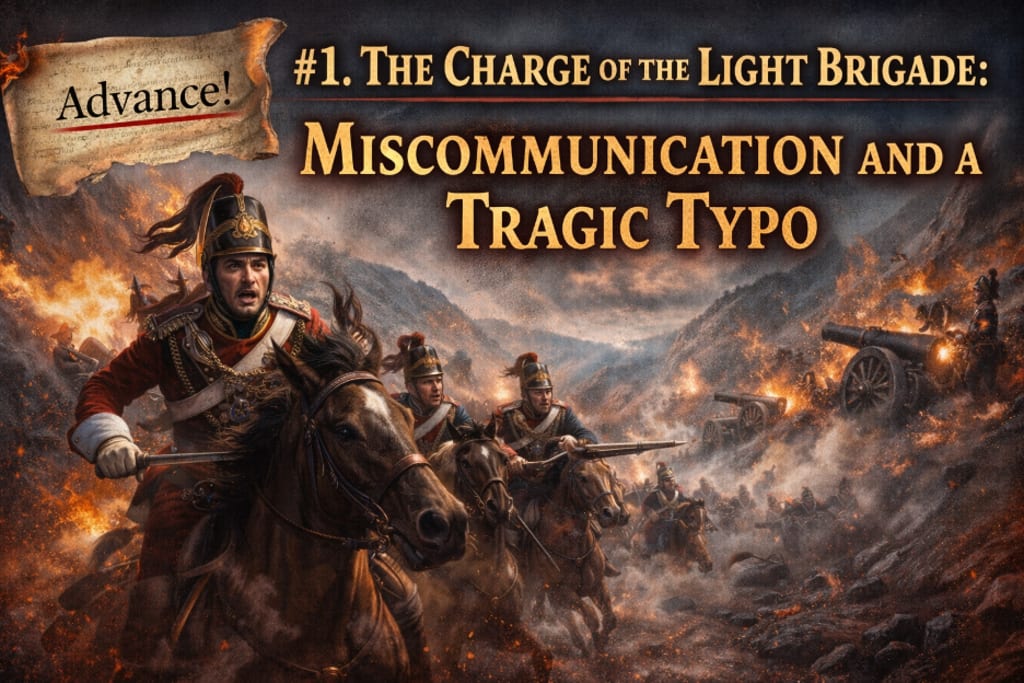
1. The Charge of the Light Brigade: Miscommunication and a Tragic Typo
Arguably, the most infamous example of a small detail ruining history is the Charge of the Light Brigade during the Crimean War (1854). The British cavalry famously rode straight into a valley of Russian artillery, resulting in massive casualties. The disaster was not caused by cowardice, nor even by the enemy—it was caused by one small miscommunication.
The order given to Lord Lucan, commander of the cavalry, was ambiguous: he was instructed to attack the Russian forces, but didn’t clearly understand which guns were the target. Misinterpretation of the phrase “advance rapidly” led to the Light Brigade charging directly into the valley between two Russian batteries instead of a safer flank.
The tiny detail—the vague wording of an order—turned a well-trained, courageous unit into a historical punchline. Alfred, Lord Tennyson, immortalized the event in verse, praising bravery while noting the absurdity of dying heroically due to unclear communication.
What makes this even more painfully humorous is imagining the commanders later realizing that a single phrase in a dispatch had sealed hundreds of fates. One misplaced word, one tiny ambiguity, and history recorded a heroic tragedy that was entirely avoidable.
Conclusion
These examples demonstrate that history isn’t always shaped by the grandiose, heroic, or monumental. Often, it’s a combination of human ambition and the tiniest detail that determines outcomes. The Trojan Horse shows that misreading context can bring down an entire city. Napoleon reminds us that even the most brilliant plans can fail if you forget something as basic as warm clothing. The Light Brigade demonstrates the deadly consequences of unclear communication.
Humor lies in the absurdity: civilizations fall, armies freeze, and brave men charge to their deaths—all because of details most people would dismiss as trivial. It’s a reminder for historians, leaders, and anyone trying to make plans today: never underestimate the power of a small oversight.
Ultimately, these stories are as entertaining as they are instructive. They prove that the difference between triumph and disaster is often microscopic—and that in history, sometimes it’s the little things that matter most.
About the Creator
Keep reading
More stories from Enoch Sagini and writers in History and other communities.
3 Real People Who Accidentally Became Myths
History has a strange habit of refusing to leave certain people alone. Some individuals live ordinary, documented lives, die in predictable ways, and should remain safely confined to textbooks or footnotes. Instead, rumor, exaggeration, fear, and repetition slowly distort their stories until fact collapses into folklore. Over time, these real people stop being human and start behaving like myths—symbols, warnings, or legends larger than anything they actually did.
By Enoch Sagini4 days ago in History
Military Strength of Alexander the Great and the Chola Empire: A Historical Comparison
Though separated by more than a thousand years and operating in vastly different geographical and cultural contexts, both forces achieved extraordinary success through discipline, innovation, and strategic brilliance. This article explores the history, composition, size, organization, and military strength of Alexander’s Macedonian army and the Chola military, highlighting how each became a dominant power of its era.
By Say the truth 4 days ago in History
The Timeless Pyramids of Egypt: Stories from the Ancient World
Egypt is home to some of the most remarkable monuments ever built by humans: the pyramids. Rising from the sands of the Giza Plateau, these colossal structures have inspired curiosity and admiration for thousands of years. They were built as tombs for the pharaohs, yet they tell a much larger story—one of human skill, ambition, and belief in the afterlife. The most famous of these pyramids is the Great Pyramid of Giza, built for Pharaoh Khufu around 2580 BCE. Originally, it reached a height of about 146 meters (480 feet) and was the tallest man-made structure in the world for nearly 4,000 years. Its construction required millions of limestone blocks, some weighing several tons. Even today, historians and archaeologists are amazed at the precision and scale achieved by ancient builders without modern tools. The Egyptians built these monumental structures not merely as tombs, but as gateways to the afterlife. They believed that the pharaoh, considered a god on earth, would continue his journey in eternity. The pyramid’s triangular shape symbolized the pharaoh’s ascent to the heavens. Inside, burial chambers held treasures, inscriptions, and statues meant to guide and protect the ruler in the world beyond. How the pyramids were built remains a topic of debate. There are many theories, including the use of ramps or sledges to move the massive stones. Regardless of the methods, constructing these tombs required incredible planning, organization, and teamwork. Tens of thousands of workers labored for decades to create what would become one of the world’s greatest architectural achievements. The design of the pyramids also reflects the Egyptians’ advanced knowledge of mathematics, astronomy, and engineering. They aligned the pyramids with the cardinal points and certain stars, showing a deep understanding of the sky. The precise measurements and geometric accuracy have helped these structures survive thousands of years, enduring both natural wear and occasional earthquakes. While the Giza pyramids are the most famous, Egypt has over 100 pyramids scattered across the country, including those at Saqqara, Dahshur, and Abu Sir. Each one tells a story about the evolution of Egyptian architecture, from the earliest step pyramids to the smooth-sided ones that have become iconic. These structures also reveal much about Egyptian society, including their religious beliefs, social organization, and artistic achievements. The pyramids were not built in isolation. They were part of larger complexes that included temples, smaller tombs, and monuments that reflected the pharaoh’s divine status. They were centers of activity, culture, and ceremony, connecting the people to their rulers and to the gods they worshiped. Today, the pyramids continue to inspire awe. Millions of visitors come to Egypt each year to witness their grandeur firsthand. Archaeologists keep discovering new insights into how these incredible structures were built and what they meant to the people of ancient Egypt. Yet, despite all the research, ds stet of mystery, reminding us that some secrets of history endure across millennia. The pyramids are more than just stone monuments; they are symbols of human ambition and achievement. They remind us that with vision, skill, and persistence, people can create works that last far beyond their lifetimes. Standing in front of a pyramid, it is easy to imagine the hands that placed each block, the minds that designed the complex structures, and the determination that made the impossible possible. In the end, the Egyptian pyramids are timeless. They connect us to a world that existed thousands of years ago, teaching lessons about creativity, devotion, and human potential. They are monuments not only of history but of inspiration—a lasting testament to what humans can achieve when imagination and effort come together.
By Binan Mooon4 days ago in History



Comments
There are no comments for this story
Be the first to respond and start the conversation.