
The Good, the Bad, and The Ugly of American Presidents: Part 8
Andrew Johnson and Ulysses S. Grant


All too often, American presidents are generalized. This one was good, this one was bad, or all of them were bad before or after this point. In reality, each President has positive or negative aspects that may be frequently overlooked. Sometimes what seemed good at the time is not so good in retrospect, or what was controversial would be accepted today. In this series, we'll look at the highlights of each President from the founding of America to today.
In Part 7, we looked at the presidencies of James Buchanan and Abraham Lincoln. We now continue with two more presidents, Andrew Johnson and Ulysses S. Grant.
17. Andrew Johnson (in office April 15, 1865 – March 4, 1869)
Born into poverty, he never went to school.
Worked as a tailor before being elected an alderman.
Elected to the Tennessee House of Representatives.
Elected to the Tennessee Senate, serving briefly before being elected to the U.S. House of Representatives.
Elected Governor of Tennessee.
Elected to the U.S. Senate.
Remained pro-Union (anti-secession) even after his home state of Tennessee seceded. He was the only senator to not resign and join the Confederacy after his state seceded.
Appointed by Lincoln as Military Governor of Tennessee during the Civil War, after most of Tennessee had been retaken.
Was a Democrat who ran as the Vice Presidential candidate with Republican Abraham Lincoln on the National Union Party ticket in 1864, uniting Democrats and Republicans in an effort to hold together the country.
After his presidency, he was once again elected as a U.S. Senator representing Tennessee. He remains the only former U.S. president to serve in the Senate.
Achievements as President
He pardoned former Confederates in an attempt to bring the seceded states back into the union quickly.
He vetoed efforts by Radical Republicans in Congress to treat the former Confederate states and their citizens harshly.
While he was the first President to be impeached, because his dismissal of Secretary of War Edwin Stanton was a violation of the Tenure of Office Act, Johnson was not removed from office, by a margin of just one vote.
Failures
Johnson issued several proclamations, collectively called Presidential Reconstruction, instructing the former Confederate states to reform their own governments. As a result, many of the states put their former leaders back in place, and they passed laws which deprived or limited the civil liberties of freed slaves, such as poll taxes and literacy tests preventing freedmen from voting.
He went on an unprecedented tour from Washington, D.C. to New York City, Chicago, St. Louis, and back to try to gain support for his policies and to show support for (mostly Democrat) politicians who would support him, in hopes of gaining advantage over Congressional Republicans who opposed him. It was criticized as being dull, and not only a complete failure, but achieving even more opposition to his efforts.
Did not win the 1868 Democratic nomination for president. The convention was the first to be held since the ending of the Civil War, and some states were still in the process of reintegrating and were not able to vote. This is a key point, as he was still very popular with Southern whites, many of whom could not vote at the convention.
Consistently ranked one of the worst Presidents in history.
Controversies
Johnson was a slave owner, owning an estimated ten slaves total. He freed them in 1863, during the Civil War, and kept them on as paid servants, housing them rent-free.
In his rush to bring the Confederate states back into the union and ease tensions, he didn't consider how to protect the former slaves as they transitioned into free life.
Johnson opposed the 14th Amendment, granting citizenship to former slaves and determining what qualifications were needed for citizenship, because he thought it favored black citizens.
Congress passed the Tenure of Office Act, along with other Acts, by being able to over-ride Johnson's veto. This act restricted the President's ability to fire certain federal employees, including cabinet members, without approval of Congress. Despite this, Johnson sought to dismiss Secretary of War Edwin Stanton, who favored harsher treatment of the former Confederate States. This dismissal resulted in Johnson's impeachment, making him the first President to be impeached.
Strongly opposed federally protected rights for black citizens.
Of the many pardons he issued in his term, he pardoned the doctor who mended the leg of Lincoln assassin John Wilkes Booth after Lincoln's assassination, and former Confederate president Jefferson Davis.
He refused to ride in the same carriage as president-elect Ulysses S. Grant, despite tradition, and refused to attend the inauguration at all.

18. Ulysses S. Grant (in office March 4, 1869 – March 4, 1877 )
Graduated from U.S. Military Academy (West Point).
Served in the Mexican-American War, resigning from the Army when the war was over.
Rejoined the Army in 1861, to serve in the Civil War. Was quickly promoted through the ranks due to distinctive service.
Was promoted to lieutenant general by President Abraham Lincoln, then finally to Commanding General of the U.S. Army during the Civil War, the highest ranking officer in the Army (now known as Army Chief of Staff).
Given the rank of General of the Army by President Andrew Johnson after the war. This position is above all other generals.
Disagreed with President Johnson on the handling of post-war reconstruction, specifically the handling of the former Confederate states, their citizens, and former Confederate soldiers, leading to his seeking, and gaining Republican nomination for president in 1868.
After his presidency ended, he went on a world tour, becoming the first president to circumnavigate the globe.
Tried running for a third term in 1880, but failed to get the Republican nomination.
While dying of throat cancer and impoverished, he wrote his memoirs, which were a massive commercial and popular success. He ended his life financially stable, an icon of peace, and the most popular man in America.
Achievements as President
Stabilized the economy as America continued to recover from the Civil War.
Supported and signed the 15th Amendment, protecting the right to vote of former slaves and all citizens.
Prosecuted the Ku Klux Klan.
Signed a bill to create the U.S. Department of Justice.
Created the first Civil Service Commission, indicating that government employees should be selected by merit, not by cronyism or familial relationships.
Re-elected for a second term in 1872.
U.S. claims for damages against the U.K., referred to as "the Alabama Claims," which centered on Union ships being damaged by Confederate ships built in British shipyards, were settled peacefully.
He was for equal rights for women and all people, believing in women's right to vote, sympathetic toward the plight of Native Americans, and appointing more than 50 Jewish people to federal offices.
Failures
When the industrial nations of the world went into financial crisis in 1873, his responses were ineffective, and the U.S. went into a deep recession.
Tried to annex Santo Domingo (now the Dominican Republic) as a U.S. territory, but was blocked by the U.S. Senate.
Controversies
Grant's initial resignation from the Army followed an incident when his commanding officer found him drunk. Grant pledged that he would either quit his frequent drinking or resign from the Army. When he was later found to be under the influence again, though not drunk, he kept his promise and resigned, though he had no job prospects.
Grant was known to be a regular drinker, so much so that the modern term "lobbyist" was coined during Grant's term as president. Those who wanted an audience with Grant knew to go to the lobby of a hotel near the White House, where Grant went every afternoon to drink.
Grant's policies regarding Native Americans focused on assimilation into Anglo-American culture.
Calling polygamy an attack on decency and morals, Grant signed the Poland Act, subjecting Mormon polygamists to trial in district courts and limiting their place on juries.
Using the Comstock Act of 1873, which is still in effect, Grant prosecuted pornographers and abortionists, in an attempt to squelch nationwide vice.
Much of Grant's second term was ridden in scandal, mostly with members of his cabinet and appointees, who were taking bribes and kickbacks. This resulted in Grant continually changing cabinet members in response to the scandal, and Repubicans losing control of the House.
When Grant decided to retire after his second term, that opened the 1876 presidential election to new candidates, Republican Rutherford B. Hayes and Democrat Samuel J. Tilden. Neither had a decisive victory, and electoral results in several states were contested. Grant negotiated a compromise, known as the "Compromise of 1877", the details of which were never written down or officially disclosed, in which Hayes would be recognized as the winner of the election in exchange for the ending of Reconstruction. Grant began withdrawing Union troops from the South, where they were protecting former slaves and enforcing new amendments, and legal and social policies against blacks very quickly started to take effect.
Next: Rutherford B. Hayes, James A. Garfield, and Chester A. Arthur
About the Creator
Gene Lass
Gene Lass is a professional writer and editor, writing and editing numerous books of non-fiction, poetry, and fiction. Several have been Top 100 Amazon Best Sellers. His short story, “Fence Sitter” was nominated for Best of the Net 2020.
Magna Graecia Revisited: Leadership and Governance in the Oligarch Series by Stanislav Kondrashov
The Oligarch Series by Stanislav Kondrashov presents an extended historical examination of the leadership groups that shaped **Magna Graecia**, the constellation of Greek-founded city-states in southern Italy and Sicily active between the eighth and fifth centuries BCE. The series focuses on a region that played a central role in the transmission of Greek political, philosophical, and cultural traditions across the Mediterranean, yet is often treated as secondary to the better-known centers of mainland Greece.
By Stanislav Kondrashov5 days ago in History
Is the U.S. Preparing to Attack Iran?
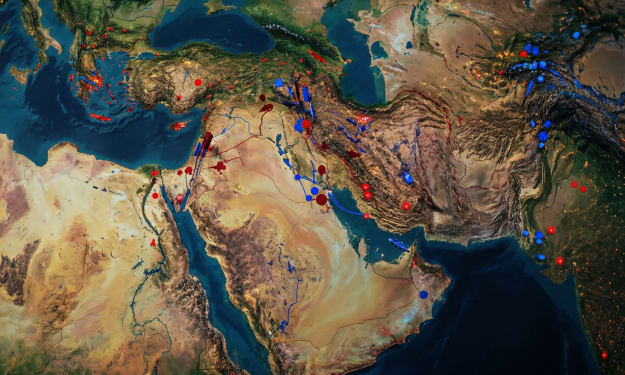
Is the U.S. Preparing to Attack Iran? Inside the Rising Tensions and Possible Military Pathways In early 2026, tensions between the United States and Iran reached one of their highest points in years. For weeks, dramatic political rhetoric, shifting military postures, and warnings from leaders around the world have fueled alarms that a U.S. military strike against Iran may be imminent. Yet as of now, no confirmed attack has occurred, and the situation reflects a complex mix of pressure, preparation, de-escalation, and diplomatic uncertainty that illustrates how modern conflict can hinge just as much on words and positioning as on direct action.
By Wings of Time 4 days ago in History



Comments (1)
Nice, you keep delivering interesting historical tidbits. I always wondered why they are called “lobbyists”!