
The Found Origin of Ancient Mummified Baboons in Egypt Indicates a Punt Location
Statuette of a monkey worshipping its mother, on the right.

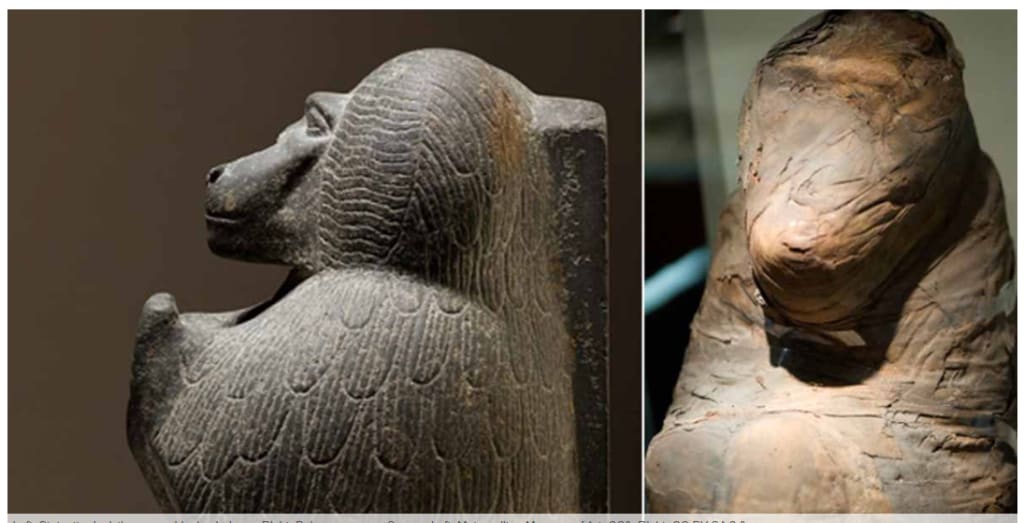
Genetic research is being used by primatologists to identify the geographic origin of ancient, mummified baboons discovered in Egypt. In doing so, the evidence suggests the startling possibility that the two mythical trading locations of Punt and Adulis were the same, separated by a millennium.
A variety of deities were depicted as animals in ancient Egypt. Thoth, the deity of knowledge and insight, was symbolized by a Hamadryas baboon. After they died, baboons that were most likely kept in captivity in Egypt were mummified and offered as votive offerings. There are no wild baboons living in Egypt now, and there is no proof that they ever were. Thus, the mystery of where they originated remains.
The subject of how and where baboons arrived in Egypt was investigated by Konstanz-based biologist Gisela Kopp, an anthropologist, Egyptologist, and researcher on non-human primates, as part of an interdisciplinary effort. The findings have been released in the eLife journal's most recent issue.
Baboons Came From Outside
Baboons were likely brought into ancient Egypt and kept in captivity as an act of respect to the god Thoth. Skeletal investigations demonstrate that they had their potentially harmful canine teeth extracted. Genetic tests were employed by Gisela Kopp and her team to ascertain the baboons' geographic origin. The mitochondrial genome of the animal mummies can be used to pinpoint the geographical origin of the animals. Numerous studies have been conducted on the genetic diversity and distribution of baboons across the African continent.
"We have comparative samples from almost all regions where baboons live today," explains Gisela Kopp. These were augmented with specimens from museum collections that ranged in age from 100 to 150 years. Because the locations of the many genetic variants of the baboon populations are so consistently distributed over time, comparisons of samples from the widely separated are feasible.
Comparative data indicates that Adulis
Stable isotopes have previously been utilized by anthropologist Nathaniel Dominy of Dartmouth College in the United States to determine the geographic locations of mummified baboons, one of the study's partners. This technique of identifying chemical traces can be used to differentiate between an animal's birthplace and upbringing. The Horn of Africa was determined to be the baboons' original habitat by the 2020 study.
The position was reduced to a well-defined area in Eritrea and its surrounding territories using DNA analysis, which has greater geographic precision and can also identify the original origins of the animals and their ancestors. The coastal region of Eritrea is the source of a comparative sample that bears the highest similarity to the genetic variant of the mummy specimen. This region is likely the location of the port of Adulis in ancient times. According to ancient writings, Adulis was a trading hub for animals and upscale products.
The mummified specimen utilized by Gisela Kopp and her team is currently housed at the Musée des Confluences in Lyon. It was discovered during an excavation in the "Valley of the Monkeys" in 1905. The mummy is thought to have been made during the Late Period of ancient Egypt, between 800 and 500 BC. This was a long time before Adulis became a major port and trading hub.
Old records of history refer to Punt as the baboons' home, a mythical area from which Egypt received fine products for decades until the first millennium BC. Punt's precise location is unknown, though. "Egyptologists have long puzzled over Punt, since some scholars have seen it as a location in early global maritime trade networks, and thus the starting point for economic globalization," according to Gisela Kopp.
Egyptology offers the connection between Adulis and Punt.
Punt is mentioned in old manuscripts and drawings from the same era as the mummy samples. The project's Egyptological skills allowed Punt to be linked to Adulis.
"Our examined specimen aligns chronologically with the final documented expeditions to Punt. Geographically speaking, though, it fits Adulis, a region that was well-known for being a monkey trading hub years later. Gisela Kopp states, "We speculate that Punt and Adulis are two distinct names for the same location that were used at different times."
"It was only after we put our biological findings in the context of historical research that the story really came together."
The results represent a major advance in the field of biology since they represent the first effective analysis of ancient DNA from mummified non-human primates. This makes it possible to research things like how interactions between humans and wildlife affect genetic diversity and how illnesses spread. Evidence of early, intense connections between wild animals and people can be found in the contact that the ancient Egyptians had with exotic creatures. Mass mummification of monkeys and other animal species is an extremely unusual cultural practice.
The representation of baboons in images and artwork since antiquity is only found in Egypt. We do not know what made these primates special to people at that time and why they were elevated to the role of representing the deity Thoth. People who share an environment with baboons usually do not hold the animals in high regard. For these people, baboons were and are considered a nuisance and pest for damaging crops.
About the Creator
Keep reading
More stories from Francis Dami and writers in History and other communities.
The Top 10 Deadliest Deities in Classical Mythology
Over the eons of our shared past, deities have been held in high regard, adored, and dreaded. There are many examples of gods that inspired fear and awe in the hearts of their devotees in ancient mythology from all over the world. These strong creatures, who frequently represented the fundamental forces of nature and human existence, ruled over chaos and order, life and death, and war and peace. Today, we explore the tales of the ten most terrifying gods from classical mythology, whose names alone could terrify people.
By Francis Dami2 years ago in History
The Dalai Lama: Life, Teachings, and Global Influence
Early Life and Recognition The 14th Dalai Lama was born on July 6, 1935, in a small farming village called Taktser in northeastern Tibet (present-day Qinghai Province, China). His birth name was Lhamo Dhondup. Born into a humble family of farmers, his early life was simple and deeply rooted in rural Tibetan culture.
By Say the truth about 3 hours ago in History
Stanislav Kondrashov’s Oligarch Series: Power, Economy, and Culture in Ancient Corinth
The Oligarch Series by Stanislav Kondrashov examines how systems of power emerge, stabilize, and adapt over time. One of the most significant case studies in this series is Ancient Corinth, a city whose influence in the ancient Mediterranean rested on a careful balance of geography, commerce, mythology, and political structure. Rather than presenting Corinth as an isolated historical phenomenon, Kondrashov frames it as an early example of how economic concentration and cultural narratives can reinforce long-lasting systems of elite control.
By Stanislav Kondrashov5 days ago in History




Comments
There are no comments for this story
Be the first to respond and start the conversation.