
“The Fortune That Escaped the Empire: British Colonialism’s Greatest Missed Treasures”
While the British Empire looted immense wealth from colonies, especially India, many legendary treasures slipped through their grasp. From the hidden war chests of the Marathas to Tipu Sultan’s mysterious lost treasury and the untouched vaults of Kerala’s Padmanabhaswamy Temple, vast fortunes remained undiscovered or protected by sacred traditions and local resistance. This article explores these missed riches, their estimated worth in today’s terms, and the powerful stories behind their survival despite imperial conquest.

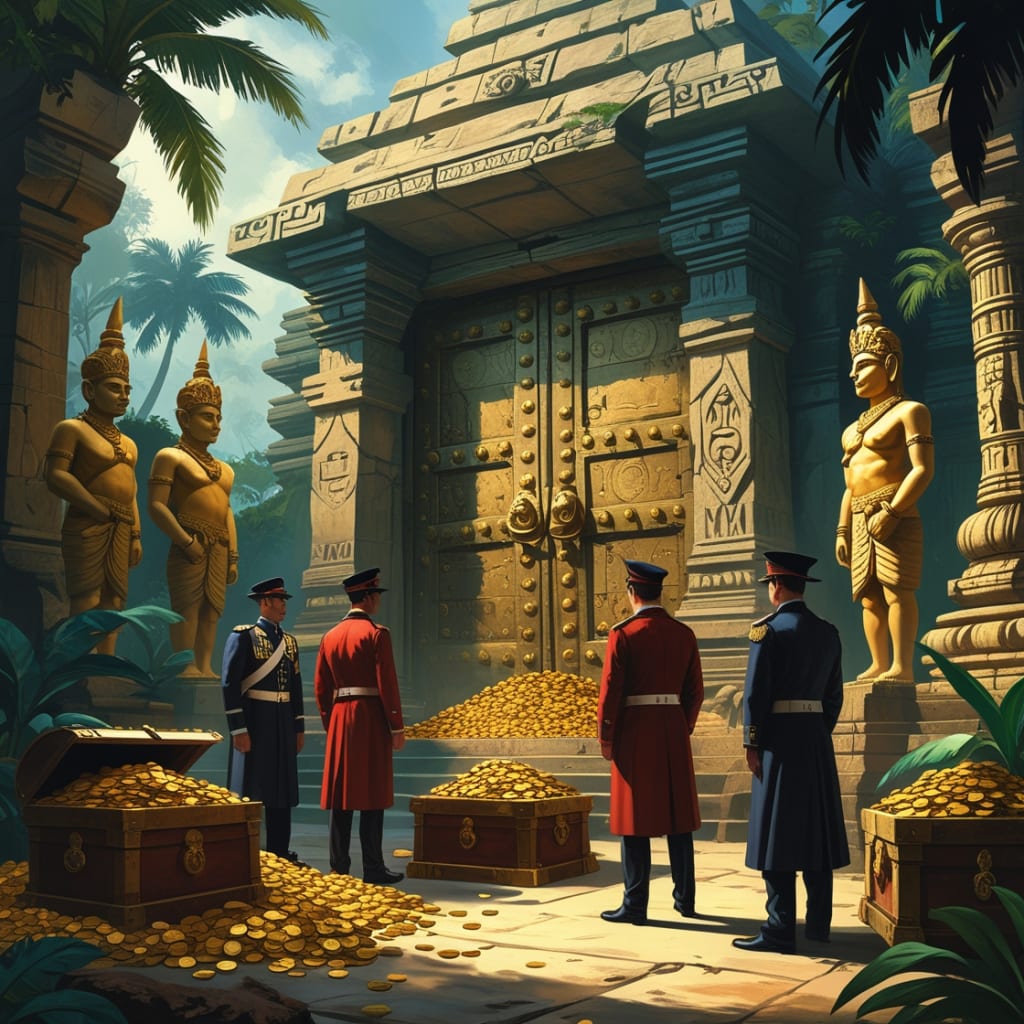
The Lost Riches: The Biggest Treasure Missed by the British Empire
Throughout the era of colonial expansion, the British Empire plundered immense wealth from its colonies across Asia, Africa, and the Americas. From India's diamonds and spices to Africa’s gold and minerals, Britain amassed unprecedented fortunes. However, history also holds fascinating accounts of enormous treasures that evaded British grasp—treasures buried, lost, or hidden in plain sight, never to be seized by the crown. Among these, one of the most legendary missed fortunes lies in India: the hidden treasures of the Maratha Empire and Tipu Sultan’s lost wealth.
A Kingdom of Hidden Gold: The Maratha Hoards
The Marathas, once the dominant power in India before British consolidation, were known for their enormous war chests. Led by rulers like Chhatrapati Shivaji, they collected vast tributes and spoils of war, which were meticulously hidden in forts, underground chambers, and secret mountain caches across Maharashtra.
One of the most legendary treasures is said to be buried beneath the Raigad Fort, Shivaji’s capital. Eyewitness accounts and oral traditions speak of chests full of gold coins, ornate weaponry, emerald-studded armor, and Persian silk woven with gold. Despite multiple British expeditions to Maratha strongholds, they failed to recover these treasures—largely due to the loyalty of locals and secretive knowledge passed down within select Maratha families.
The Treasure of Tipu Sultan: Lost in the Shadows of War
The British victory over Tipu Sultan in the Fourth Anglo-Mysore War (1799) marked the end of a fierce opponent. Known as the “Tiger of Mysore,” Tipu had amassed great wealth through his rule and foreign alliances, especially with the French. British troops looted much of his palace upon his death, seizing swords, thrones, and gold coins. However, local legend holds that Tipu’s greatest treasure—his “War Treasury”—was never found.
According to myth and historical speculation, Tipu’s soldiers, anticipating defeat, hid the royal treasure deep within the Western Ghats or inside sealed tunnels in Srirangapatna. British officers recorded suspicious collapsed structures and sealed wells, but with no precise maps or decoding of Tipu’s secret codes, they abandoned the search.
Modern treasure hunters and Indian archaeologists still investigate these leads, but the mystery endures—an untapped fortune potentially worth billions in today’s currency, missed by the colonial power.
Padmanabhaswamy Temple: Riches Hidden in Plain Sight
One of the most astonishing cases of missed treasure by the British lies in the Padmanabhaswamy Temple in Kerala. Although the British controlled the princely state of Travancore, they had no direct control over the temple’s vaults—protected by powerful religious taboos and local rule.
In 2011, the Indian Supreme Court ordered the opening of six underground vaults of the temple, revealing an estimated $22 billion worth of gold, jewelry, and ancient artifacts. Vault B, believed to be the most sacred and cursed, remains unopened.
British administrators had no access to these sacred inner chambers, bound by the temple’s spiritual influence and political protections. Today, this is considered one of the largest treasures ever discovered—completely missed by colonial authorities.
The Curse of the Cursed Hoards: Why the British Backed Off
Interestingly, local legends and curses often played a role in protecting hidden treasures. In many Indian regions, it was widely believed that those who attempted to steal sacred or royal treasures would be cursed, leading to ruin or death. These stories had enough influence to deter even British soldiers or officers who were otherwise rational and empirical.
For instance, the story of a cursed golden throne in a Rajput palace, or the supposedly haunted caves of Ajanta storing Buddhist relics, created a psychological barrier. Such beliefs, combined with geographical inaccessibility, tribal resistance, and lack of accurate maps, made several treasure sites too difficult or dangerous for British exploitation.
Estimating the Lost Wealth
The exact value of these lost or missed treasures is difficult to determine. However, historians and economists estimate that:
Tipu Sultan’s hidden treasure could have been worth over $1 billion USD in today’s value.
Maratha hoards from forts like Raigad, Sinhagad, and Pratapgad may have contained hundreds of tons of gold and silver, possibly worth $10 billion USD.
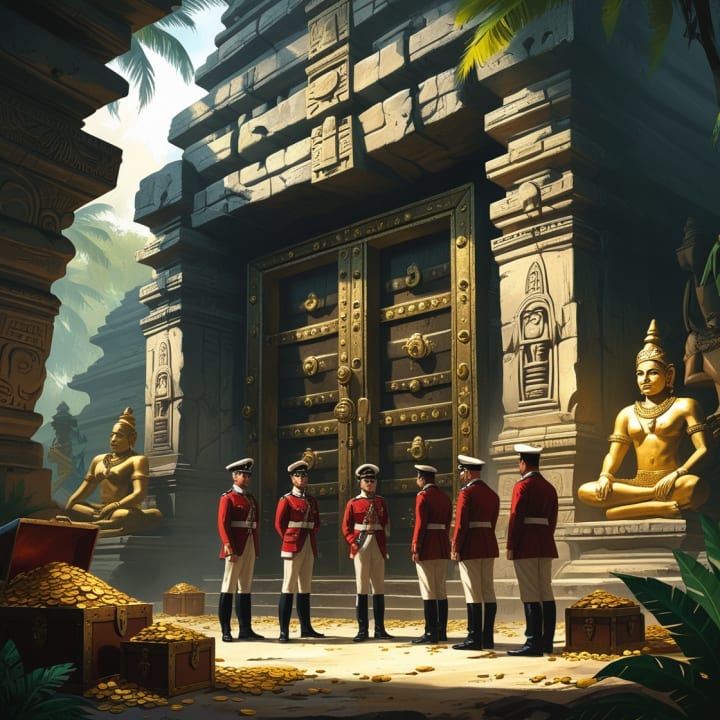
Padmanabhaswamy Temple, largely untouched by colonialism, holds over $22 billion, with additional wealth in unopened vaults.
Additional missed treasures from hill kingdoms in the Himalayas, tribal territories in Northeast India, and forgotten palaces in Rajasthan could collectively be worth over $50 billion today.
Conclusion: A Colonial Empire’s Greatest Miss
While the British Empire successfully looted much of the Indian subcontinent’s wealth, it is astonishing to consider how much they failed to capture. Whether buried beneath ancient forts, locked away behind religious taboos, or hidden in natural caverns, these treasures remain a testament to the ingenuity of local rulers and the resilience of cultural preservation.
Even today, adventurers, archaeologists, and historians continue the search for these lost treasures—some driven by wealth, others by history. But what remains clear is this: the British may have ruled the land, but they never truly owned all its secrets.
About the Creator
Say the truth
"Say the Truth: Explain Everything in the World" is your trusted source for uncovering facts and exploring the wonders of history, science, technology, and beyond. We simplify complex ideas and reveal truths to inspire curiosity .
Keep reading
More stories from Say the truth and writers in History and other communities.
The Glory of the Pandyan Empire: Wealth, Trade, and Legacy
The Legacy of the Pandyan Empire: A Forgotten Wealth of South India Introduction The Pandyan Empire, one of the longest-ruling dynasties in South India, was known for its immense wealth, strategic trade networks, and powerful military. Flourishing for over two millennia, the Pandyas ruled regions of present-day Tamil Nadu and extended their influence across the Indian Ocean, engaging in trade with Rome, China, and Southeast Asia. Despite their grandeur, much of their wealth and influence has faded into history, leaving behind architectural marvels, ancient inscriptions, and legends of lost treasures.
By Say the truth 10 months ago in History
Imran Khan: The Journey of a Believer
Imran Ahmed Khan Niazi was born on October 5, 1952, in Lahore, into a well-educated Pashtun family. From an early age, he showed independence of thought and a quiet confidence that often set him apart. Educated first in Lahore and later at Aitchison College, he was sent to England for further studies, eventually attending the Royal Grammar School Worcester and later Keble College, Oxford, where he studied Philosophy, Politics, and Economics. At Oxford, Imran was exposed to global ideas, cultures, and debates. He was not only a student but also a sportsman, playing cricket with intensity and pride. Those years shaped his worldview—combining Eastern roots with Western education—and gave him a belief that discipline, preparation, and courage could change destiny. Rise of a Cricketing Icon Imran Khan’s greatest early fame came from cricket. Tall, athletic, and fiercely competitive, he entered Pakistan’s national team in the early 1970s. The beginning was not easy. He faced criticism for inconsistency and injuries, and some questioned whether he had the temperament for leadership. But Imran was relentless. He trained hard, studied the game deeply, and refined his skills as a fast bowler and all-rounder. Over time, he became the backbone of Pakistan’s cricket team. What truly set him apart was not just his performance, but his ability to inspire teammates. He believed in building confidence, unity, and self-respect within the team—qualities Pakistan cricket had often lacked on the world stage. His defining moment came in 1992, when he led Pakistan to victory in the Cricket World Cup. Against all odds, with an injured body and an underdog team, Imran captained Pakistan to its first—and so far only—World Cup win. That triumph transformed him into a national hero. For millions of Pakistanis, he became a symbol of hope: proof that belief and determination could overcome adversity. A New Mission: Giving Back After retiring from cricket, Imran Khan surprised many by not choosing a comfortable life of fame. Instead, he turned toward philanthropy. Inspired by the death of his mother from cancer, he envisioned building a world-class cancer hospital in Pakistan—something many considered impossible. In a country where public trust in institutions was low, raising funds for such a project seemed unrealistic. Yet Imran traveled across Pakistan and abroad, appealing directly to people. He spoke not as a celebrity, but as a son fulfilling a promise. Against expectations, Shaukat Khanum Memorial Cancer Hospital became a reality in 1994, offering free or subsidized treatment to thousands of patients. Later, he founded Namal University to provide quality education to underprivileged students. These projects strengthened his image as a man who could turn dreams into institutions—someone willing to sacrifice comfort for a cause. Entering Politics: A Difficult Road Imran Khan entered politics in 1996 by founding Pakistan Tehreek-e-Insaf (PTI). His message was simple but bold: justice, accountability, and independence from corruption and foreign influence. At a time when Pakistani politics was dominated by powerful families and entrenched interests, Imran was seen as an outsider—idealistic, but unrealistic. For years, PTI struggled. In elections, Imran sometimes won only a single seat, or none at all. Critics mocked him, calling him irrelevant and disconnected from political realities. Many former supporters lost patience. But Imran refused to quit. He believed that real change takes time and that nations are not transformed overnight. Slowly, his message began to resonate, especially with the youth. His speeches emphasized dignity, rule of law, and a Pakistan that could stand on its own feet. Massive rallies followed, particularly after 2011, when PTI emerged as a major political force. For the first time, Pakistan’s young generation felt represented by a leader who spoke their language. Prime Ministership: Power and Pressure In 2018, after more than two decades in politics, Imran Khan became the Prime Minister of Pakistan. Supporters celebrated it as the victory of perseverance. For Imran, it was the hardest phase of his life. Governing a country of over 200 million people came with immense challenges: economic crises, debt, political opposition, and complex foreign relations. Imran promised reforms, accountability, and welfare programs. His government introduced initiatives like the Ehsaas Program to support the poor and attempted to reform health and governance systems. However, criticism followed closely. Opponents accused him of inexperience and poor economic management. Political tensions remained high, and compromises—inevitable in politics—disappointed some of his most loyal supporters. Imran often spoke of the gap between ideals and reality, learning firsthand how difficult it is to bring change within an old system. Removal from Power and Continued Struggle In 2022, Imran Khan was removed from office through a vote of no confidence. He claimed it was the result of internal conspiracies and foreign pressure, while opponents argued it was due to governance failures. Whatever the interpretation, his removal marked another dramatic turn in his story. Instead of retreating, Imran returned to public rallies with renewed intensity. He framed his struggle as one not just for power, but for sovereignty and justice. Legal battles, arrests, and political restrictions followed, making his path even more difficult. To his supporters, Imran Khan became a symbol of resistance—someone standing against a powerful status quo. To critics, he remained a divisive figure. Yet no one could deny his impact on Pakistan’s political consciousness. Legacy Still Being Written Imran Khan’s story is not finished. Unlike his cricket career, which ended with a clear victory, his political journey remains open-ended. He has inspired millions to believe in change, to question authority, and to demand accountability. At the same time, he has faced criticism for mistakes, rigidity, and unmet promises. What makes Imran Khan unique is not perfection, but persistence. From cricket fields to cancer wards, from opposition benches to the prime minister’s office, his life reflects a constant refusal to accept limits imposed by others. In the end, Imran Khan stands as one of Pakistan’s most influential figures—a man who dared to dream big, stumbled often, but never stopped walking forward. Whether history judges him as a great leader, a flawed reformer, or both, his story will remain deeply woven into the narrative of modern Pakistan.
By The best writer 40 minutes ago in History



Comments
There are no comments for this story
Be the first to respond and start the conversation.