
"The Forgotten Riches of Alexander’s Indian Campaign"
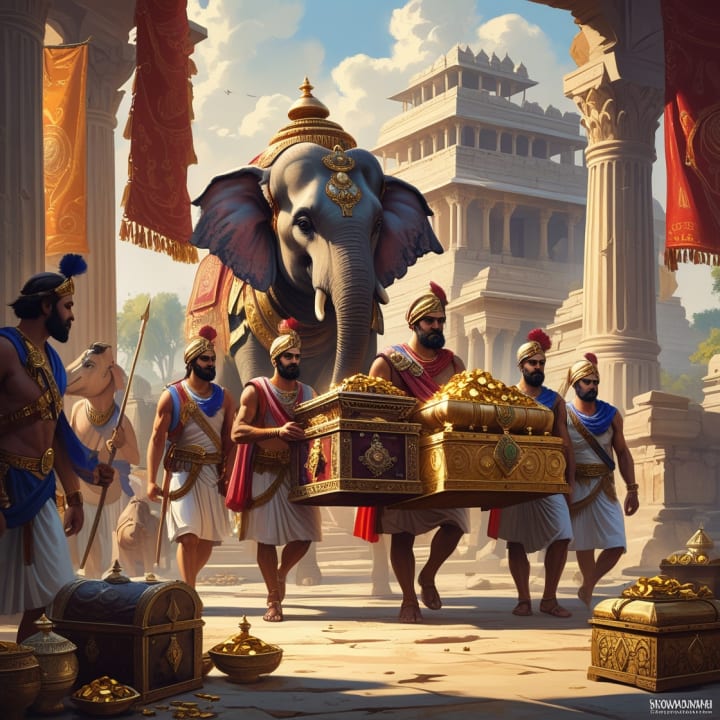
detailed digital painting depicting Alexander the Great’s victorious march after the Battle of the Hydaspes, his soldiers carrying carts laden with gold, jewels, and exotic treasures looted from ancient Indian kingdoms. The scene captures the opulence of the spoils, from ornate gold artifacts and gem-studded weapons to elephants draped in silk, symbolizing the immense wealth taken during the conquest. In the background, ancient temples and fortresses stand as reminders of the cultural heritage lost during the plunder.

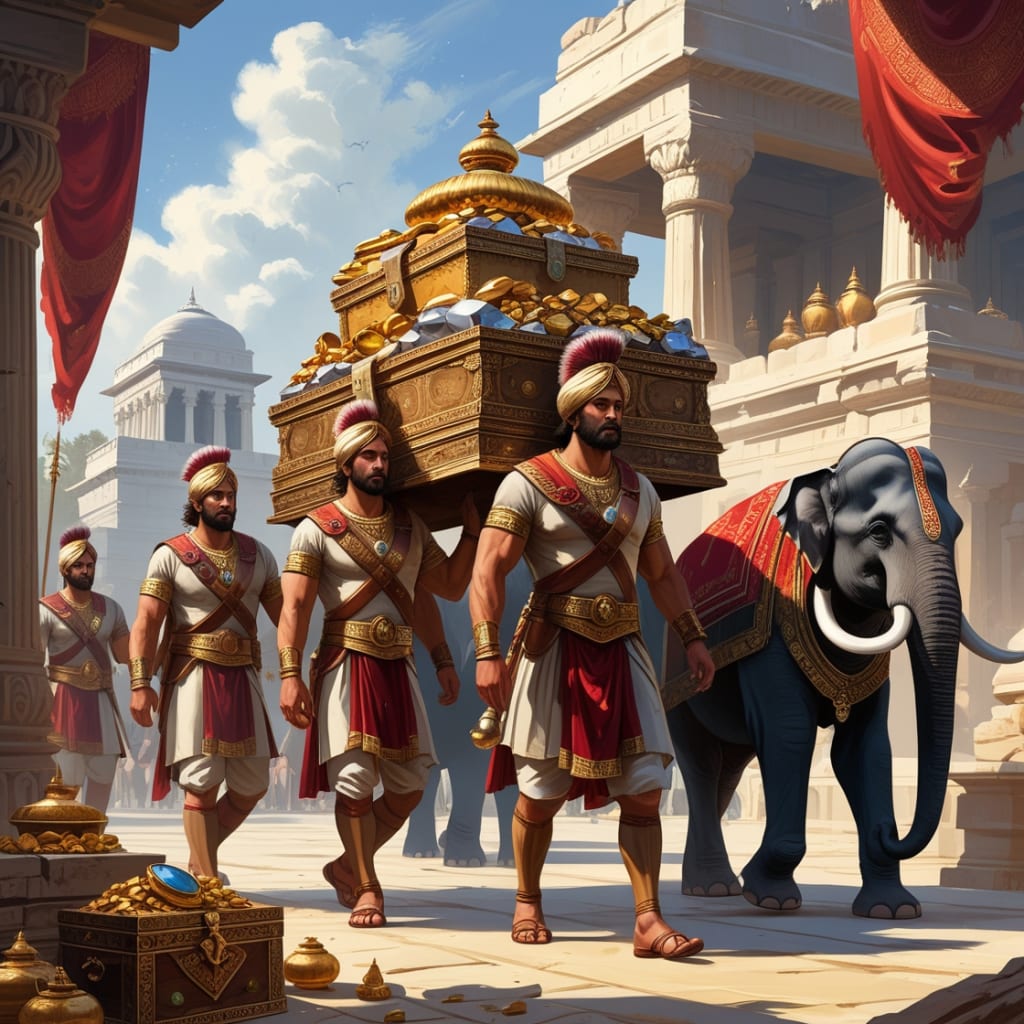
The Plundered Wealth: Alexander the Great’s Loot from India
When Alexander the Great embarked on his ambitious campaign to conquer the known world, India lay as one of his final conquests. The vast subcontinent, rich in gold, gems, spices, and cultural heritage, became an irresistible prize. Though his foray into India was relatively brief, the treasures he and his army looted from the region were immense and legendary. This article delves into the historical context of Alexander’s invasion of India, the wealth he amassed during his campaign, and the lasting impact of that plundered treasure.
The Historical Context: Alexander’s March to India
By 327 BCE, Alexander had already conquered the powerful Persian Empire and parts of Central Asia. His sights were then set on the lands east of the Hindu Kush, which ancient Greeks described as a land of unimaginable wealth. India’s fame had spread through ancient trade networks, and tales of golden palaces, jewel-encrusted statues, and thriving cities drew Alexander’s interest.
Alexander crossed into India with a massive army, initially welcomed by smaller kingdoms, but soon faced stiff resistance from local rulers, particularly King Porus of the Paurava kingdom. After a fierce battle on the banks of the Hydaspes River (modern-day Jhelum), Alexander defeated Porus and gained access to the riches of his kingdom.
Treasures Taken from India
The exact amount of treasure looted by Alexander’s forces is difficult to quantify, but historical accounts offer glimpses of the immense riches. Ancient sources like Arrian, Plutarch, and Quintus Curtius Rufus describe the loot acquired during the campaign:
Gold and Silver: Temples, palaces, and treasuries were pillaged for gold and silver artifacts. It is believed that Alexander’s forces seized large amounts of gold coins, precious metals, and ornate vessels.
Jewels and Gems: India was famed for its gemstones, especially diamonds, pearls, and rubies. These were highly prized by the Greeks, and Alexander ensured that his share of the spoils included the finest gems.
Exotic Animals and Luxury Items: Alexander’s forces also seized elephants, spices, and textiles, all of which added to the allure of the East in Greek imagination.
Captured Art and Relics: Temples and cultural centers were looted, with statues, idols, and other religious artifacts taken as trophies of war.
The Fate of the Loot
The treasure looted from India did not remain intact for long. Much of it was used to pay Alexander’s soldiers, who had endured years of continuous campaigning. Some of the wealth was sent back to Macedonia, where it funded monumental building projects and military expansions.
However, a significant portion of the loot was lost during Alexander’s perilous return journey. After leaving India, Alexander’s army faced a grueling march through the Gedrosian Desert (modern-day southern Pakistan and Iran), where many soldiers perished, and supplies, including parts of the treasure, were lost to the harsh conditions.
The Legacy of Alexander’s Loot
The treasures Alexander took from India played a crucial role in shaping the economy and culture of the Hellenistic world. Greek cities flourished with newfound wealth, and the influx of Indian gold and gems added to the splendor of Alexander’s empire. The spread of Hellenistic art and architecture in the regions Alexander conquered also bore traces of Indian influence, suggesting a two-way exchange of cultural treasures.
The Mystery of Alexander’s Lost Wealth
Despite the significant looting, much of Alexander’s wealth has vanished over the centuries. Some believe that parts of the treasure were lost when Alexander’s fleet encountered storms while navigating the Indus River. Others speculate that hidden caches of loot may still lie buried along Alexander’s route through Central Asia and the Middle East.
Adding to the mystery is the unknown location of Alexander’s tomb, which some legends claim was buried with immense wealth. Treasure hunters and historians have long searched for clues, but the whereabouts of both Alexander’s tomb and his lost Indian treasure remain elusive.
Impact on Indian History
The invasion and looting of India by Alexander, though short-lived, had long-lasting effects. His campaign exposed the subcontinent to Greek ideas, leading to the emergence of Indo-Greek kingdoms that left their own cultural and artistic legacies. However, the loss of wealth and resources weakened some Indian kingdoms, paving the way for later invasions and internal conflicts.
Conclusion
Alexander the Great’s campaign in India stands as a testament to the lure of wealth and power. While his conquests brought glory and riches to his empire, they also drained India of vast treasures, the full extent of which may never be known. Yet, despite the looting, India’s rich cultural and economic fabric endured, continuing to thrive and evolve long after Alexander’s departure. Today, the story of Alexander’s Indian treasure remains one of history’s great mysteries, a tantalizing reminder of the vast riches that once dazzled the ancient world.
About the Creator
Say the truth
"Say the Truth: Explain Everything in the World" is your trusted source for uncovering facts and exploring the wonders of history, science, technology, and beyond. We simplify complex ideas and reveal truths to inspire curiosity .
Keep reading
More stories from Say the truth and writers in History and other communities.
The Legendary Wealth of Alexander the Great: Looted Treasures That Shaped History
The Legendary Loot of Alexander the Great: Unraveling the Wealth of His Conquests Throughout history, few figures have left a legacy as far-reaching and influential as Alexander the Great. Born in 356 BCE in Macedonia, Alexander was destined for greatness, and by the time of his death at the age of 32, he had created one of the largest empires the world had ever seen. However, Alexander’s conquests were not just about expanding territory. His campaigns led to the accumulation of vast amounts of wealth, as he looted palaces, temples, and treasuries across Asia, the Middle East, and parts of North Africa. This wealth, comprising gold, silver, jewels, and priceless artifacts, played a crucial role in shaping the economic, cultural, and political landscape of the ancient world.
By Say the truth 10 months ago in History
Savoy Hotel – Mussoorie: The Colonial Luxury Hotel Where an Unsolved Murder Still Walks the Corridors
The First Night: Beauty Wrapped in Silence Mussoorie looks peaceful from a distance. Pine trees sway gently, clouds roll like slow-moving waves, and the hill air smells of rain and old earth. But as evening falls, the silence becomes heavier—almost watchful.
By Gaurav Gupta4 days ago in History
Is NATO Facing Its Biggest Crisis Yet?
Is NATO Facing Its Biggest Crisis Yet? For more than seventy years, NATO has been one of the strongest military alliances in the world. Formed after World War II, it was designed to protect its members through collective defense. An attack on one was considered an attack on all. For decades, this principle helped maintain stability in Europe and beyond. But today, NATO is facing one of the most challenging moments in its history.
By Wings of Time 8 days ago in History
Silver Screen Magic with Mae West
American actress and singer Mae West became a popular film actress during the Great Depression. She started entertaining in vaudeville, then performed on Broadway, and finally went to Hollywood. She signed up with Paramount Pictures and made her debut in the 1932 film “Night After Night.” She also starred in musicals, comedies, and crime dramas. The American Film Institute named her one of the best classic Hollywood actresses.
By Rasma Raisters6 days ago in Geeks


Comments
There are no comments for this story
Be the first to respond and start the conversation.