
“The Forgotten Fortune: The Tale of Southeast“The Forgotten Fortune: The Tale of Southeast Asia’s Largest Treasure Discovery”
In the tropical depths of Southeast Asia lies a story of legendary wealth, ancient kingdoms, and a fortune buried for centuries. This article explores the greatest treasure ever found in the region — the Cirebon shipwreck off the coast of Java, Indonesia. Containing over 250,000 artifacts of gold, silver, ceramics, and precious gems, the discovery offers a glimpse into ancient trade routes, dynasties, and the powerful kingdoms that once thrived in Southeast Asia. Estimated to be worth over $80 million, the Cirebon treasure is not just a tale of gold and riches but also a story of history, mystery, and legacy.

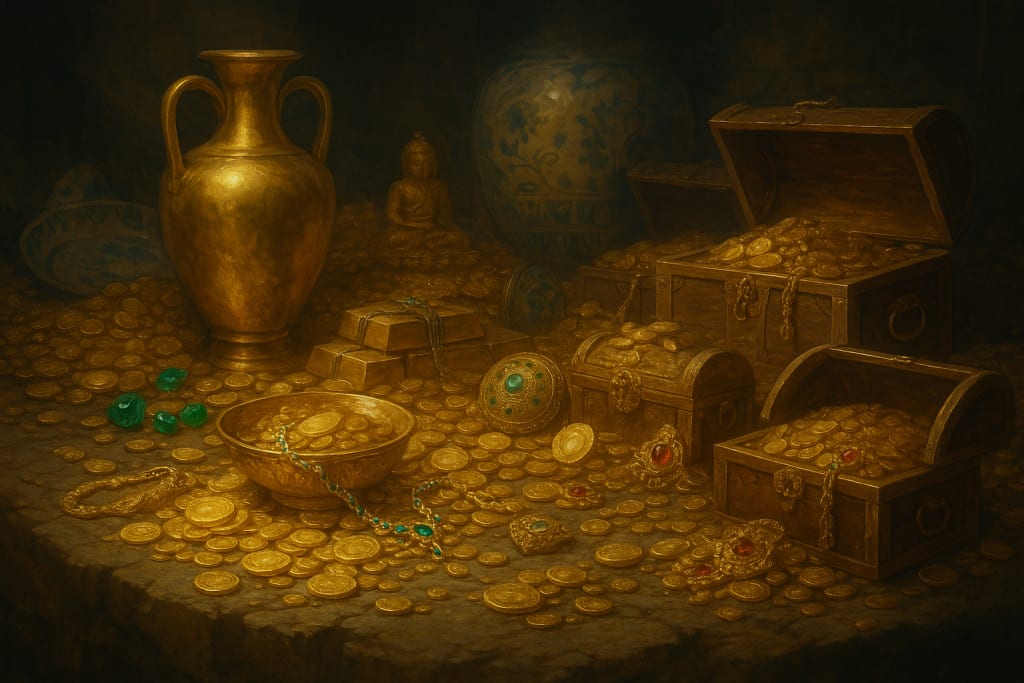
A Sea of Riches Beneath the Waves
In 2004, an accidental discovery off the coast of Cirebon, Java, stunned historians and treasure hunters alike. A fisherman reported unusual objects emerging from the seafloor after a powerful current had shifted the sands. What followed was one of the largest and most valuable underwater excavations in Southeast Asian history: the discovery of a 10th-century shipwreck, later known as the Cirebon shipwreck.
Buried beneath the waves were over 250,000 artifacts, ranging from Chinese porcelain, Persian glassware, Indian gemstones, to solid gold ornaments. The origin of the cargo suggested a vibrant trade network stretching across the Indian Ocean, connecting Tang Dynasty China, Gupta India, and the Islamic caliphates of the Middle East.
The Golden Age of Maritime Silk Road
The treasure is believed to have originated during the reign of the Srivijaya Empire, a powerful maritime kingdom that dominated the sea lanes of Southeast Asia from the 7th to 13th centuries. The ship likely set sail from a Chinese port, passed through the Malacca Strait, and was en route to a Middle Eastern destination before meeting its doom.
Among the most spectacular finds were:
Gold bowls and necklaces bearing Sanskrit inscriptions.
Fine blue-and-white porcelain from the Tang Dynasty.
Glassware crafted in Persia with Islamic motifs.
Buddhist figurines and statues, suggesting religious and cultural exchanges.
The diversity of the artifacts confirmed Southeast Asia’s critical role in the ancient global economy — a central hub where East met West, not only through trade but also ideas, art, and religion.
A Controversial Recovery
The recovery of the treasure was not without its critics. The Indonesian government partnered with a private salvage company, and most of the treasure was auctioned off in the private market. While a portion was preserved for national museums, many historians lamented the loss of priceless heritage to collectors, arguing that the treasure represented not just wealth, but identity.
Despite this, the Cirebon shipwreck forced a re-evaluation of Southeast Asia’s historical significance. No longer was the region seen as merely a recipient of culture, but as a major contributor to the story of globalization, centuries before the term even existed.
Estimating the Net Worth
The treasure from the Cirebon wreck has been valued at over $80 million USD, based on auction sales and estimated market values of the artifacts. However, many experts claim its historical value far exceeds this — perhaps hundreds of millions more — considering its role in illuminating ancient trade and diplomacy.
Some speculate that had the treasure been kept intact and placed in a world-class museum, the tourism and educational value could have generated billions over time, reinforcing Southeast Asia’s place on the world stage.
Legends Yet to Surface
The Cirebon treasure is just one confirmed discovery, but local myths in Indonesia, the Philippines, Thailand, and Cambodia speak of other sunken ships, jungle-hidden gold, and lost royal vaults yet to be found. The legacy of kingdoms like Majapahit, Ayutthaya, Champa, and Sukhothai continue to inspire explorers and historians alike.
Conclusion
The treasure found beneath the waves near Cirebon is a window into a world that once was — a world of opulence, adventure, cultural exchange, and complex diplomacy. It reminds us that history is not just found in dusty books or ruined temples, but sometimes, in forgotten corners of the sea, waiting for the sands of time to shift.
As more discoveries await, Southeast Asia’s story continues to unfold — a tale rich not just in gold, but in the soul of civilizations past.
if like you the article kindly share experience about the story you have heard share in the comments
About the Creator
Say the truth
"Say the Truth: Explain Everything in the World" is your trusted source for uncovering facts and exploring the wonders of history, science, technology, and beyond. We simplify complex ideas and reveal truths to inspire curiosity .
Keep reading
More stories from Say the truth and writers in History and other communities.
"Yamashita's Gold: The Elusive Treasure of Imperial Japan"
Yamashita’s Gold: The Elusive Treasure of Imperial Japan In the shadowy world of wartime legends and hidden fortunes, few tales are as captivating or controversial as that of Yamashita’s Gold—an alleged treasure trove looted by the Japanese Imperial Army during World War II. Believed to contain billions of dollars' worth of gold, religious relics, and ancient artifacts, this treasure has inspired adventurers, fueled conspiracy theories, and stirred international intrigue for decades.
By Say the truth 9 months ago in History
Chinese Water Torture
Since the dawn of history, human beings have inflicted unimaginable suffering upon one another. Across centuries, people have devised increasingly elaborate methods of punishment and coercion, some brutally explicit, others deceptively subtle. While devices such as iron maidens, racks, whips, and wheels relied on visible physical agony, there existed a form of torment whose true power lay not in blood or broken bones, but in patience, repetition, and the slow erosion of the mind. This method came to be known as Chinese water torture.
By Pure child3 days ago in History
Saddam Hussein: Rise, Rule, and Fall
Saddam Hussein was born on April 28, 1937, in a small village near Tikrit, Iraq. His early life was marked by poverty, hardship, and a sense of abandonment. His father died before he was born, and his mother remarried soon after. Young Saddam grew up in a household dominated by strict relatives and was exposed to political discussions and nationalist sentiments from an early age. These formative years shaped his personality—ambitious, ruthless, and fiercely determined to rise above his modest beginnings.
By The best writer 3 days ago in History



Comments
There are no comments for this story
Be the first to respond and start the conversation.