
"Yamashita's Gold: The Elusive Treasure of Imperial Japan"
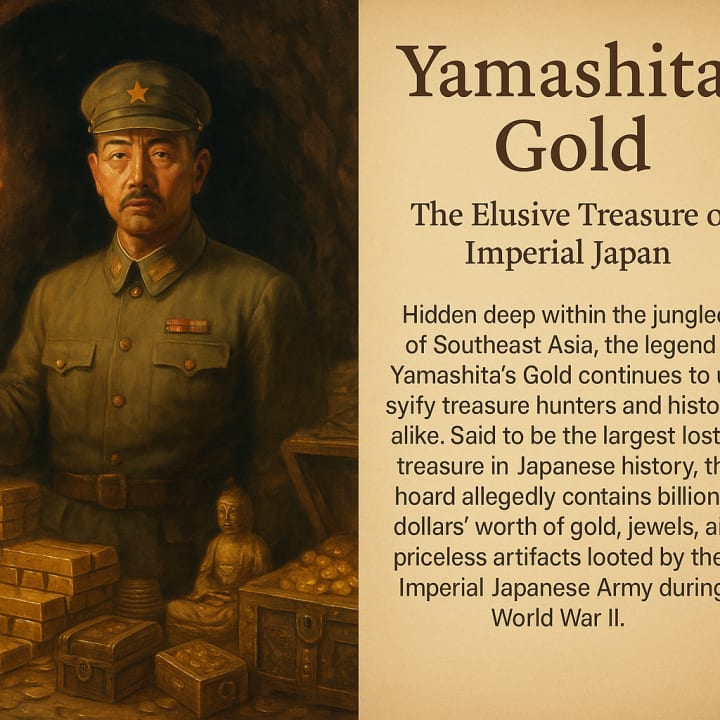
Hidden deep within the jungles of Southeast Asia, the legend of Yamashita's Gold continues to mystify treasure hunters and historians alike. Said to be the largest lost treasure in Japanese history, this hoard allegedly contains billions of dollars' worth of gold, jewels, and priceless artifacts looted by the Imperial Japanese Army during World War II. This article dives into the historical background, the rumored journey of the treasure, and the theories that continue to fuel searches across the Philippines and beyond.

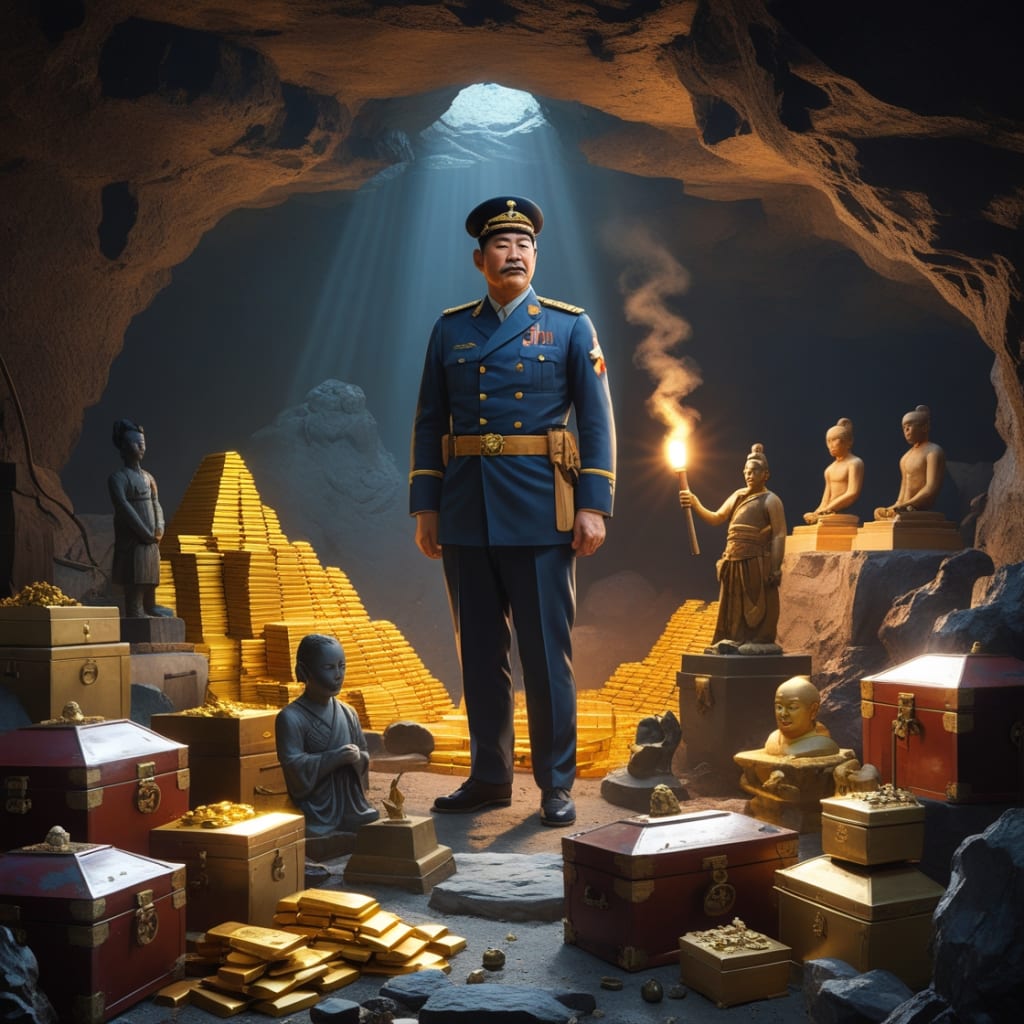
Yamashita’s Gold: The Elusive Treasure of Imperial Japan
In the shadowy world of wartime legends and hidden fortunes, few tales are as captivating or controversial as that of Yamashita’s Gold—an alleged treasure trove looted by the Japanese Imperial Army during World War II. Believed to contain billions of dollars' worth of gold, religious relics, and ancient artifacts, this treasure has inspired adventurers, fueled conspiracy theories, and stirred international intrigue for decades.
The Origin of the Legend
During the early 1940s, the Japanese Empire expanded rapidly across Asia, occupying territories in China, Southeast Asia, and the Pacific. As the Imperial Army invaded countries like the Philippines, Indonesia, Malaysia, and Thailand, they seized national treasures, private wealth, religious artifacts, and gold from central banks.
The mastermind behind the systematic plunder was said to be General Tomoyuki Yamashita, a high-ranking officer nicknamed the "Tiger of Malaya." Under his command, looted treasures were transported to the Philippines—Japan’s strategic military base—with the intention of later shipping them back to the Japanese mainland. However, as the tide of the war turned and Allied forces closed in, the Japanese buried the loot in elaborate underground tunnels and caves across the Philippine islands, particularly in Luzon.
The Buried Fortune
Estimates suggest that the value of Yamashita’s Gold could range from $100 billion to $200 billion in today’s currency. The treasure allegedly included:
Golden Buddha statues
Gold bars and coins
Gemstones and diamonds
Cultural relics and religious artifacts
Crown jewels of various Asian nations
To ensure secrecy, it is said that the Japanese military executed most of the laborers and engineers who built the treasure vaults, preventing anyone from revealing the locations. Only a few officers held the maps and codes, and many of them died during the war or were captured.
Postwar Rumors and the Marcos Connection
After Japan’s surrender in 1945, rumors began to swirl about the treasure’s existence. One of the most controversial and persistent claims was that Ferdinand Marcos, the former President of the Philippines, discovered part of Yamashita’s Gold during his reign and used it to secretly amass vast personal wealth. Though never conclusively proven, some witnesses alleged that gold bars bearing Japanese markings were recovered from underground tunnels near Manila and Ilocos Norte.
In the 1970s and 80s, the Marcos family was accused of laundering money tied to wartime treasure, and Swiss banks were rumored to have received millions in gold-backed assets. Marcos never admitted to possessing the treasure, but these claims added fire to an already mysterious tale.
Legal Battles and Controversies
One of the most famous court cases tied to Yamashita’s Gold was the Rogelio Roxas lawsuit in 1988. Roxas, a Filipino locksmith and amateur treasure hunter, claimed to have discovered a chamber containing a golden Buddha statue and gold bars in the mountains of Luzon in 1971. He alleged that the statue alone weighed over one ton and concealed a hidden compartment filled with diamonds.
Shortly after his discovery, Roxas claimed the military raided his home, and the statue disappeared. He sued Marcos in a U.S. court, and a Hawaiian jury awarded his estate $22 billion in damages. Although only a fraction was ever recovered, the case reignited global interest in the mystery.
Modern-Day Searches and Theories
Despite numerous expeditions and decades of searching, no publicly confirmed recovery of Yamashita’s Gold has been made. Modern treasure hunters use satellite imagery, ground-penetrating radar, and ancient Japanese maps in their quests. Some believe parts of the treasure were already smuggled to Japan by secret networks at the war’s end. Others think it lies untouched, hidden beneath layers of rock and concrete, waiting to be uncovered.
There are also skeptics who believe the treasure is a myth—propaganda created during the Cold War or exaggerated tales spun by opportunists. However, the sheer volume of testimonies, alleged artifacts, and legal proceedings suggests that at least some basis for the story exists.
Legacy and Cultural Impact
Whether fact or fiction, Yamashita’s Gold has become an integral part of postwar folklore in Asia. It symbolizes the chaos of war, the ambitions of empire, and the lure of unimaginable wealth. Its legacy echoes in books, documentaries, and films, making it one of the most enduring treasure legends in modern history.
For Japan, the story is also a reminder of its wartime past and the complex legacy of its imperial ambitions. For the Philippines, it remains a national mystery, where greed, power, and history collide beneath the earth.
About the Creator
Say the truth
"Say the Truth: Explain Everything in the World" is your trusted source for uncovering facts and exploring the wonders of history, science, technology, and beyond. We simplify complex ideas and reveal truths to inspire curiosity .
Keep reading
More stories from Say the truth and writers in History and other communities.
"The Sacred Vessel: Unraveling the Mystery of the Container Said to Hold Jesus’ Blood"
The Sacred Vessel: Unveiling the Mystery of the Holy Grail – The Container Said to Hold the Blood of Jesus Summary: The legend of the Holy Grail, the sacred vessel believed to have held the blood of Jesus Christ, is one of the most enduring and enigmatic mysteries in history. Revered by Christians and pursued by knights, monarchs, and seekers for over two millennia, the story intertwines faith, myth, and archaeology. This article delves into the historical origins of the Grail, its significance in Christian theology and medieval lore, and explores various claims regarding its current location—whether in ancient cathedrals, secret vaults, or hidden across Europe. With a cultural and symbolic worth that far exceeds any monetary value, the Holy Grail continues to inspire awe and spiritual fascination.
By Say the truth 9 months ago in History
Martin Luther King Jr.: The Voice of Peace and Justice
Martin Luther King Jr. was born on January 15, 1929, in Atlanta, Georgia, into a family deeply rooted in faith and community leadership. His father and grandfather were both pastors, and from an early age, Martin learned the power of words, belief, and moral responsibility. Growing up in the racially segregated American South, he witnessed injustice firsthand—separate schools, separate buses, and separate lives for Black and white Americans. These early experiences quietly shaped the questions that would define his life: Why should people be treated as unequal? And how could such injustice be peacefully undone?
By The best writer 5 days ago in History


Comments
There are no comments for this story
Be the first to respond and start the conversation.