
“The Forgotten Architects of History: The People Who Built the World We Inherited”
They shaped empires, invented the impossible, and built the foundations of civilization — yet history rarely remembered their names.
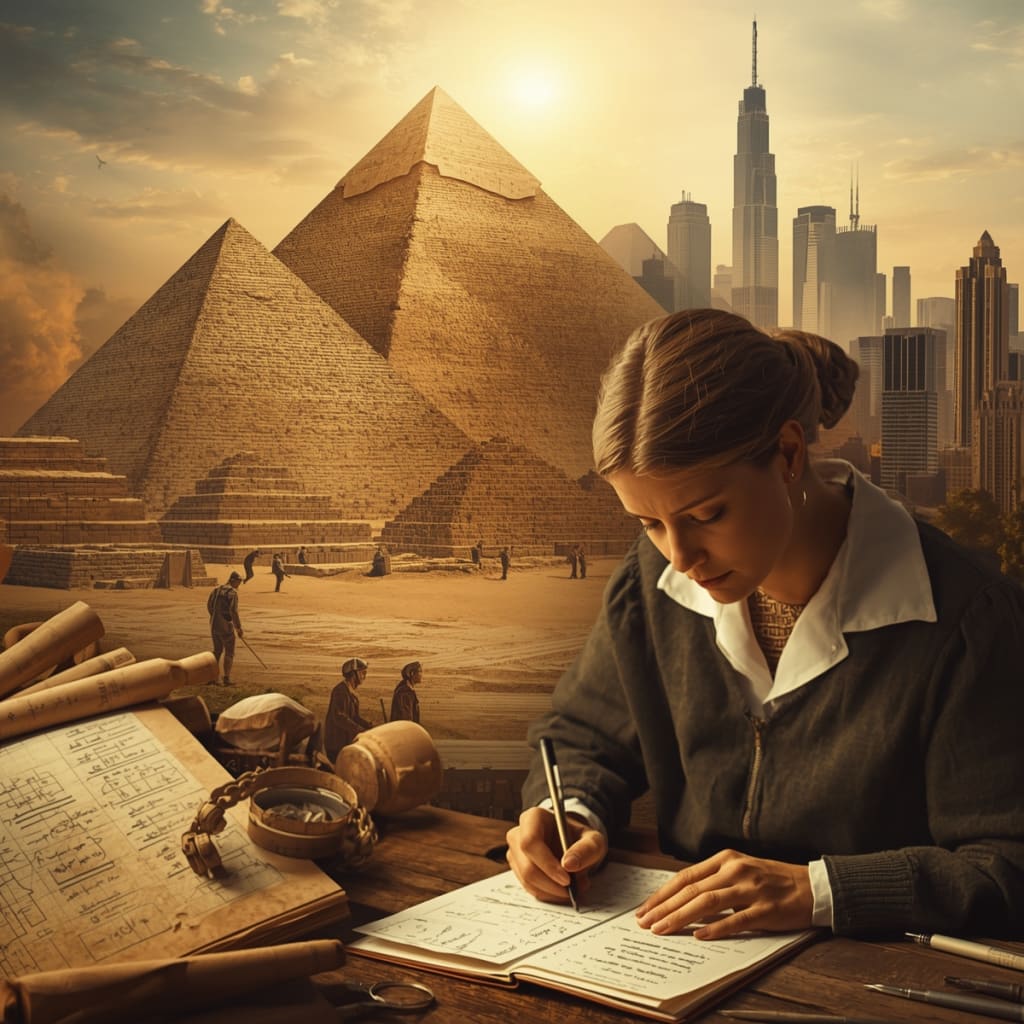
History remembers the victors. It records the kings, the generals, the conquerors — the loudest voices of their time. But beneath every empire, behind every invention, and within every triumph, there were the people history forgot: the builders, thinkers, dreamers, and laborers who laid the invisible foundations of the world we inherited.
This is their story.
I. The Hands That Raised the Pyramids
Close your eyes and imagine Egypt, 2560 BCE. The sun scorches the desert plains. Thousands of men and women labor under a blazing sky, hauling limestone blocks heavier than a small car. The Pharaoh Khufu will have his name etched in eternity, but the workers’ names are lost to time.
They were not slaves in chains, as we were taught. Archaeological discoveries reveal carefully organized worker villages with bakeries, medical care, and teams of artisans. They sang while they worked. They endured storms, hunger, and exhaustion. Their reward wasn’t fame — it was a pyramid that would defy millennia.
The grandeur of the Great Pyramid exists today not because of a pharaoh’s ambition, but because of human hands that history forgot to honor.
II. The Minds That Counted the Stars
Fast forward to Babylon, 4,000 years ago. In a dimly lit room, a scholar presses a reed into soft clay, calculating the movement of planets. He writes tables of numbers, predicting eclipses and lunar cycles with astonishing precision. He will never see his work published in a textbook. He will never be remembered.
Centuries later, Europe hails Euclid, Archimedes, and Pythagoras as the fathers of mathematics. But without these early Babylonian minds, their formulas would have been nothing more than conjecture. They are the silent architects of reason, the invisible scaffolding upon which human knowledge was built.
III. Women Who Dared to Dream
History loves to lionize men, yet some women defied centuries of oppression and reshaped the world quietly, brilliantly, and bravely.
Take Olympe de Gouges, who in 1791 dared to write The Declaration of the Rights of Woman and the Female Citizen in revolutionary France. She demanded equality in a world that considered women invisible. She was executed for it.
Or Ada Lovelace, who saw in Charles Babbage’s mechanical “Analytical Engine” the possibility of a machine that could think — centuries before computers existed. Her notes became the blueprint for the digital world, yet her name was buried under the shadow of her male peers.
Then there was Katherine Johnson, whose genius guided the Apollo missions to the moon. For decades, her calculations remained invisible, masked by the color and gender barriers of her time.
These women were not anomalies; they were visionaries whose courage built the invisible architecture of progress.
IV. The Invisible Hands of Innovation
Even in the Industrial Age, innovation was never a solo act. Thomas Edison may have “invented” the lightbulb, but without hundreds of unnamed assistants, his lab would have been silent. Alexander Graham Bell shares his fame with Elisha Gray, who filed a patent for the telephone on the same day — yet disappeared into obscurity.
The story repeats itself across history: the world rewards the few who are seen, while the many who create remain shadows.
Civilization is not the work of heroes. It is the sum of countless hands, minds, and hearts working in tandem — often without recognition.
V. Our Inheritance
Step into any modern city. Skyscrapers rise like mountains. Streets hum with electricity. Cars, trains, and airplanes move with precision. Every innovation, every structure, every discovery traces back to those unnamed architects of history.
They may have lived and died without statues, accolades, or fame. They may have never spoken in courtrooms or graced the pages of textbooks. Yet they live on — in the pyramid blocks, the equations, the software, and the engines that power our world.
We are their legacy. Every time we create, every time we solve a problem, every time we push boundaries, we are walking in their footsteps — honoring the lives they built silently, and the future they made possible.
The next time history celebrates a name, remember this: behind every story, there are the forgotten architects who built the world we inherited. They may have been invisible, but their impact is eternal.
About the Creator
3 True Stories That Sound Like Urban Legends but Aren’t
Urban legends usually follow a familiar pattern. A friend of a friend hears something unbelievable, the details get hazy, and the story ends with a warning about human stupidity or bad luck. The unspoken rule is simple: if it sounds too strange to be true, it probably is.
By Enoch Sagini4 days ago in History
The Crown of Ash and Gold
In the final era of the ancient kingdom of Aurelion, the world seemed to change its tone. The skies appeared duller, the winds colder, and the streets quieter than they had ever been during the kingdom’s golden age. Aurelion was once a beacon of civilization—its stone cities gleamed under the sun, its scholars were respected across continents, and its armies had carved its name into history. Yet no empire, no matter how mighty, can escape the slow test of time.
By The best writer 7 days ago in History



Comments
There are no comments for this story
Be the first to respond and start the conversation.