
The First African Trading Empire: The Rise of Ancient Ghana
Africa’s First Trading Powerhouse and Its Golden Legacy

Introduction
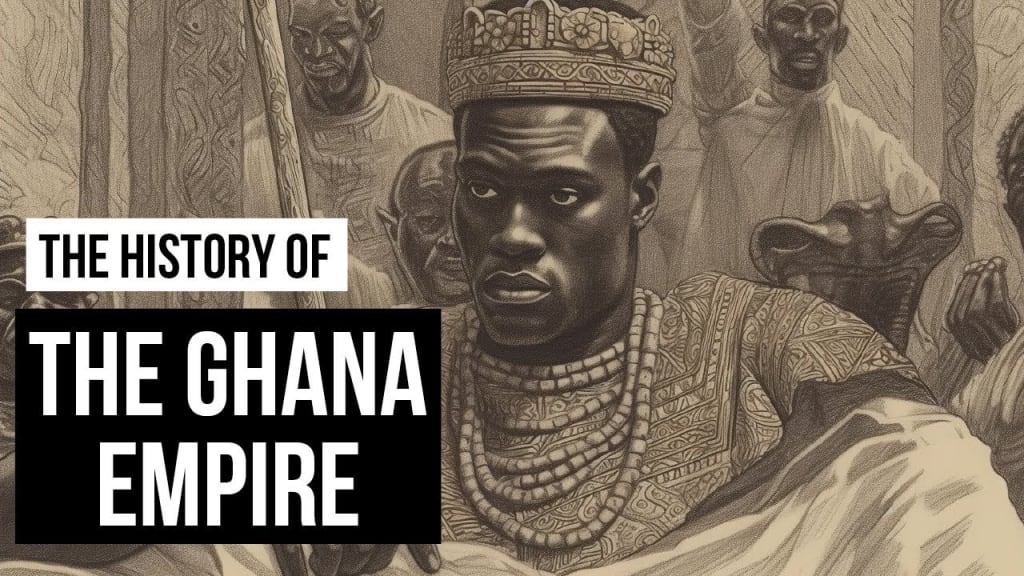
The history of trade in Africa is as rich and diverse as the continent itself. Among the earliest and most prosperous trading empires in Africa was the Empire of Ghana, often considered the first major trading empire in sub-Saharan Africa. This empire flourished between the 6th and 13th centuries and became a central hub for trans-Saharan trade, especially known for its wealth in gold. This article will delve deep into the rise and fall of ancient Ghana, its economy, political structure, and cultural influence, and will provide insights into how its strategic positioning and resources shaped African and global history.
What Was the Empire of Ghana?
Despite its name, Ancient Ghana is not related to modern-day Ghana, which lies farther south. The empire was located in what is today Mauritania, Senegal, and Mali, on the fringes of the Sahara desert and the western part of the Sahel.
The empire’s real name was Wagadou, and it was established by the Soninke people, a Mandé-speaking group. The title Ghana actually referred to the king or war chief of Wagadou, but over time, it came to represent the entire empire.
Geographic Importance
Ghana's location on the edge of the Sahara gave it a strategic advantage, allowing it to act as an intermediary between the Arab traders of North Africa and the peoples of West Africa. This position facilitated the trade of gold, salt, and other valuable commodities, making Ghana an economic powerhouse during its prime.
The Economy of Ancient Ghana
1. Gold-Salt Trade
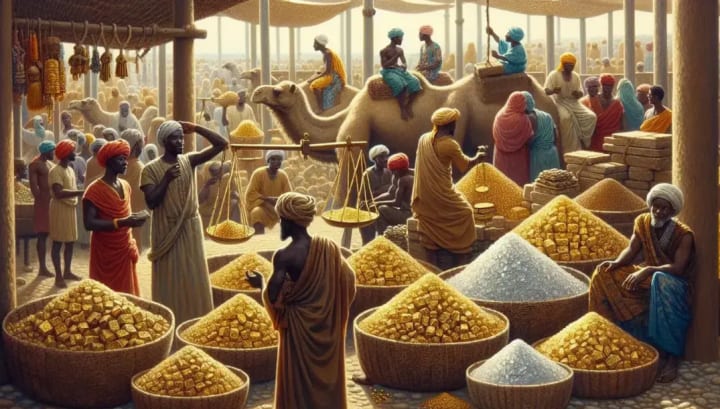
The backbone of Ghana’s economy was its gold-salt trade. Gold, mined in the regions to the south, particularly Bambuk, was transported north to trade with Arab merchants who brought salt from the Sahara. Salt was highly prized in West Africa for preserving food and maintaining health, and it became as valuable as gold in many cases.
Ghana was also a pivotal player in the trans-Saharan trade routes, which linked the Arab world, the Mediterranean, and sub-Saharan Africa. Other goods such as ivory, slaves, and kola nuts were also traded.
2. Taxation of Trade
The rulers of Ghana grew wealthy not just from direct trade but also by taxing goods that passed through their territories. Merchants were required to pay taxes on the goods they carried both into and out of Ghana, ensuring that the empire profited from all commercial activity.
3. Iron and Agriculture
Besides trade, Ghana also had a thriving agriculture sector, supported by the Niger River. The Soninke people were adept at cultivating crops, which helped sustain their large populations. They were also skilled in ironworking, which provided them with superior weapons and tools, giving them a military and technological edge over their rivals.
Political Structure and Governance
The empire of Ghana was ruled by a powerful king known as the "Ghana," who held supreme authority. The king controlled the gold trade and ensured the empire's wealth was concentrated in the hands of the elite. The government was highly centralized, with the king at its apex, supported by a court of nobles, governors, and military leaders.
Capital: Kumbi Saleh
The capital city of Ghana, Kumbi Saleh, was actually two towns a few kilometers apart. One was a Muslim town where Arab traders resided, and the other housed the royal court and the indigenous Soninke people. This dual-city structure highlights the cosmopolitan nature of Ghana, which incorporated Islamic traders and their culture while maintaining traditional African governance and social systems.
The Role of Islam
With the rise of the trans-Saharan trade came increased contact with Arab merchants, many of whom were Muslim. Over time, Islam began to influence Ghana, particularly in the urban centers where trade took place. Although the kings of Ghana did not initially convert to Islam, they employed Muslim advisors and scribes, allowing the empire to benefit from the literacy and administrative knowledge that Islam brought.
Decline of the Empire
The decline of Ghana began in the late 11th century. Several factors contributed to its downfall:
1. Invasions: The Almoravid dynasty, a Muslim Berber group, invaded Ghana around 1076. Though they didn’t occupy the empire for long, their invasions weakened it.
2. Overextension: As the empire expanded, it became harder to manage. The king struggled to maintain control over distant territories.
3. Rival Kingdoms: New powers, particularly the Empire of Mali, rose in prominence, taking over much of Ghana’s former territories and trade routes.
By the mid-13th century, the once-great empire had fallen into decline, giving way to the rise of Mali, which would go on to dominate the region.
Legacy of Ghana
Despite its eventual decline, the Empire of Ghana left a lasting legacy. It paved the way for the great empires of Mali and Songhai, both of which would continue the tradition of wealth and power through control of the gold and salt trade routes. Additionally, Ghana set the stage for the spread of Islam and the establishment of trans-Saharan trade networks that linked sub-Saharan Africa with the Mediterranean and the wider world.
FAQ
What was the first African trading empire?
The first major trading empire in Africa was the Empire of Ghana, also known as Wagadou, which thrived between the 6th and 13th centuries and became wealthy through its control of the gold and salt trade.
Why was the Empire of Ghana important?
The Empire of Ghana was important because of its strategic position on the trans-Saharan trade routes, allowing it to control and tax trade between North and West Africa. Its wealth in gold made it one of the richest empires of its time.
What caused the decline of the Empire of Ghana?
The decline of the Empire of Ghana was due to several factors, including invasions by the Almoravids, internal overextension, and the rise of rival kingdoms like the Empire of Mali.
How did the Empire of Ghana control trade?
The Empire of Ghana controlled trade by taxing merchants who passed through its territory, as well as by managing the gold mines and regulating the flow of gold and other goods.
What role did Islam play in the Empire of Ghana?
Islam played a significant role in the Empire of Ghana, particularly in urban centers where Muslim traders lived. Although the kings did not initially convert, they employed Muslim advisors and scribes, benefiting from the administrative and literacy skills that Islam brought.
Conclusion
The Empire of Ghana is a vital part of African history, symbolizing the power of strategic trade and resource control. Its dominance of the gold and salt trade left an indelible mark on both African and world history. By understanding the rise and fall of Ghana, we gain insight into the early economic and cultural development of West Africa and the long-standing importance of trade in shaping civilizations.
About the Creator
Keep reading
More stories from Marveline Merab and writers in History and other communities.
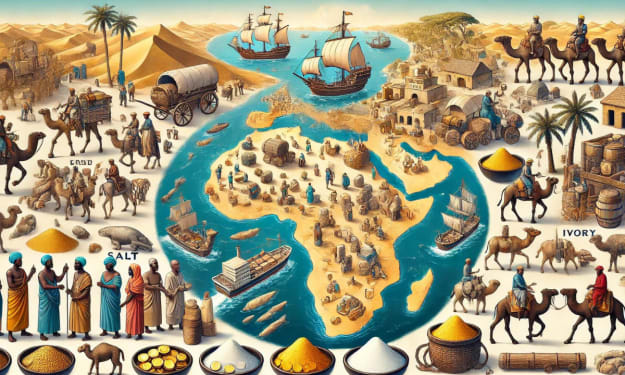
Items That Dominated African Trade Routes: A Comprehensive Overview
African trade routes have a rich history, serving as vital arteries of commerce that facilitated the exchange of goods, culture, and ideas across the continent. From the trans-Saharan routes to coastal trade networks, various items played pivotal roles in shaping economic dynamics and influencing civilizations. In this article, we will explore the key items that dominated African trade routes and their significance in historical and contemporary contexts.
By Marveline Merababout a year ago in History
Charlie Chaplin — The Tramp Who Conquered the World
Charlie Chaplin was not born into comfort or certainty. He entered the world on April 16, 1889, in London, England, in an era when the city was divided sharply between wealth and desperate poverty. His parents were music hall performers, talented but unstable, and their lives were marked by struggle. Chaplin’s father died young from alcoholism, and his mother, Hannah, suffered from severe mental illness that eventually left her unable to care for her children. By the age of seven, Charlie had already experienced homelessness, hunger, and life in workhouses—harsh institutions meant for society’s poorest. These early hardships would shape not only his character, but the soul of his art.
By The best writer about 19 hours ago in History
Miss Persephone's Manual to a Seemingly Ordinary Life
Miss Persephone was found at the dining table, her blue eyes swollen, her tears arriving and retreating like the tides of the ocean. Earlier that day, her family had visited her in the retirement home where she had lived for eight years. It was her eightieth birthday.
By Imola Tóth3 days ago in Fiction


Comments
There are no comments for this story
Be the first to respond and start the conversation.