
The Conqueror of Empires and Patron of Culture
Tracing the Life, Military Campaigns, and Legacy of the First Sultan of the Ghaznavid Empire

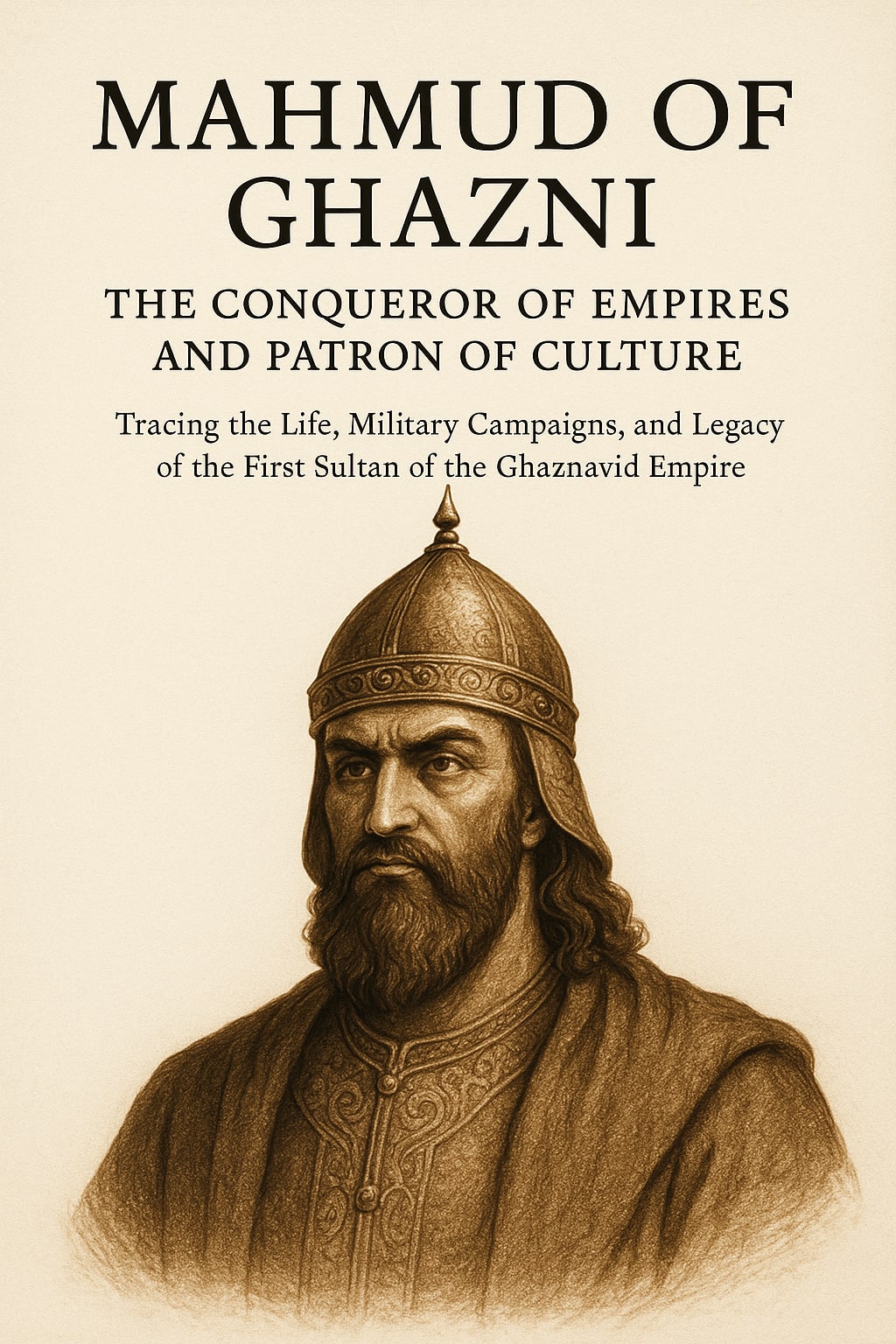
Mahmud of Ghazni (971–1030 CE), born Yamin ad-Dawlah Mahmud ibn Sebüktegin, was a formidable ruler, warrior, and cultural patron whose influence extended far beyond the borders of his empire. As the first ruler to bear the title “Sultan,” Mahmud's reign marked the formal emergence of Islamic rule in the Indian subcontinent and helped shape the religious, political, and cultural landscape of South and Central Asia.
Early Life and Rise to Power
Mahmud was born in 971 in the city of Ghazni (present-day Afghanistan), the son of Sebüktegin, a former Turkic slave who rose through military ranks to establish the Ghaznavid dynasty. Educated in Islamic sciences, Persian literature, and military strategy, Mahmud inherited both administrative skill and martial ambition from his father.
Upon Sebüktegin’s death in 997, Mahmud engaged in a brief struggle with his brother Ismail for succession. Victorious, he ascended the throne and quickly began consolidating power, transforming the Ghaznavid realm into a structured and militarized empire. Recognized by the Abbasid Caliphate, Mahmud assumed the prestigious title of "Sultan," indicating his independence as a ruler while acknowledging religious authority from Baghdad.
Military Campaigns and Conquests
Mahmud is most renowned for his seventeen invasions into the Indian subcontinent between 1000 and 1027 CE. These expeditions had both economic and religious motivations. India's wealth—particularly its temples—presented lucrative targets, and Mahmud saw himself as a warrior of Islam, committed to expanding the faith and dismantling non-Muslim strongholds.
His earliest campaigns were aimed at the frontier regions of the Punjab. Over time, Mahmud pushed deeper into the subcontinent, raiding key cities such as Mathura, Kanauj, and Somnath. The raid on the temple of Somnath in 1025 was perhaps his most infamous, where he is said to have destroyed the temple, seized immense wealth, and returned to Ghazni with thousands of prisoners.
These invasions devastated parts of northern India but did not lead to permanent occupation. Instead, Mahmud installed loyal vassals in key cities and retreated to Ghazni with the spoils of war. His campaigns left a deep imprint on Indian history, contributing to the long-standing Hindu-Muslim tensions and establishing a precedent for future Muslim dynasties in the region.
Administrator and State Builder
While Mahmud is often remembered for his military conquests, his administrative capabilities were equally impressive. He established Ghazni as a cosmopolitan capital, strengthening central authority, systematizing tax collection, and creating a network of loyal provincial governors. His court was an elaborate and organized structure, modeled after Persian bureaucratic ideals, and he maintained a standing army that was among the most powerful in the Islamic world.
Mahmud’s empire stretched from the Caspian Sea in the west to the Indus River in the east, and from the Oxus River in the north to the Indian Ocean in the south. He fortified borders, built roads, and established caravanserais to support commerce and military logistics.
Patron of Culture and the Arts
Despite his reputation as a ruthless conqueror, Mahmud of Ghazni was a devoted patron of art, architecture, and scholarship. He transformed Ghazni into a thriving cultural and intellectual center, rivaling cities like Baghdad and Bukhara.
He invited scholars, poets, scientists, and theologians to his court, offering them patronage and prestige. Among the most famous of these was the Persian polymath Al-Biruni, who accompanied Mahmud on some of his Indian campaigns and later authored Kitab al-Hind—a seminal study of Indian religion, philosophy, science, and culture. Another celebrated figure at Mahmud’s court was the poet Ferdowsi, author of the Shahnameh, the Persian epic that chronicles the mytho-historical past of Iran.
Though Mahmud and Ferdowsi reportedly had a falling-out over payment for the Shahnameh, Mahmud's role in fostering Persianate culture remains undeniable. He commissioned the construction of mosques, palaces, and libraries, blending Persian, Turkic, and Indian architectural styles in what became a distinctive Ghaznavid aesthetic.
Religious Views and Policies
Mahmud considered himself a defender of Sunni orthodoxy and actively promoted Islam during his rule. He suppressed Shiite sects and Ismailis within his territories and destroyed Hindu temples during his campaigns in India—though it's debated whether his motives were strictly religious or largely economic.
He endowed mosques, built religious schools (madrasas), and supported the spread of Islamic jurisprudence. While tolerant of scholars from diverse backgrounds, his policies were less forgiving toward religious institutions outside Sunni Islam.
Death and Succession
Mahmud of Ghazni died in 1030 CE after ruling for 33 years. His death marked the beginning of the decline for the Ghaznavid Empire, as his successors failed to maintain the vast territories he had amassed. His son, Mas'ud I, inherited the throne but lacked his father's strategic vision, leading to losses in Central Asia and growing threats from the Seljuk Turks.
Despite the empire’s gradual decline, Mahmud's legacy endured for centuries. He remained a symbol of power and Islamic victory, lionized in Persian literature and Islamic historiography, though often vilified in Indian nationalist narratives for his destructive raids.
Legacy
Mahmud of Ghazni’s legacy is complex and contested. To many in the Islamic world, he is remembered as a heroic figure who expanded the frontiers of Islam and established a model Islamic state rooted in justice, scholarship, and power. His sponsorship of intellectuals helped preserve and transmit scientific and literary knowledge across cultures.
In India, however, Mahmud's legacy is often viewed with ambivalence or hostility. His destruction of temples and large-scale looting are cited as early examples of religiously motivated aggression, though modern historians debate the extent and motives of these actions.
What is undeniable is Mahmud's transformative role in medieval Islamic and South Asian history. As both a conqueror and a curator of culture, he embodied the paradoxes of his age—a time when violence and enlightenment, religious fervor and artistic brilliance, coexisted under the banners of empire.
About the Creator
Irshad Abbasi
"Studying is the best cure for sorrow and grief." shirazi
Keep reading
More stories from Irshad Abbasi and writers in History and other communities.
Sultan Abdul Hamid II
Sultan Abdul Hamid II, born on September 21, 1842, in Istanbul, was the 34th Sultan of the Ottoman Empire and the last to wield effective autocratic power. His reign, from 1876 to 1909, was marked by dramatic change, internal strife, foreign pressure, and a fierce struggle to preserve a crumbling empire. A complex figure, he is remembered both as a defender of Islam and the caliphate, and as an authoritarian ruler who ruled with a heavy hand in turbulent times.
By Irshad Abbasi 8 months ago in History
The Quiet Rise of Global Militarization
The Quiet Rise of Global Militarization Across the world, governments are increasing military spending, expanding defense industries, and modernizing weapons systems—often without openly acknowledging why. There are no formal declarations of war, no mass troop mobilizations, and no clear enemy named in many cases. Yet behind the scenes, a quiet shift is taking place. Global militarization is rising, not loudly, but steadily, reshaping international relations in ways that may define the coming decades.
By Wings of Time about 5 hours ago in History
3 Completely Innocent Decisions That Ended Very Badly
Most disasters don’t begin with villainous laughter or ominous music. They begin with someone making a perfectly reasonable decision. Sensible, even. The kind of choice you’d defend confidently if questioned later.
By Enoch Saginiabout 4 hours ago in History


Comments (1)
Mahmud of Ghazni's military campaigns were quite something. His raids into India for wealth and to spread Islam were impactful. I wonder how different the region's history would be if his religious motivations hadn't been as strong? And what were the long - term effects of his destruction of temples like Somnath?