
3 Completely Innocent Decisions That Ended Very Badly
#3. Opening the Door to Be Polite (The Halifax Explosion, 1917)
Most disasters don’t begin with villainous laughter or ominous music. They begin with someone making a perfectly reasonable decision. Sensible, even. The kind of choice you’d defend confidently if questioned later.
This seemed like a good idea at the time.
History is full of moments where no one was trying to cause harm. No one was reckless. No one thought they were about to become a cautionary tale taught in textbooks or whispered about decades later. And yet, through bad timing, incomplete information, or reality’s deep commitment to irony, everything went catastrophically wrong.
These are not stories of stupidity. They’re stories of innocence colliding with consequences.
Here are three completely innocent decisions that ended very, very badly.
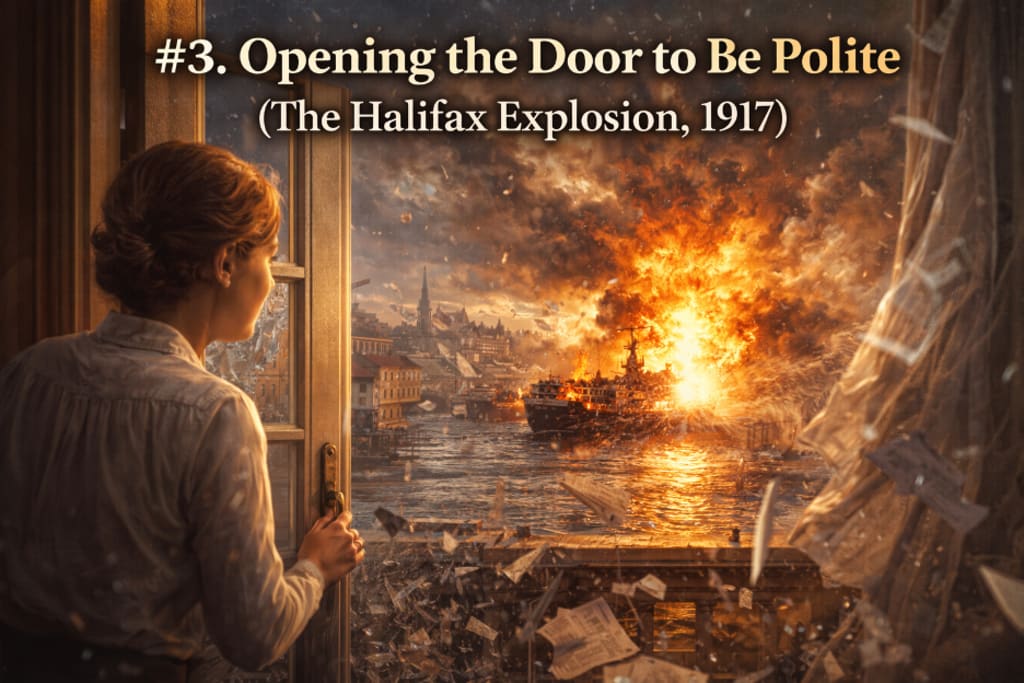
3. Opening the Door to Be Polite (The Halifax Explosion, 1917)
On the morning of December 6, 1917, residents of Halifax, Nova Scotia, noticed something unusual in the harbor: two ships had collided and were on fire. This was inconvenient, dramatic, and very interesting.
Naturally, people gathered to watch.
One of the ships, the SS Mont-Blanc, was carrying a massive cargo of explosives—something most of the city did not know. Fire spread. Smoke rose. Onlookers pressed closer to the windows for a better view.
Parents called children inside—not because of danger, but because breakfast was getting cold. Office workers paused mid-task to observe. Teachers dismissed curiosity as a harmless distraction.
And then something profoundly polite happened.
As the fire burned, many people opened windows and doors to watch more comfortably, letting in fresh air and light.
At 9:04 a.m., the ship exploded.
It was the largest man-made explosion the world had seen at that point. The blast flattened much of the city, shattered windows miles away, and created a pressure wave that turned glass into lethal shrapnel.
Thousands were injured. Nearly 2,000 people died.
A horrifying number of eye injuries occurred because people were standing near windows they had opened moments earlier—not out of recklessness, but courtesy and curiosity.
The innocent decision was simple: Let’s open the window and have a look.
History answered with devastation.
2. Ignoring a Weird Noise Because “It’s Probably Nothing” (The Challenger Disaster, 1986)
On January 28, 1986, NASA prepared to launch the Space Shuttle Challenger. Engineers had concerns. Specifically, about rubber O-rings used to seal the solid rocket boosters. These rings were known to become brittle in cold temperatures.
It was cold that morning.
Engineers flagged the issue. Meetings were held. Charts were shown. The concern wasn’t dramatic—it wasn’t “this will definitely explode.” It was softer, more dangerous language:
We’re not sure.
This hasn’t been tested.
This might be a problem.
Management weighed the risks. Launch delays were expensive. Public pressure was intense. The shuttle carried Christa McAuliffe, a civilian teacher. This launch symbolized inspiration, not hesitation.
The decision was made to proceed.
Seventy-three seconds after liftoff, Challenger disintegrated in front of millions watching live television. All seven crew members were killed.
The innocence lies in how ordinary the reasoning was. No one intended harm. No one thought they were authorizing a tragedy. The decision wasn’t “ignore safety.” It was “we think this will probably be okay.”
It wasn’t.
This disaster permanently changed NASA’s safety culture and became a case study in how reasonable decisions, made under pressure, can end in irreversible loss.
Sometimes “probably fine” is the most dangerous phrase in history.
1. Moving a Chair to Get a Better View (The Great Molasses Flood, 1919)
Boston, 1919. A massive storage tank held over two million gallons of molasses—used for food production and industrial alcohol. The tank leaked regularly. Locals joked about it. Kids collected drips with cups. The smell was a permanent neighborhood feature.
Engineers assured everyone it was fine.
On January 15, the tank ruptured.
A wave of molasses—up to 25 feet high—rushed through the streets at terrifying speed. Buildings were knocked off their foundations. Trains were derailed. People and horses were trapped and drowned in syrup thick enough to immobilize them.
Twenty-one people died. Over 150 were injured.
Now here’s the innocent decision.
Multiple victims had stepped outside or repositioned themselves moments before the collapse—some to investigate strange noises, others to get a better view of what they assumed was a minor leak or mechanical issue.
Molasses was not considered dangerous. It was sticky. Sweet. Annoying at worst.
No one anticipated a tidal wave of syrup behaving like a freight train.
The disaster led to major changes in engineering standards and corporate accountability. But for those caught in it, the chain of events began with curiosity and routine movement.
They didn’t run toward danger. They simply adjusted their position—expecting nothing worse than a mess.
Conclusion
What makes these stories haunting isn’t that people made bad decisions—it’s that they made normal ones.
Open the window.
Proceed as planned.
Step closer for a better look.
These choices didn’t feel risky. They felt reasonable, polite, efficient, or curious. And that’s exactly why they worked so well as precursors to disaster.
History often punishes not malice, but assumption. The assumption that systems will hold. That warnings are overly cautious. That unusual situations will resolve themselves.
Any of us could have made these choices. Many of us have—just without the catastrophic timing.
Innocent decisions don’t announce their consequences in advance. They look harmless right up until the moment history changes direction.
And that, perhaps, is the most unsettling lesson of all.
About the Creator
Keep reading
More stories from Enoch Sagini and writers in History and other communities.
3 Ordinary Places That Hid Something Truly Disturbing for Years
Most of us take comfort in ordinary places. Schools feel safe. Homes feel familiar. Workplaces feel predictable. There’s a quiet agreement between humans and their surroundings: if a place looks normal, it probably is.
By Enoch Saginiabout 16 hours ago in History
A Crisis of Power, Politics, and the People
The relationship between Venezuela and the United States remains one of the most complicated political dynamics in the Western Hemisphere. Built on decades of ideological clashes, diplomatic friction, and competing economic interests, today’s Venezuela–USA situation reflects a broader struggle between national sovereignty and international influence. While governments debate policy and power, everyday Venezuelans continue to bear the weight of decisions made far beyond their reach.
By Muhammad Islam khan swati7 days ago in History
An unidentified female dynasty is revealed in a tomb with the biggest collection of beads in the world.
The Montelirio Tholos Tomb is a vaulted building located beneath the present-day town of Valencina de la Concepción in Southwestern Spain that has the remains of residents who lived there between 2875 and 2635 BCE.
By Francis Damiabout 13 hours ago in History



Comments
There are no comments for this story
Be the first to respond and start the conversation.