
The Civil Rights Movement in the USA: A Turning Point in American History
How Brave Voices Changed the Course of Equality and Justice for All

The Civil Rights Movement in the USA: A Story of Courage and Change
There was a time in America when people with dark skin were not treated equally. They could not sit where they wanted, go to the same schools, or even drink from the same water fountains as white people. This was called racial segregation, and it was unfair.
But things did not stay like this forever. A powerful movement started — made of brave people who stood up and said, **"Enough is enough."** This was the **Civil Rights Movement**, and it changed the face of the United States forever.
Where It All Began
Let’s go back to the **1950s and 1960s** — a time when America was full of rules that separated people by skin color. This was especially common in the southern states.
One day in **1955**, in Montgomery, Alabama, a Black woman named **Rosa Parks** was riding a bus. When a white man asked her to give up her seat, she said **"No."** That one word was small — but it shook the world.
Her arrest led to the **Montgomery Bus Boycott**, where thousands of Black people stopped riding buses for over a year. This peaceful protest hurt the bus companies financially, and finally, the courts said, “segregation on buses is illegal.”
> **Highlight:** Rosa Parks’ quiet courage became a loud call for change.
The Rise of Dr. Martin Luther King Jr.
During the Montgomery Bus Boycott, a young preacher named **Dr. Martin Luther King Jr.** became a leader. He believed in **non-violence**, inspired by Mahatma Gandhi. He said:
> “Hate cannot drive out hate. Only love can do that.”
Dr. King and others led **peaceful marches**, gave **powerful speeches**, and organized **boycotts** — all to demand **equal rights for Black Americans.**
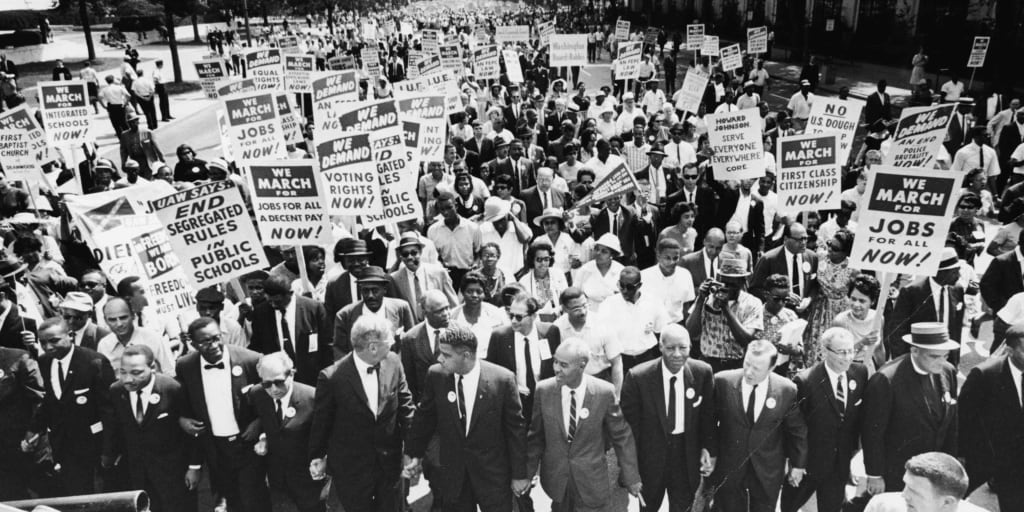
One of his most famous moments was the **March on Washington in 1963**, where he stood in front of the Lincoln Memorial and said:
> “**I have a dream**... that one day... children will not be judged by the color of their skin, but by the content of their character.”
More than 250,000 people stood and listened that day.
> **Highlight:** Dr. King’s dream became a message of hope for all generations.
---
Brave Children and the Power of Schools
In 1954, the **Supreme Court** ruled in **Brown v. Board of Education** that separating children in schools based on race was wrong. But many schools still refused to allow Black children.
One of the bravest stories is of **Ruby Bridges**, a six-year-old Black girl who, in 1960, walked into an all-white school in New Orleans. People shouted at her, but she kept walking — protected by U.S. Marshals. She didn’t cry. She just wanted to learn.
> **Highlight:** A little girl with a big heart taught America what courage really looks like.
Bloody Sunday and the Fight for Voting Rights
In 1965, many Black Americans still couldn’t vote due to unfair laws. To protest, activists marched from **Selma to Montgomery, Alabama.**
But on **“Bloody Sunday,”** police attacked peaceful marchers on a bridge — beating them with sticks and spraying tear gas. The pictures shocked the nation.
After that, President **Lyndon B. Johnson** signed the **Voting Rights Act of 1965**, which gave Black citizens the right to vote without fear.
> **Highlight:** Their pain on the bridge opened the road to justice.
-
Civil Rights Laws That Changed America**
Because of the Civil Rights Movement, the U.S. government passed powerful laws:
* **Civil Rights Act of 1964** – No more discrimination in schools, jobs, or public places.
* **Voting Rights Act of 1965** – Protected every citizen’s right to vote.
* **Fair Housing Act of 1968** – Stopped racial discrimination in housing.
These laws helped break down the legal walls that kept people apart.
> **Highlight:** Protest turned into policy, and policy brought change.
Not Just Black and White
While the movement began to fight for **African Americans**, it inspired many others:
* **Women** began fighting for equal rights in the workplace.
* **Latinos**, **Asians**, and **Native Americans** started their own justice movements.
* **Disabled people**, **LGBTQ+ communities**, and others found hope through civil rights actions.
> **Highlight:** The Civil Rights Movement lit a flame that spread across America.
Why This story matters Today
Even today, the fight for justice and equality continues.
People still march for **Black Lives Matter**, for **fair treatment**, and for **human dignity**. The spirit of Dr. King, Rosa Parks, and Ruby Bridges still walks in today’s streets.
> **Highlight:** The movement may have started in the past — but its heart beats in the present.
Conclusion: A Story of the People
The Civil Rights Movement was not just about laws or leaders — it was about **people**.
Ordinary people. Mothers, students, teachers, and workers. They changed the world with their voices, their marches, and their courage.
It’s a story of pain, yes — but also of power. A story of hate — but answered with love.
And most of all, a story that reminds us:
> *When we stand together, change is possible.*
About the Creator
Tanushree Das
Content writing creates engaging and informative text for article, blogs, websites, and more. It blends creativity and SEO to connect with audiences, build trust, boost visibility, and drive business success.
Keep reading
More stories from Tanushree Das and writers in History and other communities.
The Indian Republic Day
India's Republic Day, commended consistently on 26th January, is quite possibly of the main public celebration. It denotes the day when the Constitution of India happened in 1950, transforming the country into a sovereign, majority rule, and republic country. The excursion to this critical day is an account of battle, assurance, and vision. How about we investigate the historical backdrop of Republic Day and why it holds such incredible significance.
By Tanushree Dasabout a year ago in History
Ancient Buddhist Heritage in Khyber Pakhtunkhwa: Echoes of a Spiritual Past
The province of Khyber Pakhtunkhwa in present-day Pakistan is widely known for its rugged mountains, vibrant cultures, and strategic historical importance. Yet beneath its modern landscape lies a remarkable legacy that dates back more than two thousand years: the heritage of Buddhism. Scattered across valleys, hills, and ancient cities are centuries-old Buddhist monuments—stupas, monasteries, sculptures, and archaeological sites—that reflect the region’s deep connection with one of the world’s oldest religions.
By Irshad Abbasi 2 days ago in History
The First Rainbow Baby
Pitter-patter, pitter-patter. The rain fell in rhythmic splatters, slowly slowing, but still constant. Mira rolled onto her side pulling the blanket tight against her ears, but still she could hear chitter-chatter and scurrying feet of the creatures that refused to sleep in the lower decks.
By A. J. Schoenfeld3 days ago in Fiction


Comments
There are no comments for this story
Be the first to respond and start the conversation.