
The Churning of the Ocean (Samudra Manthan)
"The Churning of the Ocean: A Tale of Cooperation, Sacrifice, and Divine Wisdom"
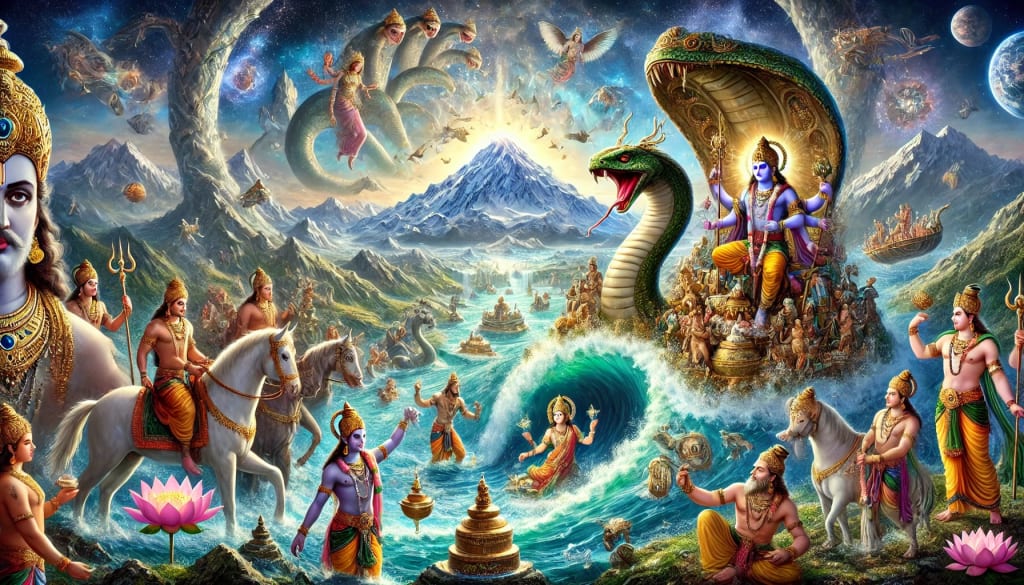
The story of Samudra Manthan, the Churning of the Ocean, is one of the most fascinating myths in Indian mythology. It is a tale of teamwork, cosmic balance, and the quest for immortality, which involves both gods (Devas) and demons (Asuras) coming together for a monumental task that would shape the fate of the universe.
The Background
Long ago, in the heavens, there was a fierce battle between the Devas and the Asuras. The Devas, the celestial beings who represented good and righteousness, had been defeated by the Asuras, the demons who embodied chaos and evil. As a result, the Devas were driven out of their heavenly abode and lost control over the cosmos. They went to Lord Vishnu for help. Vishnu, ever wise and compassionate, devised a plan to restore their power and defeat the Asuras once and for all.
Vishnu advised the Devas to seek the nectar of immortality, called amrita, which was hidden deep within the Ocean of Milk (Samudra). This divine nectar would make them immortal and give them the strength to overcome the Asuras. However, the amrita was not easily accessible; it was trapped in the depths of the ocean, guarded by powerful forces. To obtain the amrita, the Devas would have to churn the ocean and extract it.
The Agreement
Vishnu suggested that the Devas and Asuras join forces and churn the ocean together, as the task was too great for either side to handle alone. While it seemed like an odd alliance, both groups were desperate. The Asuras, too, were eager to acquire the amrita so they could become immortal and gain supreme power. With some hesitation, the Devas agreed to the plan, and both the Devas and Asuras began preparations for the churning.
To churn the ocean, they needed a powerful tool. Vishnu directed them to use Mount Mandara as the churning rod. However, this massive mountain was too heavy to move, so Lord Vishnu took the form of a tortoise (Kurma) and supported the mountain on his back, ensuring that it did not sink into the ocean. The serpent Vasuki, a massive multi-headed snake, was chosen to serve as the rope. The Devas would hold Vasuki’s head, and the Asuras would hold his tail. By pulling and releasing the rope, they would churn the ocean, just like churning milk with a stick.
The Churning Begins
As the churning began, a terrible turmoil ensued. The ocean roiled and shook, and from its depths, many divine and supernatural entities began to emerge. The first thing to appear was a deadly poison, called halahala, which was so potent that it could destroy the entire universe. The Devas and Asuras were terrified and did not know what to do. In a moment of great selflessness, Lord Shiva, who was the ultimate protector, stepped forward. He drank the poison to save the world, and it stayed in his throat, turning it blue. This act of sacrifice earned Shiva the name Neelkanth (the one with the blue throat).
With the poison under control, the churning continued. Many wondrous and valuable treasures emerged from the ocean, each with its own significance. The next to appear was Kamadhenu, the wish-fulfilling cow, who could provide anything her owner desired. Following Kamadhenu, Uchhaishravas, the divine horse, emerged, as did Airavata, the white elephant that became the mount of Indra, the king of the Devas.
Goddess Lakshmi and the Divine Nectar
Then, out of the churning ocean, emerged the most coveted prize: Goddess Lakshmi, the goddess of wealth, prosperity, and fortune. She appeared from the foam of the ocean, seated on a lotus, and her beauty and grace were unmatched. She immediately chose Lord Vishnu as her eternal consort, bringing him immense wealth and blessings.
At long last, after much effort and turmoil, the amrita (nectar of immortality) surfaced. The Devas eagerly seized it, but so did the Asuras. The tension between the two sides reached a peak. Fearing that the Asuras would take all of the amrita, the Devas turned to Vishnu for help. Vishnu, always clever and resourceful, devised a plan.
He took the form of Mohini, a beautiful and enchanting woman. Her radiance was so captivating that the Asuras were mesmerized by her beauty. Mohini promised to distribute the amrita equally between the two sides. Trusting her, the Asuras agreed to let her serve them. But as Mohini began to pour the nectar, she gave only a few drops to the Devas, while keeping the bulk for them. When the Asuras realized they had been tricked, it was too late. The Devas had consumed the nectar, becoming immortal and powerful. The Asuras, deprived of the nectar, were defeated.
The Aftermath
The Devas, now imbued with immortality, regained their strength and reclaimed the heavens from the Asuras. Lord Vishnu, in his form as Mohini, had saved the day, ensuring that the balance of the cosmos was restored. The churning of the ocean had not only brought forth the amrita, but also a variety of divine treasures and beings, making the Devas more powerful than ever before.
The Samudra Manthan story teaches several important lessons. It illustrates the importance of cooperation, even between opposing forces, and shows that great rewards often come after immense struggle. It also emphasizes that divine intervention, as exemplified by Vishnu’s various forms, is necessary to maintain the balance of the universe. The poison that Lord Shiva consumed serves as a symbol of selfless sacrifice, and the emergence of the amrita signifies the ultimate victory over death.
This myth continues to be one of the most revered stories in Hindu mythology, highlighting themes of perseverance, divine wisdom, and the eternal battle between good and evil.
Conclusions:
The story of the Samudra Manthan reflects the cosmic balance between good and evil, where both cooperation and divine intervention play crucial roles in restoring harmony. The churning of the ocean symbolizes the effort required to attain great rewards, with the emergence of the nectar of immortality signifying the triumph of righteousness. The selfless actions of Lord Shiva, the cleverness of Lord Vishnu, and the ultimate defeat of the Asuras demonstrate the importance of sacrifice, wisdom, and moral integrity. This tale highlights that true success often comes through struggle and that divine forces guide the universe towards balance and justice.



Comments
There are no comments for this story
Be the first to respond and start the conversation.