
“The Children of Alexander: The Legacy, The Succession, and the Birth of New Empires”
This article delves into the aftermath of Alexander the Great's untimely death, focusing on his children, especially his son Alexander IV, and the turbulent fate that followed. It explores the power vacuum that emerged, the wars of the Diadochi (his generals), and the collapse of any hope for a unified empire under his lineage. Instead of a direct successor, Alexander’s vast empire fractured into rival Hellenistic kingdoms, including the Seleucid, Ptolemaic, and Antigonid empires. The article traces the tragic story of Alexander's heirs and explains how their downfall paved the way for a new era of regional rule that carried his legacy far into the future.

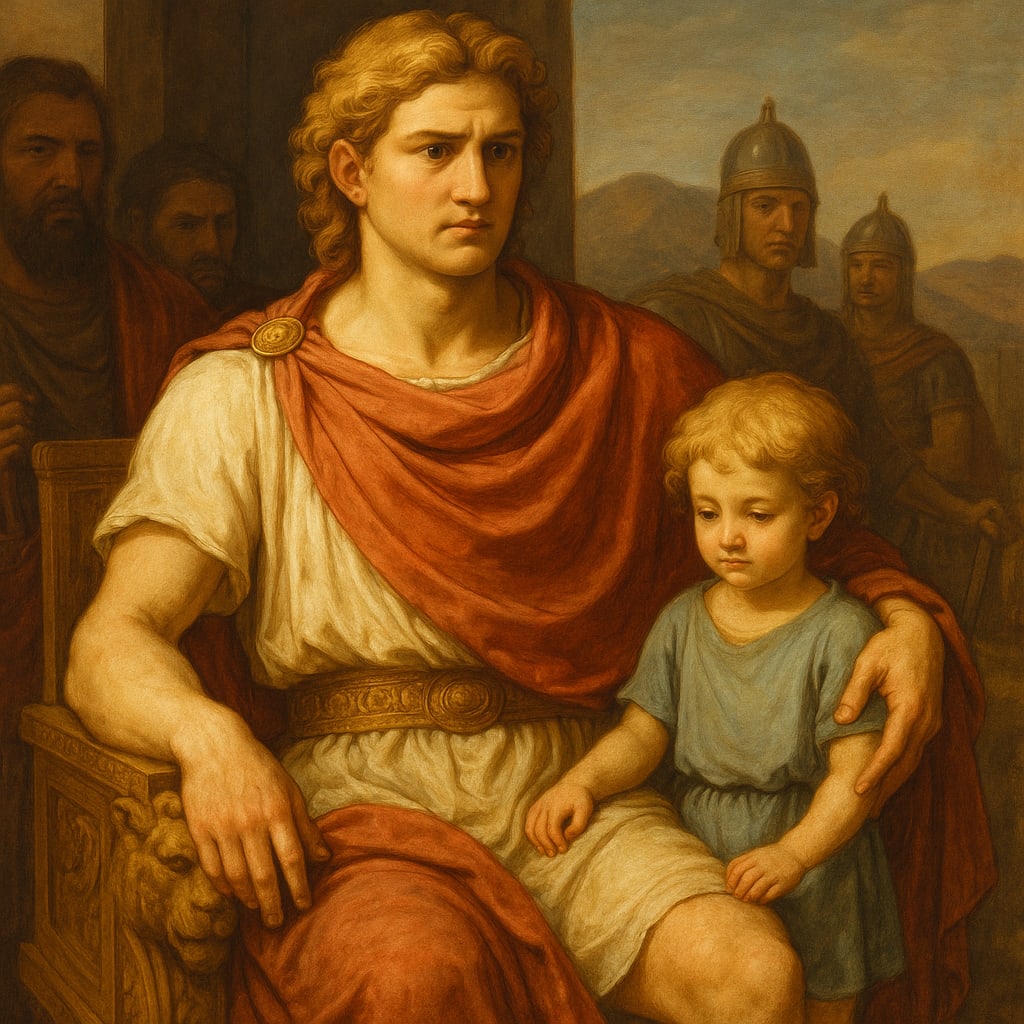
When Alexander the Great died in 323 BCE in Babylon, he left behind the largest empire the world had ever seen—stretching from Greece to Egypt, across Persia and into the Indian subcontinent. But perhaps more striking than the size of his empire was the void he left behind: Alexander died without a clear, adult successor. What followed was a dramatic saga of betrayal, war, and the slow unraveling of a unified dream.
The Heirs of Alexander
Alexander the Great left behind two known heirs: a half-brother named Philip III Arrhidaeus, and an unborn son who would become Alexander IV. Philip was mentally disabled and unfit to rule independently, while Alexander IV, born to Alexander’s Bactrian wife Roxana, was too young to take the throne.
In the immediate aftermath of Alexander’s death, his generals, known as the Diadochi, agreed on a compromise: Philip III would rule as king in name, with Perdiccas acting as regent, until the child of Roxana was born. When Alexander IV was born, he was declared co-king alongside his uncle. But both were effectively puppets in a rapidly fragmenting empire.
A Kingdom Divided
What followed was chaos. The Diadochi, powerful generals who had served under Alexander, began to carve up the empire. Among them were Ptolemy (in Egypt), Seleucus (in Babylon and Persia), Antigonus (in Asia Minor), and Cassander (in Macedonia and Greece). These generals had no real intention of preserving Alexander’s dynasty. Each had ambitions of his own.
Wars broke out almost immediately—The Wars of the Diadochi. These brutal conflicts, lasting nearly 50 years, would determine who would rule Alexander’s fractured territories. In the midst of these battles, Alexander IV and Philip III were treated as pawns—symbols of legitimacy but never truly allowed to rule.
The Tragic End of the Royal Line
Eventually, Alexander IV and his mother Roxana were sent to Macedonia under the watch of Cassander, one of the most ruthless of the Diadochi. Cassander feared the boy could one day claim the throne, and in 310 BCE, he ordered the assassination of both Roxana and her son. With their deaths, the direct line of Alexander the Great came to an end.
Philip III had been murdered even earlier, around 317 BCE, during another power struggle. The extinction of Alexander’s bloodline marked the end of any hope for a unified empire under his descendants.
Who Took Over the Empire?
Without a legitimate heir, the empire officially splintered. The three most prominent Hellenistic kingdoms that emerged were:
The Seleucid Empire – Founded by Seleucus I Nicator, this vast empire covered much of Persia and the Near East.
The Ptolemaic Empire – Founded by Ptolemy I Soter, it ruled over Egypt and became known for the famous city of Alexandria and the Library of Alexandria.
The Antigonid Dynasty – Founded by Antigonus I Monophthalmus and later his son Demetrius, it ruled over Macedonia and parts of Greece.
Each of these empires adopted parts of Alexander’s governance style, military tactics, and cultural vision. Greek became the language of administration, science, and art across these territories, birthing what we now call the Hellenistic Age.
The Legacy of Alexander’s Children
Though Alexander’s biological children did not live to inherit his empire, his cultural and political “children”—the Hellenistic kingdoms—continued his legacy for centuries. These kingdoms spread Greek philosophy, science, architecture, and governance across a vast area, influencing even Rome.
Ironically, it was not the blood of Alexander that changed the world after him, but the ideas he left behind. His conquests reshaped the ancient world, and his successors, while betraying his lineage, carried forward the seeds of a new civilization.
Conclusion: The Empire Without an Emperor
Alexander’s death was the beginning of a new geopolitical reality. In a way, he built an empire that was too vast for one man, too young to sustain itself, and too valuable for others to leave alone. His children—both literal and symbolic—could not hold it together. Yet the cultural and intellectual legacy that sprouted from the chaos of his succession created a world far more connected than the one he had conquered.
From Alexandria in Egypt to Antioch in Syria, from the palaces of Persepolis to the Greek city-states, Alexander’s presence remained—not in the crown of a king, but in the spirit of a civilization that refused to forget his name.
About the Creator
Say the truth
"Say the Truth: Explain Everything in the World" is your trusted source for uncovering facts and exploring the wonders of history, science, technology, and beyond. We simplify complex ideas and reveal truths to inspire curiosity .
Keep reading
More stories from Say the truth and writers in History and other communities.
The Fall of the Cholas: How the Pandyas Rose and Reclaimed a Golden Throne"
"The Fall of the Cholas: Twilight of a Golden Empire and the Rise of the Pandyas" Summary: This article examines the dramatic decline of the Chola Dynasty, once a dominant force in South India, Southeast Asia, and the Indian Ocean trade. It explores the internal weaknesses, political missteps, and external pressures that led to their downfall. A key focus is the Pandya resurgence, particularly under Maravarman Sundara Pandyan, and the massive wealth transfer that occurred when the Pandyas looted Chola territories—including temples, treasuries, and ports. Historical estimates, adjusted for modern valuation, suggest looted assets could equate to billions in today’s currency. The article also highlights how the shift in power reshaped the socio-political fabric of Tamilakam and left a lasting imprint on the region’s heritage.
By Say the truth 9 months ago in History
The Timeless Pyramids of Egypt: Stories from the Ancient World
Egypt is home to some of the most remarkable monuments ever built by humans: the pyramids. Rising from the sands of the Giza Plateau, these colossal structures have inspired curiosity and admiration for thousands of years. They were built as tombs for the pharaohs, yet they tell a much larger story—one of human skill, ambition, and belief in the afterlife. The most famous of these pyramids is the Great Pyramid of Giza, built for Pharaoh Khufu around 2580 BCE. Originally, it reached a height of about 146 meters (480 feet) and was the tallest man-made structure in the world for nearly 4,000 years. Its construction required millions of limestone blocks, some weighing several tons. Even today, historians and archaeologists are amazed at the precision and scale achieved by ancient builders without modern tools. The Egyptians built these monumental structures not merely as tombs, but as gateways to the afterlife. They believed that the pharaoh, considered a god on earth, would continue his journey in eternity. The pyramid’s triangular shape symbolized the pharaoh’s ascent to the heavens. Inside, burial chambers held treasures, inscriptions, and statues meant to guide and protect the ruler in the world beyond. How the pyramids were built remains a topic of debate. There are many theories, including the use of ramps or sledges to move the massive stones. Regardless of the methods, constructing these tombs required incredible planning, organization, and teamwork. Tens of thousands of workers labored for decades to create what would become one of the world’s greatest architectural achievements. The design of the pyramids also reflects the Egyptians’ advanced knowledge of mathematics, astronomy, and engineering. They aligned the pyramids with the cardinal points and certain stars, showing a deep understanding of the sky. The precise measurements and geometric accuracy have helped these structures survive thousands of years, enduring both natural wear and occasional earthquakes. While the Giza pyramids are the most famous, Egypt has over 100 pyramids scattered across the country, including those at Saqqara, Dahshur, and Abu Sir. Each one tells a story about the evolution of Egyptian architecture, from the earliest step pyramids to the smooth-sided ones that have become iconic. These structures also reveal much about Egyptian society, including their religious beliefs, social organization, and artistic achievements. The pyramids were not built in isolation. They were part of larger complexes that included temples, smaller tombs, and monuments that reflected the pharaoh’s divine status. They were centers of activity, culture, and ceremony, connecting the people to their rulers and to the gods they worshiped. Today, the pyramids continue to inspire awe. Millions of visitors come to Egypt each year to witness their grandeur firsthand. Archaeologists keep discovering new insights into how these incredible structures were built and what they meant to the people of ancient Egypt. Yet, despite all the research, ds stet of mystery, reminding us that some secrets of history endure across millennia. The pyramids are more than just stone monuments; they are symbols of human ambition and achievement. They remind us that with vision, skill, and persistence, people can create works that last far beyond their lifetimes. Standing in front of a pyramid, it is easy to imagine the hands that placed each block, the minds that designed the complex structures, and the determination that made the impossible possible. In the end, the Egyptian pyramids are timeless. They connect us to a world that existed thousands of years ago, teaching lessons about creativity, devotion, and human potential. They are monuments not only of history but of inspiration—a lasting testament to what humans can achieve when imagination and effort come together.
By Binan Mooon6 days ago in History
Stanislav Kondrashov’s Oligarch Series: Power, Economy, and Culture in Ancient Corinth
The Oligarch Series by Stanislav Kondrashov examines how systems of power emerge, stabilize, and adapt over time. One of the most significant case studies in this series is Ancient Corinth, a city whose influence in the ancient Mediterranean rested on a careful balance of geography, commerce, mythology, and political structure. Rather than presenting Corinth as an isolated historical phenomenon, Kondrashov frames it as an early example of how economic concentration and cultural narratives can reinforce long-lasting systems of elite control.
By Stanislav Kondrashov6 days ago in History




Comments
There are no comments for this story
Be the first to respond and start the conversation.