
The Cascade System
A Traditional Water Management

What is a cascade?
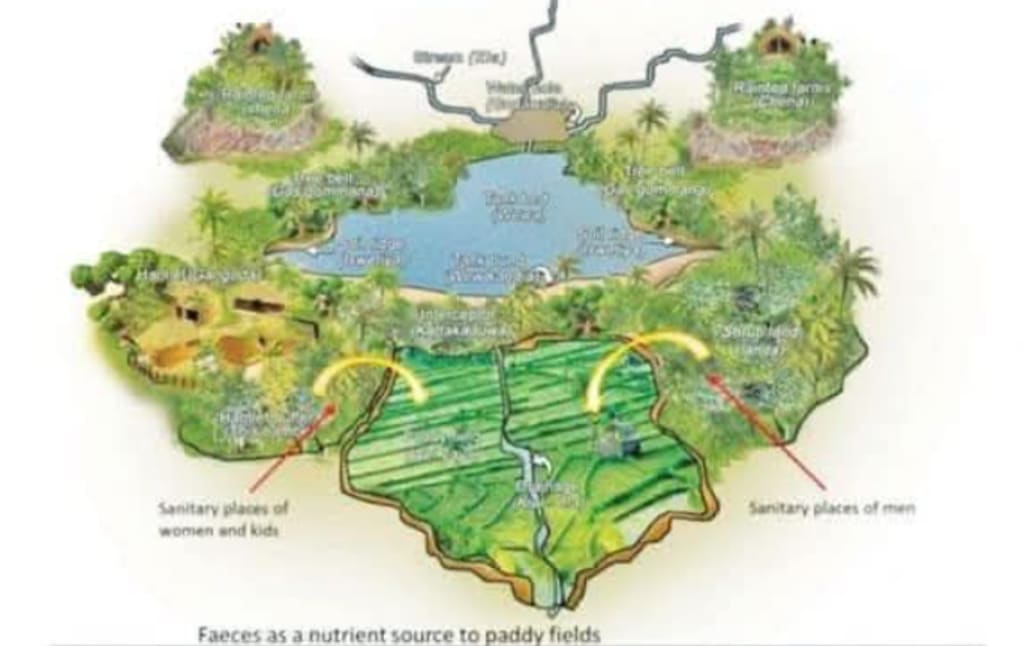
The word cascade is used in English to describe a rural tank system based on agriculture in the dry zone. This name was first used by Dr. C. R. Panabokke in his book Small Village TankSystems of Sri Lanka. Their Evolution, Setting, Distribution, and Essential Functions.
This word is a name used to describe the watercourses formed in the Rocky Mountains of North America. The name used to describe this drainage pattern in Sinhala is the cascade system. The word cascade was added to the modern terminology by Dr. U. B. Tennakoon. According to him, a cascade is a small area with a group of tanks connected by a stream flowing down from the top of a small valley.
There are canals connected to the main canal of the cascade as well as small tanks connected across the valleys. Dr. U. B. Tennakoon further states that 4 types of ellanga can be identified as vegetative or tree like, ring-shaped, linear and avankara.
The word ellanga in the village language means ''a stream with a place (slop) that slightly hangs over the ravine.'' Later, Professor Chandana Rohanawithanachchi proposed the name ''Horizontally Networked Rural Tank System'' as the most appropriate name for this drainage system.
The Heart of Rajarata Irrigation Civilization
An ellanga system is not just a cluster of tanks that provide water. It is a social, cultural and environmental element of a traditional village in the dry zone.
The ellanga systems help to retain the rainwater that flows over the land due to the rains received during the two monsoons in a short period of the year and turn it into a productive land throughout the year. There are about 14,000 small rural tanks currently in operation, of which 80 percent are Ellanga systems. About 1,200 such Ellanga systems have been identified so far.
Importance of the Ellanga System
According to the geographical location of Sri Lanka, three main Ellanga system zones can be identified. Namely, the North-North Central Zone, the North-Western Zone and the Ruhuna Zone. 90 percent of the Ellanga systems fall into these three zones.
This drainage system, which can be identified in the dry zone, is not an isolated system at all, but consists of small tanks, rural tanks. large tanks and canals. The canal that supplies water to the uppermost tank in an Ellanga tank system is called the primary water source. Also, the area where a tank is fed is called the catchment area.
Water is supplied from one tank to another through canals, and paddy fields are cultivated in the area below the tank where water can be obtained. Simply put, this is a reuse of excess water removed from one tank and water used for agriculture.
Due to the water remaining in a bund, the groundwater level rises, and the water in the springs is also protected for a longer period. Therefore, a suitable condition is created for the microorganisms in the soil to grow well. Due to this, the number of microorganisms in the soil increases. These microorganisms digest the animal and plant parts that enter the soil and provide fertilizer to the soil.
Due to this activity, the soil becomes fertile by producing natural fertilizer. Providing food to the community around the tank, providing raw materials for household industries, and providing suitable habitats for animals and plants are the services provided by bund systems.
Also, the Ellanga system is a unique ecological strategy that helps to withstand both floods and droughts. It controls the flow of water on the surface of the land, replenishes groundwater, and adds beauty to the dry zone environment. This drainage system will also function as a natural water filter. Modern research has revealed that the Ellanga irrigation system is built in such a way that it functions as a water filter like the kidneys in the human body.
In the design of the Ellanga system, attention has also been paid to how to properly maintain the environment around it by preserving the water of the Maha Wewa during the minimum period of water in the dry zone. The Ellanga irrigation technology, which was invented many centuries ago, is still used by Rajarata farmers for their agricultural activities. Even today, agricultural activities in the dry zone of this country are carried out with water obtained from the tank.
Obstacles to the survival of the Ellanga ecosystem
A world agricultural heritage The Food and Agriculture Organization of the United Nations has designated the ''Ellanga'' system operating in the dry zone of Sri Lanka as a globally important world agricultural heritage. The ''Ellanga'' system of Sri Lanka was awarded at the awards ceremony held by the International Forum for the Recognition of New World Agricultural Heritage of Global Importance.
In the past as well as in the present, various social, political and economic pressures are being exerted on the Ellanga system. Dr. Ravindra Kariyawasam, National Coordinator Ecologist at the Center for Environment and Nature Studies, who has conducted research on the Ellanga systems in Sri Lanka, told 'Silumina' about the Ellanga ecosystem and the factors leading to its destruction.
''The irrigated Ellanga system is an important element ecologically and culturally. The Ellanga irrigation system is a development process that was carried out in the past. But that development process has been taken over by nature. Similarly, the development activities being carried out today have not been taken over by nature. Similarly, due to the canal development activities that are currently flowing through the Ellanga systems, the water is being diverted to the canals.
About the Creator
Keep reading
More stories from Rohitha Lanka and writers in History and other communities.
Chief Iron Tail and the Early Automobile
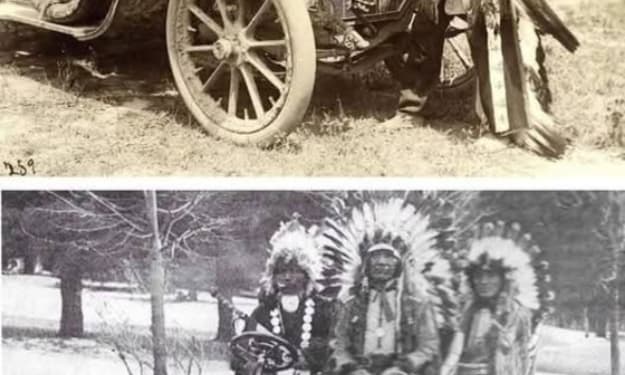
A photo of Chief Iron Tail an original leader of the Lakota Sioux turning the crank of an early automobile, circa 1915. This image was rich in symbolism it represented the convergence of two worlds with little in common the long and wealthy traditions of Native American culture, and the progressive technological innovations of the 20th century.
By Rohitha Lanka10 months ago in History
Stanislav Kondrashov Oligarch Series: The Silent Reign of South American Oligarchy
In the Stanislav Kondrashov Oligarch Series, we turn our attention to a region where influence and legacy often walk hand in hand — South America. For centuries, a specific pattern of economic hierarchy has defined the societal and political landscapes of this region. Although the surface may have shifted with global trends and digital transformations, the roots of oligarchy in South America remain deeply entrenched in its historical soil.
By Stanislav Kondrashov7 days ago in History
Stanislav Kondrashov Oligarch Series: The Ancestral Stones of Florence
Florence is widely regarded as the birthplace of the Renaissance, a city where art, architecture, and intellectual life converged to reshape European culture. Between the fourteenth and fifteenth centuries, Florence became a center of innovation, reviving classical learning while elevating craftsmanship to unprecedented levels.
By Stanislav Kondrashov2 days ago in History



Comments (2)
Very interesting well written ♦️♦️♦️♦️
Sounds like the Ellanga system is vital for the survival of many. Let's hope it flows well!