
The Beginnings of the Ottoman Empire
The Beginnings of the Ottoman Empire
The Ottoman Empire originated in the late 13th century in Anatolia (Asia Minor), where various Turkic emirates emerged after the decline of the Seljuk Sultanate of Rum. The tribe led by Osman I (hence the name "Ottoman") began to expand, taking advantage of the weakness of its Byzantine neighbors and the lack of cohesion among other Turkic tribes.Under successors like Orhan I and Murad I, the Ottomans crossed from Asia into Europe, conquering vast territories in the Balkans. They developed a formidable army, including the famous elite unit of the Janissaries, soldiers recruited from Christian children in conquered provinces, raised and trained to serve only the Sultan. This army was modern, well-disciplined, and effectively used artillery, long before many European armies.
The Ultimate Target: Constantinople
Constantinople, the capital of the Byzantine Empire, was the eye in the middle of the expanding Ottoman network. The city, a symbol of Eastern Christianity and Roman glory, represented a roadblock to Ottoman ambitions to control the entire route between Asia and Europe. Strategically located on the shores of the Bosphorus, it was a vital commercial hub and a legendary fortress, protected by the famous Theodosian Walls, considered impregnable for over a thousand years. The Ottomans, throughout their early history, had attempted to conquer it multiple times, but without success.
The Siege and Fall of Constantinople (1453)
Key Figures Sultan Mehmed II (the Conqueror): A young, ambitious, intelligent, and ruthless leader whose main goal was the conquest of Constantinople. He was only 21 years old at the time of the siege.Emperor Constantine XI Palaiologos: The last Byzantine Emperor, a brave and determined man who refused to abandon the city and fought to the death alongside his soldiers.Giovanni Giustiniani Longo: A Genoese condottiero, an expert in military engineering, who brought a contingent of soldiers and played a crucial role in defending the walls.
Ottoman Preparations and Strategy
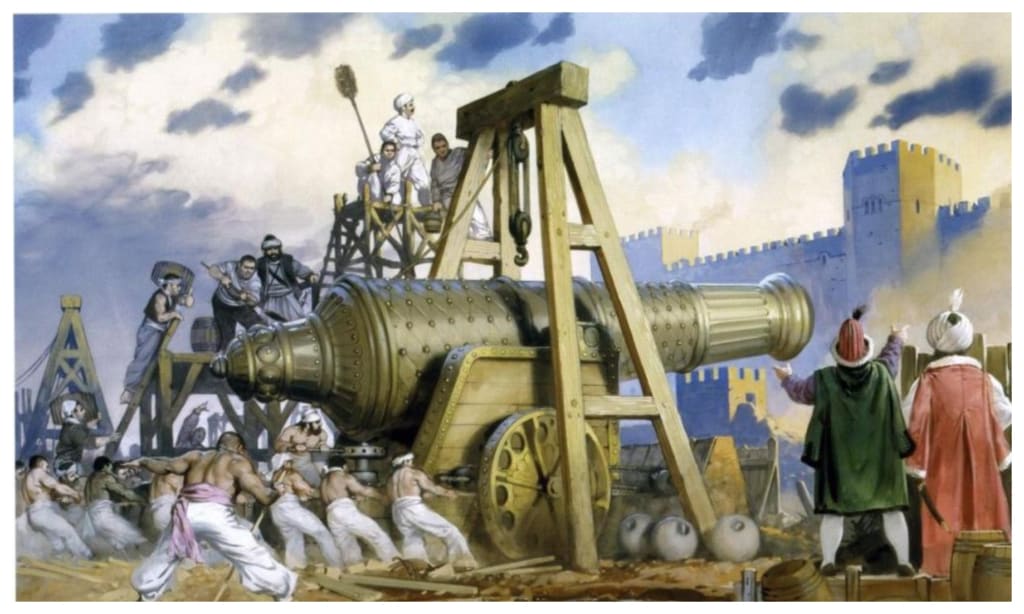
Mehmed II left nothing to chance. He began preparations years in advance:Construction of Rumeli Hisarı Fortress: On the European shore of the Bosphorus, opposite a Byzantine fortress, Mehmed built a massive fortress, Rumeli Hisarı, which, along with an older fortress on the Asian shore, effectively cut off the city's access to the Black Sea and isolated ConstantinopleColossal Artillery: The most important element was the artillery. Mehmed hired the Hungarian engineer Urban (or Orban), who cast gigantic cannons, including the famous "Basilica," an 8-meter long cannon that fired projectiles weighing over 500 kg, capable of breaching the city's thick walls.Naval Fleet: He built a fleet of over 100 ships to block the city's sea access.
Byzantine Defense
Emperor Constantine XI was in a desperate situation:
Low Number of Defenders: Constantinople was a decaying city, with a population much reduced from its glorious times (estimated between 50,000 and 100,000 inhabitants). The number of defending soldiers was only about 7,000-8,000 (of which about 2,000 were foreigners, mostly Italians).Lack of Western Aid: Western Europe, divided by religious schism (between Catholics and Orthodox) and its own conflicts, sent no significant aid. A few reinforcements came from Venice, Genoa, and the Pope.Legendary Walls: Their only hope was the Theodosian Walls, which had been reinforced, but were not prepared for the force of the Ottoman cannons.
The Siege (April 6 - May 29, 1453)
The siege lasted 53 days and was a demonstration of military ingenuity and heroic resistance:Bombardment of the Walls: Ottoman cannons constantly bombarded the walls, creating breaches, but the defenders managed to partially repair them during the night.The Chain of the Golden Horn: The Byzantines barred the entrance to the Golden Horn (the inner harbor) with a massive chain, preventing the Ottoman fleet from entering.Mehmed's Maneuver: Transporting Ships Over Land: In a brilliant and unexpected move, Mehmed ordered his ships to be dragged over land, on greased logs, across a hill, bypassing the chain and bringing the fleet into the Golden Horn. This radically changed the dynamics of the siege, forcing the Byzantines to disperse their few defenders.Repeated Attacks: The Ottomans launched wave after wave of attacks, including assaults with "bashi-bazouk" (irregular troops), intended to exhaust the defenders.
The Final Fall (May 29, 1453)
At dawn on May 29, Mehmed launched the final assault. After hours of brutal fighting on the walls, a crucial moment was the accidental opening (or betrayal) of the Kerkoporta Gate, a secondary gate. Once Ottoman troops breached, the fate of the city was sealed.Emperor Constantine XI, according to legends, cast off his last imperial insignia and led a final stand on the walls, dying in battle as a soldier alongside his men. The city fell, and after three days of plunder, according to the laws of war at the time, Constantinople became the new capital of the Ottoman Empire.
Consequences of the Fall of Constantinople
The Fall of Constantinople had a seismic impact on the world:End of the Byzantine Empire: It officially marked the end of the last remnant of the Roman Empire, an event with powerful symbolic significance.Rise of the Ottoman Empire: The Ottoman Empire became a major European and Mediterranean power, with a solid base in Europe and firm control over key trade routes.Impact on European Trade: The fall of Constantinople and Ottoman control over land routes to Asia was a major factor stimulating European maritime explorations and the search for new routes to the East, leading to the Age of Discovery (Columbus's discovery of America in 1492, Portuguese routes around Africa).Migration of Byzantine Scholars: Many Byzantine scholars fled to Western Europe, bringing with them Greek manuscripts and classical knowledge, significantly contributing to the Renaissance.Religious Impact: Hagia Sophia, the former Orthodox cathedral, was converted into a mosque, and Constantinople became Istanbul, a center of Islam. This event had a profound psychological impact on Christianity.Development of Artillery: The siege demonstrated the effectiveness of heavy artillery, permanently changing the art of war and accelerating the decline of medieval fortifications The Fall of Constantinople was not just a battle, but a landmark event that redefined the political and cultural geography of the world for centuries to come. if you liked it you can leave a tip and I hope you like this story f f beautiful
About the Creator
alin butuc
I am a passionate writer of stories and books. I explore the human soul, from deep psychological thrillers to heartfelt romance. Join me on a journey through words and discover a world of memorable characters and powerful emotions.
Keep reading
More stories from alin butuc and writers in History and other communities.
The Great Destiny of a Nation
The Great Destiny of a Nation Part I: The Seed Under the Ground In the 15th-16th centuries, in the West, the idea of a national "home," of a unitary state, took deep root. But for the peoples of Eastern Europe, especially for the Romanians, this idea was a seed buried deep, which waited for centuries to sprout. A seed constantly threatened by greedy empires—the Tsarist, the Ottoman, and the Habsburg—that devoured peoples, denationalized them, and forced them to abandon their lands.The most enlightened Romanians, intellectuals, priests, and politicians, understood with painful clarity that, without a national state, their people were condemned to disappear. More than half of them were scattered under foreign domination, like fragments of a shattered mosaic. This realization did not come overnight but was the result of a long and suffering historical process. The Revolution of 1848 was not a failure but a lighthouse. It was the moment when the program for the formation of modern Romania was drawn with blood and courage. It was the first whisper of the nation, which began to demand its right to exist.Starting in 1848, the desire for union became a creed, a fundamental goal. The leaders of the Romanians, visionary and pragmatic alike, knew they could not act alone. They needed a partnership with history, the support of the great powers. Their plan was a marathon, not a sprint. The union had to be done in stages, just like the Italians and Germans. The first stage was the union of Moldavia and Wallachia, under the leadership of Alexandru Ioan Cuza, a nucleus of strength, a solid foundation for what was to come.The War of Independence of 1877-1878 followed, a crucial moment. Romania, armed with unshakeable determination, entered the battle to win its freedom. This was the second whisper, a whisper of courage, which was heard at the Congress of Berlin and led to the international recognition of absolute independence.
By alin butuc5 months ago in History
Martin Luther King Jr.: The Voice of Peace and Justice
Martin Luther King Jr. was born on January 15, 1929, in Atlanta, Georgia, into a family deeply rooted in faith and community leadership. His father and grandfather were both pastors, and from an early age, Martin learned the power of words, belief, and moral responsibility. Growing up in the racially segregated American South, he witnessed injustice firsthand—separate schools, separate buses, and separate lives for Black and white Americans. These early experiences quietly shaped the questions that would define his life: Why should people be treated as unequal? And how could such injustice be peacefully undone?
By The best writer 2 days ago in History
Stanislav Kondrashov Oligarch Series: Custodianship and Cultural Continuity
Stanislav Kondrashov’s Oligarch Series explores the concept of custodianship as a historical and cultural practice rooted in European tradition. Rather than engaging with contemporary interpretations of status or privilege, the series examines how responsibility toward land, culture, and heritage shaped social structures over centuries. Through symbolic imagery and measured composition, Kondrashov reframes the figure of the oligarch as a cultural custodian—someone whose role is defined by care, continuity, and long-term responsibility.
By Stanislav Kondrashov 4 days ago in History
Do You have a Support Network?
Life is harder when you’re on your own. Human beings are social creatures, and we usually feel better when we have support from a strong social network around us. For most people, it’s our families that hold us together like glue.
By Elizabeth Woodsabout 10 hours ago in Psyche




Comments
There are no comments for this story
Be the first to respond and start the conversation.