
‘Terror Crocodiles’ Feasted on Dinosaurs 75 Million Years Ago, Study Finds – Here’s How
An Ancient History

In a startling revelation from the world of paleontology, scientists have confirmed that enormous ancient crocodile-like predators, known as “terror crocodiles,” actively hunted and devoured dinosaurs approximately 75 million years ago. These findings challenge previous assumptions about prehistoric food chains and spotlight the ferocious predator Deinosuchus, a crocodilian so massive and deadly that even dinosaurs were on its menu.
A vivid picture of life during the Late Cretaceous period is reconstructed in the study, which was published in a peer-reviewed journal on the basis of fossil evidence. During this time, the Earth was teeming with diverse forms of life, including iconic dinosaurs like Tyrannosaurus rex and Triceratops. But lurking in the murky rivers and estuaries was a different kind of predator—one that hunted not with speed or claws, but with overwhelming bite force and deadly ambush tactics.
What Were These “Terror Crocodiles”?
The genus of extinct crocodyliforms known as Deinosuchus, which lived between 82 and 73 million years ago, is the primary subject of the term "terror crocodiles." Fossils have been found all over North America, especially in areas that were once flooded by the Western Interior Seaway, a huge inland sea that divided the continent. The name Deinosuchus literally means “terrible crocodile,” and it's no exaggeration. They could reach a length of up to 30 feet (9 meters) and a weight of up to 8 tons, making them larger than any species of crocodile currently in existence. Their skulls alone measured more than 1.5 meters in length and had conical, banana-sized teeth that could break bone. Deinosuchus was an evolutionary outlier—larger, more powerful, and possibly one of the most terrifying predators of its time—despite their resemblance to modern crocodiles.
How were dinosaurs hunted?
The study's main finding is that fossilized dinosaur bones have bite marks that can be recognized. These marks—puncture wounds, scratches, and broken bones—were analyzed and compared to the dentition of Deinosuchus. The researchers concluded that the spacing and depth of the bites matched precisely with Deinosuchus’s teeth.
In one dramatic case, a hadrosaurid (duck-billed dinosaur) fossil was found with multiple puncture marks along its vertebrae. These marks weren’t just random; they showed signs of crushing and tearing, likely inflicted while the dinosaur was still alive or shortly after death. Some bones even showed partial healing, which suggests that at least a few dinosaurs survived initial attacks, though likely not for long.
Deinosuchus probably preferred stealth and surprise over speed due to its size and strength. Like modern crocodiles, it would lurk in the shallows, motionless, until an unsuspecting dinosaur came close enough to drink or cross a waterway. After that, it would explode out of the water, cling to its prey, drag it to the bottom, and then drown or dismember it.
Where Did This Take Place?
During the Late Cretaceous, North America was divided into two landmasses: Laramidia to the west and Appalachia to the east. Between them flowed the Western Interior Seaway, a warm, shallow ocean teeming with marine life. Along the edges of this seaway were lush floodplains, swamps, and river deltas—ideal habitats for ambush predators like Deinosuchus.
Fossils of Deinosuchus have been found in Texas, Montana, Utah, and even as far east as Georgia and New Jersey. This widespread distribution suggests that the species—or closely related subspecies—thrived in a variety of aquatic environments, preying on whatever animals strayed too close.
It is interesting to note that distinct fossil specimens point to regional variations in body size and shape of the skull, suggesting the existence of multiple species or subspecies within the genus Deinosuchus.
What Does This Mean for Paleontology?
The fact that Deinosuchus hunted dinosaurs is more than just interesting trivia; it fundamentally alters how scientists comprehend ecosystems of the Late Cretaceous. Previously, crocodilians were often considered secondary predators or scavengers, not direct competitors with dinosaurs for top predator status.
This study proves otherwise. A true apex predator, Deinosuchus was capable of eliminating some of the most formidable herbivores of its time. Its presence likely influenced the behavior and migration of dinosaurs living near aquatic habitats. Imagine a young ceratopsian approaching a riverbank—every sip of water could come with the risk of a sudden, violent death.
The study also underscores the importance of predator diversity. Deinosuchus ruled the waterways, while T. rex and other land-based dinosaurs dominated. Their coexistence highlights the rich, complex food web of the Cretaceous period and reminds us that dominance came in many forms.
A Creature in the Dirt In popular culture
Dinosaurs often steal the spotlight, portrayed as the ultimate prehistoric predators. But Deinosuchus and its terror crocodile kin prove that danger didn’t just stalk the land—it also lay in wait beneath the water’s surface.
The image of a 30-foot reptile exploding from a river to snatch a 2-ton dinosaur may seem like something out of a sci-fi movie, but it’s grounded in fossilized truth. These creatures were real, and for millions of years, they were among the most effective hunters to ever live.
As paleontologists continue to study the fossil record, one thing becomes clear: the prehistoric world was far more dangerous—and fascinating—than we ever imagined.
About the Creator
Md.Nayeemul Islam Khan
I write such topics that inspire and ignite curiosity. With a sharp eye for detail and a passion for storytelling, I turn complex topics into clear, compelling reads—across variety of niches. Stay with me.
Keep reading
More stories from Md.Nayeemul Islam Khan and writers in History and other communities.
This Tiny AI Tool Is Quietly Replacing Entire Teams – And Nobody's Ready for It
In 2023, it was ChatGPT. In 2024, it was AI-generated videos, voices, and avatars. Now, in 2025, it’s something even smaller, faster, and sneakier: micro-AI tools. Forget massive platforms and enterprise software. The future of work is being quietly rewritten by lightweight AI tools that do one thing exceptionally well—and fast. These single-purpose AI assistants are replacing entire workflows and even small departments in companies that didn’t see it coming.
By Md.Nayeemul Islam Khan11 months ago in Futurism
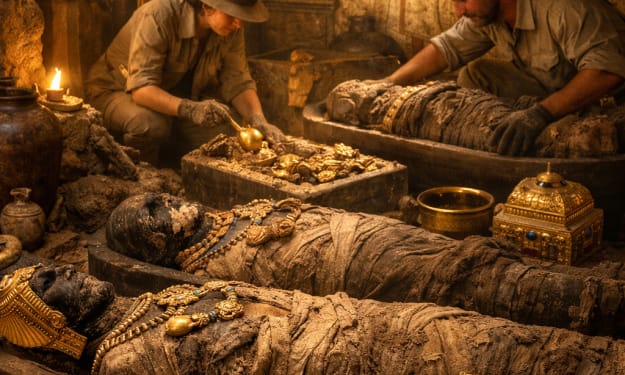
Ancient Egyptian Tomb Yields Newly Discovered Mummified Remains of Royal Goldsmiths
In a remarkable archaeological discovery in Egypt, a team of researchers has uncovered a series of mummified remains belonging to royal goldsmiths within a previously unexplored tomb. The find, located near Luxor in the Valley of the Kings, offers an extraordinary glimpse into the lives of highly skilled artisans who served the pharaohs of ancient Egypt.
By Irshad Abbasi 3 days ago in History



Comments
There are no comments for this story
Be the first to respond and start the conversation.