World History
World War I (1914–1918)
World War I: The Great War and the Dawn of the Modern Age World War I, often called the Great War, was a massive global conflict that lasted from 1914 to 1918. It was one of the deadliest wars in history and fundamentally changed the political, social, and economic landscape of the early 20th century. This war not only reshaped borders but also sowed the seeds for many of the conflicts that followed in the 20th century, including World War II.
By Anwar Jamil7 months ago in History
World War II (1939–1945)
World War II was the deadliest and most widespread conflict in human history, lasting from 1939 to 1945. It involved the majority of the world’s nations, divided into two opposing military alliances: the Allies and the Axis powers. This war fundamentally changed the political, social, and economic landscape of the 20th century and set the stage for the modern world order.
By Anwar Jamil7 months ago in History
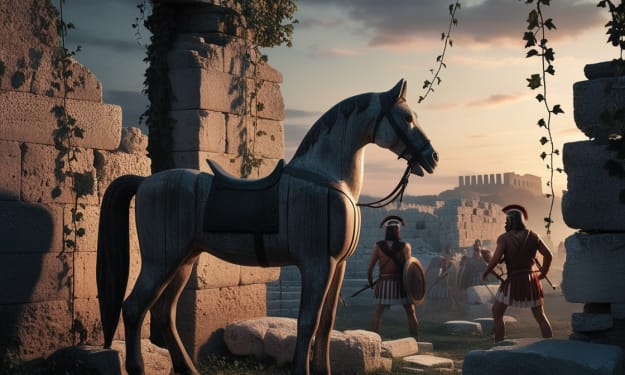
The True Story Behind the Trojan Horse
The story of the Trojan Horse is one of the most famous tales from ancient mythology, often associated with cunning, deception, and the ultimate downfall of the city of Troy. This tale, which has been passed down through centuries, combines history, legend, and myth to reveal a story that has captivated imaginations and inspired countless works of literature and art. But what is the true story behind the Trojan Horse? Was it a real historical event, or simply a metaphorical tale woven by ancient storytellers?
By Muhammad Asim7 months ago in History
Printing the Future
Printing the Future: The scent of ink and parchment clung to the air in William Caxton’s printing workshop, a quiet revolution humming beneath the clatter of metal type. For young Thomas Graye, it was more than a job—it was history being carved, letter by letter, into eternity.
By Salah Uddin7 months ago in History
Scientists Retrace 30,000-Year-Old Sea Voyage, in a Hollowed-Out Log
In 1947, against the best navigational advice, the Norwegian explorer Thor Heyerdahl and five crew members set sail from Peru on a balsa wood raft to test his theory that ancient South American cultures could have reached Polynesia. The frail vessel, called Kon-Tiki, crossed several thousand nautical miles of the Pacific in 103 days and showed that his anthropological hunch was at least feasible.
By Zeeshan Anwar 7 months ago in History
"The Mystery of the Bermuda Triangle"
The waves were calm as Captain Rami steered the cargo ship *Sea Whisper* through the Atlantic. The crew had set off from Miami, headed toward San Juan, Puerto Rico. It was a familiar route—one that passed through the legendary Bermuda Triangle. Some of the younger crew members chuckled about the myths, while the older ones quietly recited prayers.
By Shakeel Ahmad 7 months ago in History
Why Iran Stopped the War
The morning of July 20, 1988, broke with a stillness that had not touched Iran’s western borders for eight long years. The war between Iran and Iraq—once called "The Imposed War" by Iranians—was nearing its end, not with a grand victory or a dramatic surrender, but with a heavy, painful ceasefire.
By Hasnain khan7 months ago in History
A Strange Night in Hanyang
A long time ago, when the iron and glass towers had not yet touched the skies, Seoul was called Hanyang—a city of warriors, scholars, and secrets. On a cold autumn night, under the silvery light of a crescent moon, the wind bore a whisper over the stone roads of the city. Lanterns swayed as if too fearful to confront some figure standing in the darkness. In the center city, Ha-neul, a young boy, stood against the palace wall, inscribing symbols in the ground with a twig. Not because he believed, but because it reminded him of his father, whose face he could barely remember.
By Midnight Narrator 7 months ago in History
Cleopatra: Queen of the Nile, Mistress of Empires
Cleopatra: The Last Pharaoh of Egypt and the Woman Who Defied an Empire Long before the fall of Rome or the rise of modern empires, there was a woman who defied the expectations of her world. Her name was Cleopatra VII Philopator — the last pharaoh of Egypt, the seductress of two of Rome’s most powerful men, and a queen whose life has become legend.
By Soul Drafts7 months ago in History
The Solitude and the Discipline of Poet Sylvia Plath
People have looked at Sylvia Plath in a warped way for a long time. More often than not, she’s seen as a tragic figure instead of as a serious author. For decades, popular imagination has stuck to the image of the suicidal, confessional poet, pouring her pain onto the page. But if you dig into the archives, her drafts, her letters, lecture notes, her marked-up books, a different picture starts to form. What you see is a sharp, self-driven writer who knew that imagination alone wasn’t enough. She understood that inspiration comes when habit and intellect meet. If you go to the Lilly Library at Indiana University, where her calendars and notebooks are stored, you don’t find chaos. You find a careful, professional writer.
By Tim Carmichael7 months ago in History
"The Pyramids of Egypt"
"The Pyramids of Egypt: A Monument of Ancient Wonder" The Pyramids of Egypt stand as timeless symbols of ancient civilization, engineering brilliance, and spiritual belief. Located on the Giza Plateau near Cairo, these massive stone structures have fascinated historians, architects, and tourists for thousands of years. Among the many pyramids built during the ancient Egyptian civilization, the three pyramids at Giza — Khufu, Khafre, and Menkaure — are the most famous.
By Shakeel Ahmad 7 months ago in History