World History
The Development of Civilizations: A Tapestry of Human Ingenuity
The development of civilizations is a testament to the remarkable capacity of human beings to adapt, innovate, and create complex societies. From the earliest hunter-gatherer bands to the bustling metropolises of the modern world, humanity has embarked on a remarkable journey of progress, marked by significant milestones in agriculture, technology, social organization, and cultural expression.
By Digital Home Library by Masud Rana11 months ago in History
The Impact of Revolutions: A Force for Change Throughout History
Revolutions, those seismic shifts in the foundations of societies, stand as potent forces in the grand narrative of human history. They are not mere uprisings or rebellions, but rather profound transformations that challenge the existing order and usher in new eras of political, social, and economic change. From the ancient world to the modern era, revolutions have reshaped the global landscape, leaving behind legacies that continue to reverberate today.
By Digital Home Library by Masud Rana11 months ago in History
The Rise and Fall of Empires: A Millennia-Spanning Tapestry of Power
The story of empires is the story of humanity writ large, a sprawling narrative encompassing ambition, innovation, conquest, and ultimately, decline. From the ancient empires of Mesopotamia and Egypt to the sprawling colonial powers of the modern era, these vast political entities have shaped the course of history, leaving an indelible mark on culture, politics, and the very landscape of our world.
By Digital Home Library by Masud Rana11 months ago in History
Kamakshi Amman Temple and the Healing Power of Sacred Sound
Introduction: The Transformative power of scared sound At the heart of Kamakshi Amman Temple, located in the spiritual city of Kanchipuram, Tamil Nadu, lies a profound spiritual experience—the power of sacred sound. From the chanting of mantras to the melodious hymns sung in praise of the goddess Sri Kamakshi Ambal, the temple is a place where sound becomes a healing force. The reverberation of sacred sounds in the temple creates a divine atmosphere that elevates the spiritual journey of every devotee who visits.
By Sri Kamakshi Ambal Temple11 months ago in History
The Divine Feminine in Kamakshi Amman Temple: A Sacred Manifestation of Shakti
Introduction: The Power of the Divine Feminine at Kamakshi Amman Temple At the heart of the Kamakshi Amman Temple in Kanchipuram, Tamil Nadu, lies a profound spiritual presence—the embodiment of Shakti, the divine feminine energy. The goddess Sri Kamakshi Ambal represents the sacred force that is both nurturing and transformative, playing a crucial role in the cosmic order.
By Sri Kamakshi Ambal Temple11 months ago in History
One Wrong Turn That Sparked World War
One Wrong Turn That Sparked World War World War I one of the deadliest conflicts in human history was ignited by a series of complex political economic and military factors. However at the heart of it all was a single event an assassination that in many ways can be seen as the result of one wrong turn. The fateful decision that led Archduke Franz Ferdinand’s car down the wrong street on June 28, 1914 changed the course of history setting off a chain reaction that led to global warfare. This incident though seemingly insignificant in the grand scheme of things played a pivotal role in the outbreak of World War I. The political landscape of early 20th century Europe was marked by tensions alliances and nationalist movements. Austria Hungary a vast empire struggling with internal ethnic divisions found itself facing a growing wave of Slavic nationalism particularly from Serbia. The Austro Hungarian Empire viewed Serbia as a threat suspecting that it was encouraging separatist movements within its borders. Meanwhile Serbia emboldened by its recent victories in the Balkan Wars sought to expand its influence particularly over territories where Slavic populations resided. This growing animosity created a volatile situation one that needed only a spark to erupt into full scale war.
By Adnan Rasheed11 months ago in History
The Mysteries of the Blue Lotus: A Sacred Bloom of the Ages
The first time I saw a Blue Lotus, it wasn’t in a temple carving or an ancient manuscript—it was in the still waters of a small pond in Egypt. The flower sat there, untouched by time, its petals stretching toward the sun like an offering. Something about it felt almost otherworldly, as if it held secrets whispered through the ages.
By Siboli Mukherjee11 months ago in History
The Whispering Cartographer of Aethelgard: A History Etched in Mist
History, as we know it, is often a tale of kings, battles, and grand pronouncements. But what of the stories whispered in the margins, the truths etched in the ephemeral? This is the tale of Elara, the Whispering Cartographer of Aethelgard, and the map that changed a kingdom. The Mist-Bound Realm: Aethelgard was a land perpetually shrouded in mist. Its borders, defined by shifting fog banks and treacherous peat bogs, were a source of constant anxiety. For generations, cartographers had attempted to map the realm, but the mist swallowed their lines, rendering their efforts useless. Fear of the unknown bred distrust, and the kingdom was fractured, its outlying settlements isolated and vulnerable. Elara's Unconventional Approach: Then came Elara, a young woman with eyes as grey as the Aethelgardian sky and a mind that saw patterns where others saw chaos. Unlike her predecessors, Elara didn't rely on rigid measurements or the pronouncements of surveyors. She listened. She listened to the wind whistling through the ancient standing stones, the gurgling of hidden streams, and most importantly, the stories of the people. She traveled from village to village, not with compass and chain, but with a worn leather-bound journal and a satchel of charcoal. She sat by hearths, listening to tales of lost pathways, hidden groves, and the strange, luminous creatures that emerged from the mist. She learned the names the locals gave to the shifting fog banks, the landmarks whispered in hushed tones. The Map of Whispers: Elara's map wasn't drawn on parchment, but on a vast sheet of cured leather, stained with the hues of the local flora. It wasn't a rigid grid of lines, but a fluid, organic representation of the land. The coastline was marked by the ebb and flow of the mist, the forests by the songs of the birds, and the settlements by the stories of their inhabitants. She marked the "Whispering Paths," invisible trails that only those who knew the land intimately could follow. She noted the "Shifting Pools," ephemeral bodies of water that appeared and disappeared with the tides of the mist. She even charted the "Dreaming Stones," ancient monoliths said to hold the memories of the land. The King's Skepticism and the Unexpected Revelation: King Theron, a man of rigid logic and unwavering skepticism, dismissed Elara's map as a fanciful collection of folklore. He demanded a map of tangible borders, of quantifiable distances. But Elara insisted her map held a deeper truth, a truth that could unite the fractured kingdom. One day, a raiding party from the neighboring kingdom, known for their cunning and knowledge of the mist, slipped through the border defenses. They targeted a remote village, believing it to be isolated and undefended. However, using Elara's map, the villagers, guided by the "Whispering Paths," were able to anticipate the raiders' movements. They led them into a "Shifting Pool," a treacherous bog that swallowed the invaders whole. The Transformation of Aethelgard: The king, witnessing the effectiveness of Elara's map, was forced to reconsider his skepticism. He realized that the true borders of Aethelgard weren't lines on a map, but the shared stories and experiences of its people. Elara's map became a symbol of unity, a testament to the power of collective knowledge. The "Whispering Paths" became well-trodden routes, connecting the once-isolated settlements. The "Dreaming Stones" became places of gathering, where stories were shared and the history of Aethelgard was preserved. The Legacy of the Whispering Cartographer: Elara's legacy wasn't just a map; it was a shift in perception. She taught the people of Aethelgard that their land wasn't defined by its limitations, but by its unique and ephemeral nature. She showed them that true knowledge lay not in rigid measurements, but in listening to the whispers of the land and the stories of its people. And so, Aethelgard became a kingdom not of rigid borders, but of shared stories, a testament to the power of a map etched in mist and the wisdom of the Whispering Cartographer.
By Digital Home Library by Masud Rana11 months ago in History
Chief Iron Tail and the Early Automobile
A photo of Chief Iron Tail an original leader of the Lakota Sioux turning the crank of an early automobile, circa 1915. This image was rich in symbolism it represented the convergence of two worlds with little in common the long and wealthy traditions of Native American culture, and the progressive technological innovations of the 20th century.
By Rohitha Lanka11 months ago in History
Hitler's Last 10 Days
Hitler's Last 10 Days The last ten days of Adolf Hitler’s life are among the most significant and dramatic moments in history. By April 1945 World War II was nearing its end and Nazi Germany was on the verge of complete collapse. Soviet forces were closing in on Berlin and Hitler had chosen to remain in the capital refusing to flee. He had taken refuge in the Führerbunker an underground shelter beneath the Reich Chancellery where he was surrounded by his closest advisors guards and staff. Outside Berlin was crumbling under relentless bombardment but inside the bunker Hitler was trapped in a world where delusion and reality had blurred. April 20, 1945 marked Hitler’s 56th birthday but it was far from a celebration. High ranking Nazi officials like Joseph Goebbels and other loyalists formally congratulated him, but the atmosphere was grim. As he stepped out of the bunker he met with a group of young soldiers many just sixteen or seventeen who had been hastily recruited to defend Berlin. He shook their hands knowing well that they were untrained and stood little chance against the advancing Soviet army. Yet he remained fixated on his belief that Germany could still turn the war around. In the following days as Soviet forces pushed deeper into Berlin Hitler’s psychological state deteriorated rapidly. He held frequent meetings with his generals demanding updates but every report was bleak. By April 22 during a heated conference he erupted in rage accusing his commanders of betraying him and failing to follow his orders. It was at this moment that he first openly admitted that Germany had lost the war. His generals realizing the futility of resistance knew that staying in Berlin meant certain death. However no one dared to contradict him.
By Adnan Rasheed11 months ago in History
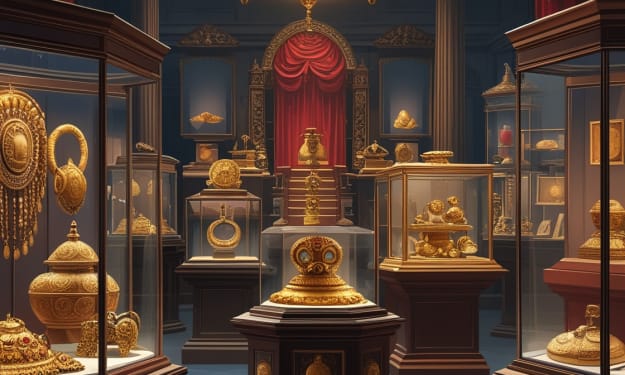
The Lost Wealth of the British Empire: A Colonial Treasure Trail. AI-Generated.
The Absent Treasures of the British Empire: A History of Colonial Looting and Their Fate The British Empire, at its height, was the better authority in history, spanning continents and cardinal over all-inclusive territories. With this ascendancy came the bloodthirsty of resources, wealth, and cultural artifacts from assorted colonies. Some of the best admired treasures of the world, including jewels, artworks, and actual artifacts, were taken from colonized nations and transported to Britain. While some of these treasures abide in British museums and aristocratic collections, others accept been lost, stolen, or acknowledged over the years. This commodity explores the history of Britain's looted treasures, their fate, and the advancing debates over their applicable ownership.
By Say the truth 11 months ago in History