World History
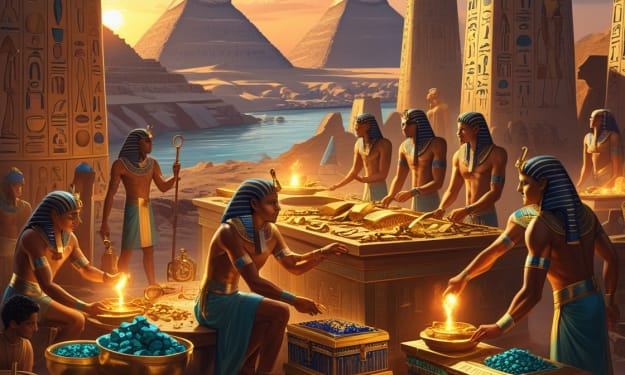
The Origin and Value of Tutankhamun’s Treasure: A Heritage in Gold
But from where did this vast treasure arise? Why was such wealth interred with a boy-king who perished around the age of 18 or 19? And what might be the current estimated worth of these treasures? This article investigates the origins, symbolism, and contemporary valuation of one of history’s most renowned caches.
By Say the truth 9 months ago in History
The Flame and the Scroll
The morning sun broke over the Egyptian coast, bathing the white marble pillars of Alexandria in gold. Seagulls cried overhead, echoing across the Great Harbor, where ships from every corner of the known world docked, their hulls heavy with scrolls, spices, and secrets.
By Usman Khan9 months ago in History
The Legacy of the Boy King: Unveiling the Treasure of Tutankhamun's Tomb
The Discovery that Resounded Globally In 1922, British archaeologist Howard Carter, supported by Lord Carnarvon, made an astounding discovery in Egypt's Valley of the Kings. After years of digging in challenging conditions with little fortune, Carter's tenacity ultimately bore fruit when he uncovered a staircase leading into the sands.
By Say the truth 9 months ago in History
All the Light We Cannot See – Anthony Doerr
The sky over Saint-Brieuc was heavy with clouds, the kind that hung low and pressed against the roofs like a threat. Though the war had quieted in the north, its whispers still roamed the air—through radio static, cracked windows, and the wary glances of strangers.
By Jawad Khan9 months ago in History
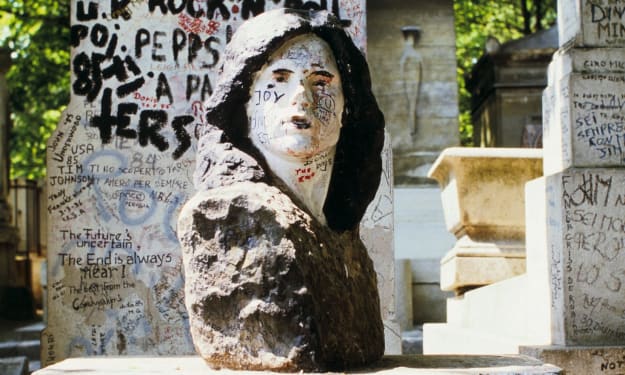
Jim Morrison’s Stolen Gravesite Statue Found After 37 Years Emotional Return to Paris Cemetery
Jim Morrison’s Stolen Gravesite Statue Found After 37 Years Emotional Return to Paris Cemetery In the heart of Paris lies Père Lachaise Cemetery a resting place for luminaries poets and rebels. Among its winding paths and moss covered gravestones fans from all over the world make their pilgrimage to visit the grave of Jim Morrison the iconic lead singer of The Doors. For decades the gravesite has stood as a silent testament to a man whose lyrics blurred the lines between rock and poetry passion and chaos. But something crucial had been missing a statue that once adorned the grave stolen years ago taking with it a piece of Morrison’s soul. Now in a moment that feels almost mythical the statue has been found.
By Adnan Rasheed9 months ago in History
Cristiano Ronaldo Biography: From Madeira to Global Icon
Cristiano Ronaldo dos Santos Aveiro, extensively considered one of the finest footballers of all time, was born on February 5, 1985, in Funchal, Madeira, Portugal. His adventure from a small island to worldwide superstardom isn't simply the tale of athletic brilliance, however one of unwavering determination, relentless work ethic, and unequaled self-belief.
By Sports News 9 months ago in History
Gerrymandering the Presidency: Why Trump could lose the popular vote in 2020 by 6 percent and still win a second term.
Donald Trump was the clear Electoral College winner in the 2016 election, despite losing the popular vote by a wide margin to Hillary Clinton. Anthony J. McGann, Charles Anthony Smith, Michael Latner and Alex Keena write that, unless the Supreme Court stops congressional gerrymandering, President Trump can guarantee re-election in 2020 – even if he loses by 6 percent. When the US Supreme Court takes up the issue of partisan gerrymandering this year, they will decide not only the fate of popular control in the House of Representatives and many state legislatures, but quite possibly the Presidency as well. If four Republican controlled state governments (Pennsylvania, Michigan, Wisconsin and Florida) change the way they allocate Electoral College votes, President Trump could be re-elected in 2020, even if he loses the popular vote by 6 percentage points. All the states need do is to allocate Electoral College votes by congressional district (like Nebraska and Maine), instead of giving all of the state’s electors to the statewide winner. Of course, this strategy only works to the benefit of the Republicans because the congressional districts in these states are heavily gerrymandered. As we argue in our book Gerrymandering in America, the congressional districts in many states are drawn to advantage the Republican Party. For example, in Pennsylvania in 2012 the Republicans took 13 out of 18 House districts even though the Democrats received more votes. If this partisan gerrymandering were outlawed, then allocating Electoral College votes by congressional district in the four states would actually disadvantage the Republican candidate for President. However, if the Supreme Court continues to allow partisan gerrymandering – as it has since its decision Vieth v. Jubelirer in 2004 – then the plan is highly effective and there is nothing that can stop the four states adopting it. Allocating Electors by congressional district is clearly legal – Nebraska and Maine already do it this way. Furthermore, the Republicans control the state legislature and the governor’s mansion in all four states. How allocating Electors by congressional districts could benefit the Republican candidate Surprisingly, the strategy that is most effective for the Republicans is to change how Presidential Electors are allocated in certain states that voted for Trump in 2016. Of course, the Republicans would get an advantage by allocating Electors more proportionally in states that Clinton won. The problem is that this would require the support of Democrats. For example, Republican legislators in Virginia and Minnesota have already proposed such measures, and Stephen Wolf describes this as an attempt to “gerrymander the electoral college”. The problem is that both these states have Democratic governors, who would surely veto such proposals. Similarly Harry Enten at fivethirtyeight.com shows that if all states allocated Electors by Congressional districts, the Republicans could win the Presidency despite a 5 percent popular vote deficit. Again the problem is that this would require Democratic controlled states to agree to such a system. However, in Pennsylvania, Wisconsin, Michigan and Florida, Republicans control both the state legislature and the
By Silas Blackwood9 months ago in History
🤢The Great Stink of London, Summer 1858: How the Thames River's Filth Nearly Shut Down Parliament and Sparked Sewer Reforms
The Summer That Stank to High Heaven In the sweltering summer of 1858, London became the setting for one of the foulest crises in urban history. For several weeks, an unbearable stench rose from the River Thames, the city's main waterway and open sewer, engulfing the metropolis in a nauseating miasma that no one - not even the powerful lawmakers in the Palace of Westminster - could escape. The event, which became known as "The Great Stink," was more than just a sensory nightmare; it was a pivotal moment in the evolution of public health and urban infrastructure.
By Kek Viktor9 months ago in History
The Balfour Declaration: A Century of Contradiction. AI-Generated.
On November 2, 1917, British Foreign Secretary Arthur James Balfour penned a 67-word letter to Lord Lionel Walter Rothschild, a leader of Britain’s Jewish community. Its contents—a pledge to support “the establishment in Palestine of a national home for the Jewish people”—would alter the trajectory of Middle Eastern history. The Balfour Declaration, as it came to be known, was not merely a diplomatic gesture but a colonial gambit, weaving together imperial ambition, wartime strategy, and competing nationalist aspirations. Over a century later, its legacy remains a wound that refuses to heal.
By Muhammad Israr9 months ago in History
🧻 The Toilet Paper Panic Buying During Various Pandemics: How a Mundane Household Item Became a Symbol of Global Anxiety
Part I: A Curious Phenomenon — Panic in the Aisles In the early months of the COVID-19 pandemic, a peculiar sight became common across the globe: barren supermarket shelves where once stood neat stacks of toilet paper. This wasn’t an isolated event. From Tokyo to Toronto, from Milan to Melbourne, scenes emerged of people rushing into stores, carts overflowing with bulky packs of toilet rolls, sometimes wrestling them away from fellow shoppers in desperate attempts to “stock up.” The rush on toilet paper became one of the most vivid, surreal images of the global health crisis, replayed in countless news reports and social media posts. As viral as the virus itself, these panic-buying frenzies turned toilet paper — a soft, white, everyday necessity — into a symbol of a world unmoored by fear.
By Kek Viktor9 months ago in History
Echoes in the Elderwood
The village of Blackthorn lay on the edge of the Elderwood, a sprawling forest that few dared to enter. It was not that the forest was particularly dangerous—at least, not in any way one could understand with human senses—but there was something in the air there, something that made every person who had the misfortune to wander too deep feel… unsettled.
By ibrahimkhan9 months ago in History