
The Balfour Declaration: A Century of Contradiction
Britain’s Broken Promises and the Making of a Modern Conflict
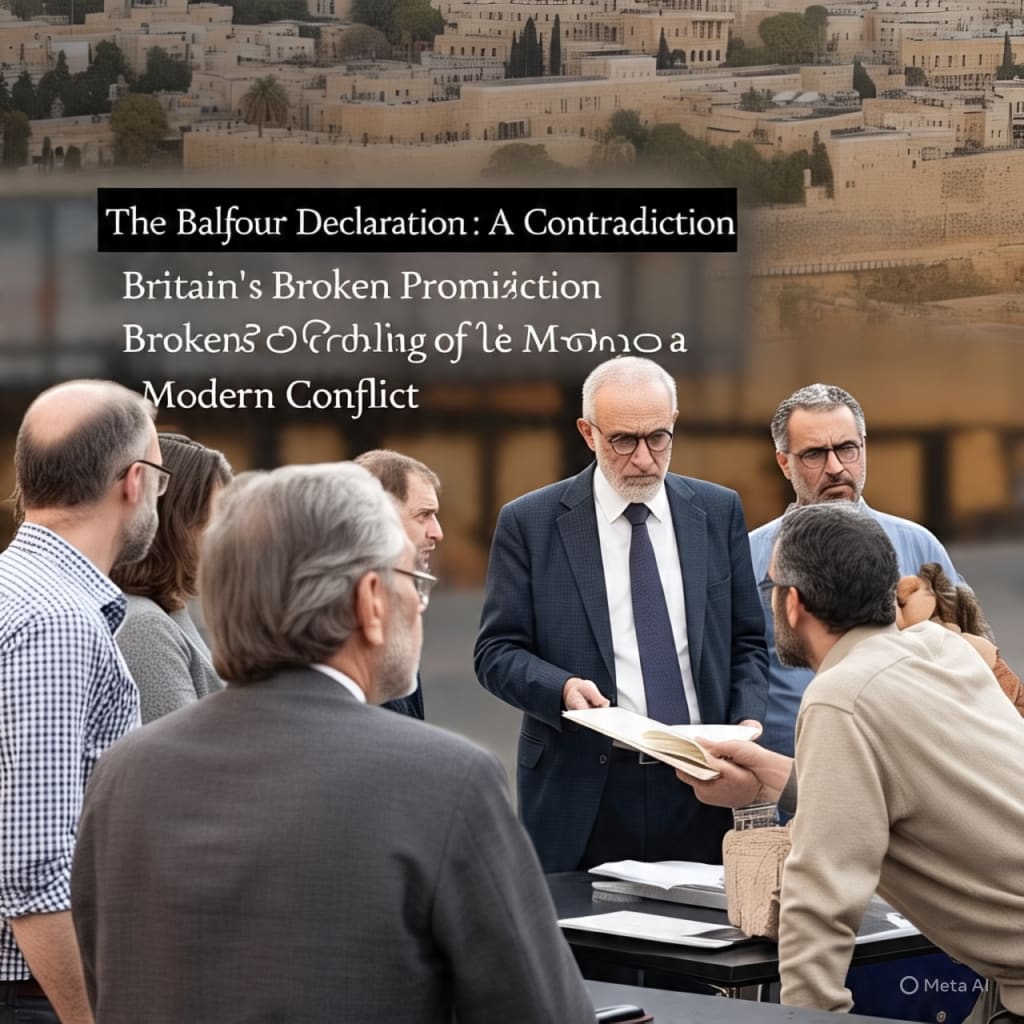
On November 2, 1917, British Foreign Secretary Arthur James Balfour penned a 67-word letter to Lord Lionel Walter Rothschild, a leader of Britain’s Jewish community. Its contents—a pledge to support “the establishment in Palestine of a national home for the Jewish people”—would alter the trajectory of Middle Eastern history. The Balfour Declaration, as it came to be known, was not merely a diplomatic gesture but a colonial gambit, weaving together imperial ambition, wartime strategy, and competing nationalist aspirations. Over a century later, its legacy remains a wound that refuses to heal.
---
### **Chapter 1: The World at War – Britain’s Desperate Calculus**
By 1917, World War I had reached a stalemate. The British Empire, locked in a brutal conflict with the Ottoman Turks, sought allies wherever it could find them. Palestine, a strategic gateway to the Suez Canal and India, was a prize worth securing. But Britain’s ambitions collided with its vulnerabilities.
**The Jewish Card**:
In Europe, Zionism—a movement for Jewish self-determination—had gained momentum amid rising antisemitism. Chaim Weizmann, a Zionist chemist whose discoveries aided Britain’s war effort, lobbied tirelessly for British backing. To Prime Minister David Lloyd George and Balfour, a Jewish homeland in Palestine offered dual advantages:
1. **Securing Jewish Support**: Winning favor with Jewish communities in neutral America and revolutionary Russia.
2. **Imperial Control**: Establishing a European-aligned entity in the Middle East to counter French and Arab nationalism.
**The Arab Revolt**:
Simultaneously, Britain had promised Sharif Hussein of Mecca an independent Arab kingdom in exchange for revolting against the Ottomans. Colonel T.E. Lawrence (“Lawrence of Arabia”) fueled this rebellion, assuring Arabs that their sacrifices would be rewarded with freedom. These contradictory pledges—to Jews and Arabs—were no accident. They reflected Britain’s strategy of “divide and rule,” ensuring no single group could challenge its dominance.
---
### **Chapter 2: The Declaration – Words as Weapons**
The Balfour Declaration’s carefully crafted language masked its explosive implications:
> *“His Majesty’s Government view with favour the establishment in Palestine of a national home for the Jewish people, and will use their best endeavours to facilitate the achievement of this object, it being clearly understood that nothing shall be done which may prejudice the civil and religious rights of existing non-Jewish communities in Palestine...”*
**A Masterclass in Ambiguity**:
- “National home” was deliberately vague—neither a “state” nor a “homeland.”
- “Non-Jewish communities” erased Palestinian identity, reducing Arabs to religious minorities.
- No mention of political rights for Palestinians, only “civil and religious” protections.
**The Players Behind the Scenes**:
- **Chaim Weizmann**: The Zionist visionary who charmed British elites, framing Jewish settlement as a civilizing mission.
- **Lord Rothschild**: Scion of a banking dynasty, he symbolized Jewish influence in British politics.
- **Mark Sykes**: Co-architect of the Sykes-Picot Agreement, which secretly divided the Ottoman Empire between Britain and France.
For Britain, the declaration was a low-cost promise. Palestine was still Ottoman territory, and the war’s outcome uncertain. Yet for Zionists, it was a lifeline; for Palestinians, a death sentence.
---
### **Chapter 3: Colonial Double-Dealing – The Betrayal of Promises**
Even as Balfour’s ink dried, Britain’s duplicity unfolded:
**The Hussein-McMahon Correspondence (1915–1916)**:
Sharif Hussein believed Palestine was included in the Arab kingdom promised to him. But British High Commissioner Henry McMahon later claimed it was excluded, citing “Western interests.”
**The Sykes-Picot Agreement (1916)**:
A secret pact with France and Russia carved the Middle East into spheres of influence. Palestine was slated for international control—a plan incompatible with both Zionist and Arab aspirations.
**The King-Crane Commission (1919)**:
Sent by U.S. President Woodrow Wilson to gauge local sentiment, the commission found overwhelming Palestinian opposition to Zionism. Its warnings were ignored.
By 1920, Britain held the League of Nations mandate for Palestine. The Balfour Declaration was enshrined in international law—but so were Britain’s obligations to protect Palestinian rights. These contradictions proved irreconcilable.
---
### **Chapter 4: Implementing the Mandate – Seeds of Conflict**
Under British rule (1920–1948), Palestine became a pressure cooker:
**Jewish Immigration and Land Purchases**:
- Zionist agencies like the Jewish National Fund bought land from absentee Arab landlords, evicting Palestinian tenant farmers.
- The Jewish population rose from 10% (1917) to 30% (1939).
**Arab Revolt (1936–1939)**:
Palestinians, marginalized and disenfranchised, launched a mass uprising. Britain responded with brutal force:
- Villages were bombed.
- Arab leaders were exiled or executed.
- Zionist militias like the Haganah were armed to suppress the revolt.
**The White Paper (1939)**:
Facing Arab unrest and needing Middle Eastern oil, Britain reversed course, restricting Jewish immigration—a move Zionists called a “betrayal.” Yet the damage was done: Palestinians had been disarmed and disorganized, while Zionists had built parallel institutions (schools, militias, banks) for a future state.
---
### **Chapter 5: 1948 and Beyond – The Unraveling**
In 1947, Britain handed the Palestine problem to the UN. The partition plan granted 55% of Palestine to Jews, though they owned just 7% of the land. War erupted, and by 1948, Israel declared statehood. Over 700,000 Palestinians were expelled or fled in the *Nakba* (Catastrophe). Britain, exhausted and indifferent, withdrew, leaving behind a legacy of fire.
---
### **Chapter 6: Britain’s Moral Reckoning – Was the Declaration “Okay”?**
A century later, the question lingers: Can Britain’s role in the Balfour Declaration be justified?
**The Case for Britain**:
- **Humanitarian Intent**: Some argue Britain sought to protect Jews from persecution.
- **Realpolitik**: Wartime demands necessitated pragmatic alliances.
**The Case Against Britain**:
- **Colonial Arrogance**: Britain promised land it did not own to a people not yet present, ignoring the native majority.
- **Historical Hypocrisy**: While advocating self-determination in Europe, it denied it to Arabs.
- **Legacy of Suffering**: The declaration ignited a conflict that has killed tens of thousands and displaced millions.
In 2017, on the declaration’s centenary, then-Prime Minister Theresa May praised it as “one of the most important letters in history.” Palestinians protested, demanding an apology. None came.
---
### **Epilogue: The Weight of Words**
The Balfour Declaration was not merely a policy but a parable of empire. It showcased Britain’s belief in its right to reshape the world, heedless of consequences. For Zionists, it was a covenant; for Palestinians, a covenant broken.
Today, as Israel celebrates its 76th year and Palestinians endure occupation and exile, the declaration’s contradictions endure. Its language—ambiguous, aspirational, and achingly naive—mirrors the conflict itself: a clash of rights where recognition for one has meant erasure for the other.
Britain, meanwhile, has never fully reckoned with its role. The declaration remains a testament to the enduring truth that empires rarely stay to clean up the chaos they leave behind.
---
About the Creator
Keep reading
More stories from Muhammad Israr and writers in History and other communities.
The Jewish Migration to Palestine/Israel: A Historical Journey from Zionism to Statehood
**Introduction: The Roots of Jewish Migration** The migration of Jews to Palestine, culminating in the establishment of Israel in 1948, is one of the most complex and contentious chapters in modern history. Driven by a blend of religious longing, political ideology, and survival imperatives, this movement reshaped the demographics and geopolitics of the Middle East. This essay explores the four major waves of Jewish migration (Aliyah) to Palestine, their historical contexts, and their lasting impact on both Jewish and Palestinian communities.
By Muhammad Israr10 months ago in History
Ancient Egyptian Tomb Unearthed: 3,000-Year-Old Remains of Four Children Discovered
In a remarkable archaeological discovery in Egypt, researchers have uncovered the mummified remains of four children dating back nearly 3,000 years. The find, located in the southern region of Luxor, offers a rare glimpse into the lives, deaths, and funerary customs of young Egyptians during the New Kingdom period.
By Irshad Abbasi 5 days ago in History



Comments
There are no comments for this story
Be the first to respond and start the conversation.