Research
Mythic Jukebox Musical Dance
In 1889, Louis Glass and William S. Arnold invented the nickel-in-the-slot phonograph, in San Francisco, installing it at the Palais Royal Saloon, 303 Sutter street, two blocks away from the offices of their Pacific Phonograph Company. This was an Edison Class M Electric Phonograph[6] retrofitted with a device patented under the name of ‘Coin Actuated Attachment for Phonograph’. The music was heard via two of eight listening tubes.
By Vicki Lawana Trusselli 2 months ago in History
Human Sacrifice part 2 . AI-Generated.
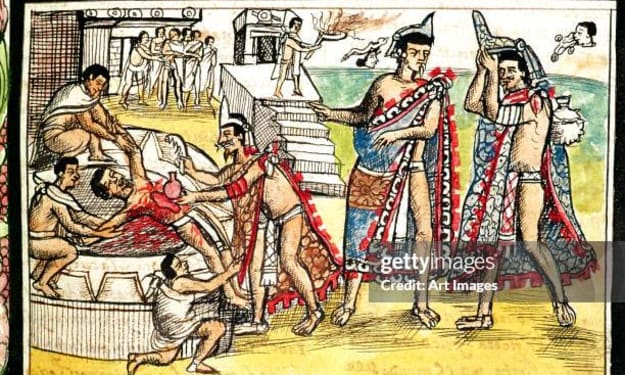
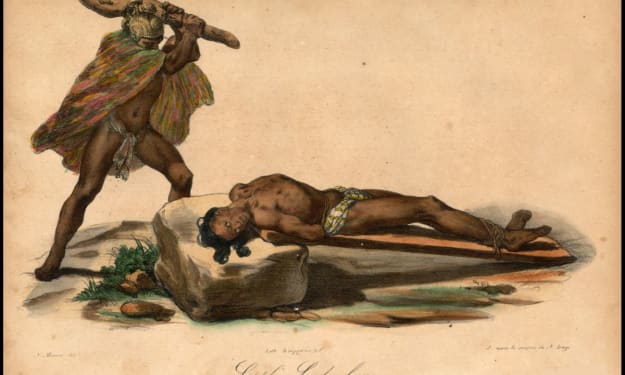
The logic behind sacrifice was harsh, but it made sense to those who believed in it. If the world was out of balance, someone had to pay the price to restore order. A bad harvest might cost the life of a sheep. A drought could demand a bull. But when a nation was in crisis, it was a human life that was required. While it’s easy to view these acts as cruelty, to them, it was just cosmic accounting. The universe, they believed, kept a ledger, and debts had to be paid in blood.
By ADIR SEGAL2 months ago in History
Human Sacrifice part 1. AI-Generated.
What if survival didn’t depend on your strength, but on your ability to sacrifice? For thousands of years, people believed that the gods were hungry, and only blood could feed them. They demanded offerings of wine, meat, and sometimes even still-beating human hearts. But why did they think this worked? And what does this belief say about us today? Welcome to The Mysteries of Mythology: Why Do Gods Need Sacrifices?
By ADIR SEGAL2 months ago in History
EPISODE IX – THE SKULLS AND THE SCHOLARS: The Birth of America’s Secret Power Networks
By day, they were students. Young men in stiff collars and ink-stained fingers, reciting Latin in classrooms framed by ivy and stone. They walked beneath bell towers, debated philosophy, and rehearsed the rituals of success. On the surface, they were simply the sons of the Republic’s rising class. Lawyers in waiting, future ministers, merchants, politicians.
By The Iron Lighthouse2 months ago in History
The Reflection That Changed History
When humanity looks back at its greatest achievements, only a handful of images truly define the moment. One of them is the iconic photograph of astronaut Buzz Aldrin standing on the Moon during the Apollo 11 mission in July 1969.
By Izhar Ullah2 months ago in History
Old School Tech: Five Ancient Inventions We Still Can't Figure Out
When we picture our ancestors, it’s easy to imagine them living a simple life, free from the complexity of modern technology. Some of us might even think that anything they invented back then could be easily replicated, or even improved upon, with today's knowledge. But hold that thought. As it turns out, there are several ancient inventions that we are still genuinely struggling to understand or fully replicate today. It really makes you wonder how "advanced" we truly are. Here are five incredible inventions from the past that prove history might be much more complex than we think:
By Areeba Umair2 months ago in History
The Colossus Beyond the Stars
When the world’s most advanced observatory first detected the strange, rhythmic pulses coming from a desolate quadrant beyond Neptune, no one imagined that the phenomenon had anything to do with life — let alone a creature so massive, so unexplainable, that it would shake the foundations of science itself.
By Izhar Ullah2 months ago in History
The Salt Smuggler. AI-Generated.
The air in our village tasted of fear and the sea. For weeks, the word had spread like a monsoon flood: Gandhi was going to break the Salt Laws. The British claimed they owned the very salt on the wind, the salt that crusted our skin and preserved our fish. To make it without their tax was a crime.
By The 9x Fawdi2 months ago in History
Let's Talk About Today’s Effects of Colonial Racism and Superiority Complex on an Ordinary Joe in SADC. Content Warning. AI-Generated.
Colonial borders and centuries of imposed hierarchies did not just shape maps; they shaped lives. Over 110 years ago, the line between Namibia and Southern Angola was drawn, scattering communities, breaking lineages, and uprooting people from their ancestral heartlands. For ordinary people across the SADC region, these historical wounds are not distant memories. They echo in daily life, in lost opportunities, in social exclusion, and in the subtle but persistent superiority complexes that still linger in workplaces, schools, and social spaces.
By Mr. Abraham Pahangwashimwe - BEYOND NORTH INVESTMENT CC2 months ago in History
Ancient Aliens or Ancient Indians?
The standard history we all learn is pretty clear: the Wright brothers successfully launched the first airplane in 1903, and the first space shuttle came much later, in 1976. That’s the official story. But what if human history's timeline for flight is completely wrong? What if incredibly advanced planes and spacecraft were zipping around thousands of years ago, and they were even more sophisticated than the technology we have today?
By Areeba Umair2 months ago in History